
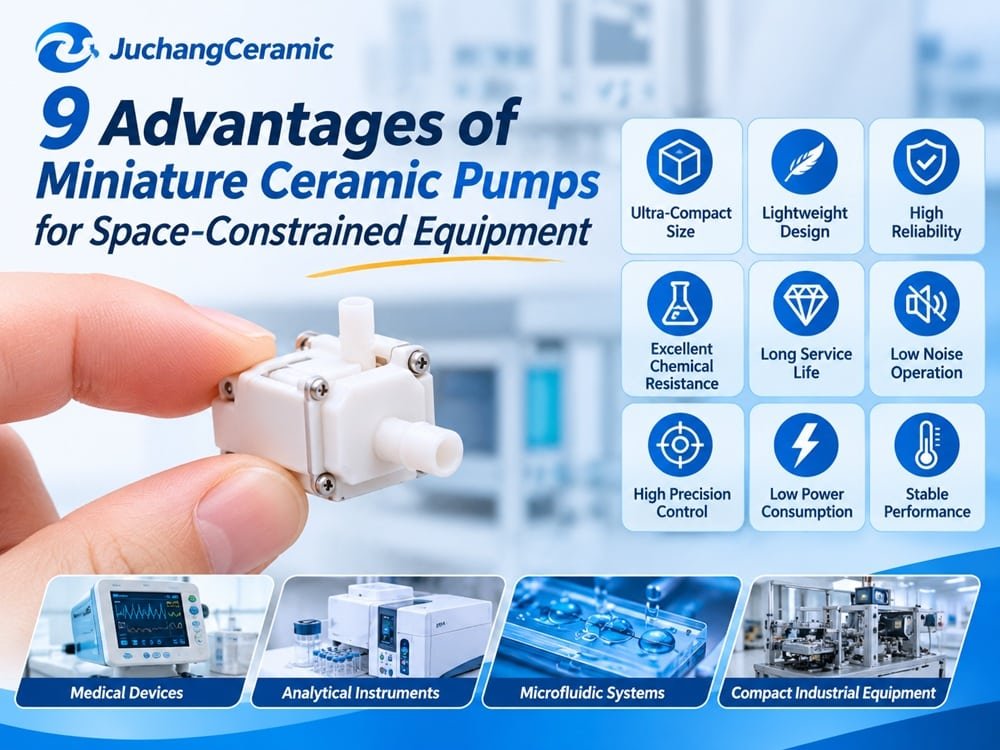
When a machine has very little room for fluid handling, choosing a smaller pump is not automatically the right answer. The pump still has to deliver the required flow, pressure, repeatability, chemical compatibility, and service life. The real advantages of miniature ceramic pumps appear when compact dimensions must be combined with precise dosing and durable wetted components.
Quick Answer
Miniature ceramic pumps are worth considering when equipment designers need accurate, repeatable liquid delivery in a small footprint, especially where wear, corrosion, contamination, or frequent operation make ordinary plastic or metal pump components less attractive. Their strongest advantages are compact integration, wear resistance, chemical compatibility with properly selected fluids, dimensional stability, and suitability for precision metering. They are not automatically the best choice for abrasive slurries, impact-prone installations, very high flow rates, or applications where the cost of ceramic precision parts cannot be justified.
Are Miniature Ceramic Pumps Worth Using in Compact Equipment?
Yes—when the application needs more than simple liquid transfer. A miniature ceramic pump can be a strong engineering choice for analytical instruments, medical and laboratory equipment, compact dosing modules, portable diagnostic systems, and automated fluid-control assemblies. In these applications, the pump may need to fit inside a crowded enclosure while maintaining a stable output over thousands or millions of operating cycles.
From our experience with precision ceramic components, the most important purchasing question is not simply how small the pump is. It is whether the ceramic plunger, cylinder, valve, and sealing arrangement are designed around the actual liquid and duty cycle. A compact pump with unsuitable clearances or incompatible seals will not become reliable just because its wetted parts are ceramic.
For equipment manufacturers, the best approach is to define the operating envelope first: target flow range, pressure, fluid properties, temperature, required accuracy, available installation space, cleaning method, and expected service interval. Then compare pump designs against those requirements. If precision and durability matter more than the lowest initial purchase price, a miniature ceramic design can deliver meaningful lifecycle value.
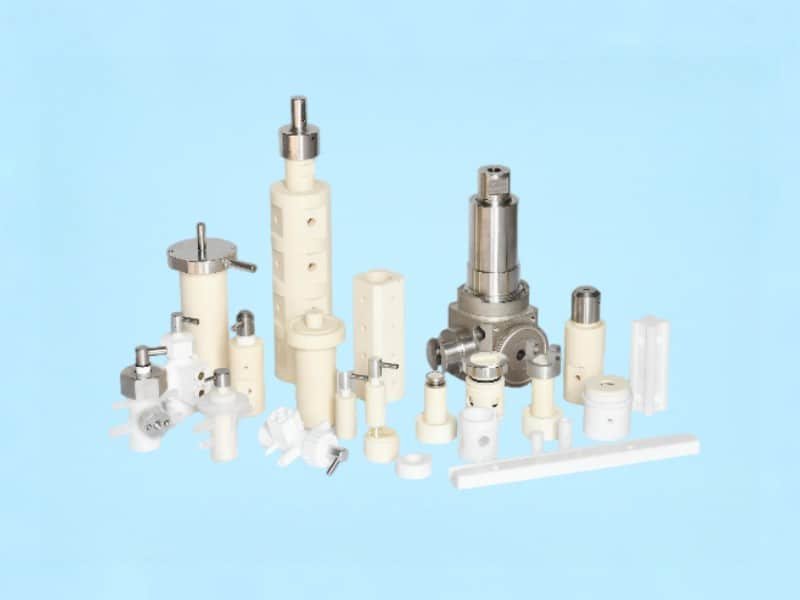
Table of Contents
- What Is a Miniature Ceramic Pump?
- How Does It Work?
- Quick Summary: Nine Advantages
- Nine Advantages of Miniature Ceramic Pumps
- Comparison with Other Miniature Pump Materials
- Benefits and Limitations
- Who Should Use One—and Who May Not Need One
- Common Selection Mistakes
- Buying Considerations for OEM Equipment Designers
- Cost-Benefit Analysis and Upgrade Advice
- Expert Recommendation
- Frequently Asked Questions
- References
What Is a Miniature Ceramic Pump?
A miniature ceramic pump is a compact fluid-handling device that uses precision-engineered ceramic components in critical wetted or moving areas. Depending on the design, these parts may include a plunger, piston, cylinder liner, valve seat, rotor, or metering element. The pump may use a reciprocating, rotary, or another positive-displacement mechanism to move a controlled volume of liquid.
Common technical ceramics include alumina and zirconia. These materials are selected for different combinations of hardness, wear behavior, chemical resistance, strength, and dimensional stability. The correct choice depends on the liquid, pressure, temperature, contact conditions, and required surface finish—not on a general assumption that one ceramic is best for every pump.
A miniature ceramic pump is not simply a conventional pump scaled down. As dimensions decrease, clearances, surface finish, alignment, valve response, and manufacturing tolerances become increasingly important. Small dimensional changes can have a noticeable effect on leakage, friction, flow consistency, and priming behavior.
For a broader product overview, see JuchangCeramic’s miniature ceramic pump range and its wider ceramic pump solutions.
How Does a Miniature Ceramic Pump Work?
Many miniature ceramic pumps operate on a positive-displacement principle. A moving plunger or piston changes the volume of a small chamber. During the intake phase, liquid enters through an inlet path. During the discharge phase, the chamber volume decreases and pushes a defined amount of liquid toward the outlet. Check valves or precision rotary valve elements control the direction of flow.
The ceramic parts provide dimensionally stable working surfaces and, in suitable fluid environments, resist wear and chemical attack better than some alternative materials. The rest of the assembly remains just as important. Drive mechanisms, seals, valve geometry, housing materials, and control electronics all influence actual performance.
In a compact instrument, the pump may be controlled by a motor, stepper drive, or another actuator. Flow can be adjusted through stroke length, stroke frequency, rotational speed, or electronic control, depending on the pump architecture. Do not assume that a small pump automatically offers high dosing accuracy: request performance data across the intended operating range.
Quick Summary: Nine Advantages of Miniature Ceramic Pumps
| Advantage | Why It Matters in Compact Equipment | Best-Fit Applications |
|---|---|---|
| 1. Small installation footprint | Helps fit fluid handling into tight equipment layouts. | Portable instruments, compact analyzers |
| 2. Precision metering potential | Supports controlled, repeatable small-volume delivery. | Reagent dosing, calibration systems |
| 3. High wear resistance | Can reduce wear at sliding or contact surfaces. | Frequent-cycle dosing modules |
| 4. Chemical compatibility | Selected ceramics tolerate many demanding liquids. | Laboratory and chemical dosing |
| 5. Dimensional stability | Helps maintain close working clearances over time. | Precision metering assemblies |
| 6. Low contamination potential | Can reduce material transfer from wetted components. | Analytical and sensitive fluid systems |
| 7. Long service-life potential | May lower replacement frequency under suitable conditions. | Automated equipment |
| 8. Design flexibility | Custom geometry can suit specific OEM layouts. | Integrated pump modules |
| 9. Better lifecycle economics | Can offset higher component cost through reduced downtime. | High-utilization equipment |
9 Advantages of Miniature Ceramic Pumps
1. A Smaller Footprint for Space-Constrained Equipment
The first advantage is straightforward: a miniature pump can be integrated into equipment where a standard industrial pump would be too large. This matters in portable analyzers, benchtop instruments, compact medical equipment, handheld diagnostic platforms, and automated modules with limited internal space.
Smaller equipment can be easier to package, transport, and install. It may also allow designers to reserve more internal volume for sensors, electronics, sample chambers, or battery capacity. However, the pump’s complete envelope must be considered. Include the motor, driver, tubing connections, mounting brackets, cable clearance, and service access—not only the pump head dimensions.
Our recommendation: Ask manufacturers for a dimensioned drawing and a complete installation envelope before approving a design. A compact pump that cannot be connected or serviced inside the enclosure is not a practical space-saving solution.
2. Precise Metering of Small Liquid Volumes
Many compact devices do not need to move large quantities of liquid. They need to deliver small quantities consistently. A precision positive-displacement pump can be designed for controlled dosing, which is valuable when reagent consumption, sample volume, or chemical concentration must remain within a defined range.
Ceramic plungers and cylinders can be manufactured with close dimensional tolerances and fine surface finishes. When paired with suitable valve design, seals, and drive control, these components can support repeatable metering. Actual accuracy still depends on fluid viscosity, pressure, temperature, air bubbles, valve behavior, calibration, and operating speed.
For applications requiring very small delivery volumes, compare a microliter ceramic metering pump with a general-purpose miniature pump. The more specialized option may be worthwhile if its rated range aligns with the actual dose required.
3. Strong Wear Resistance in Repeated-Cycle Operation
Moving components experience friction and contact during operation. In a pump that cycles frequently, wear at the plunger, cylinder, valve seat, or rotor interface can gradually affect clearances and performance. Technical ceramics are often selected for their hardness and wear characteristics, making them useful in precision sliding or contact applications.
This advantage is especially relevant for commercial equipment that runs for long periods or performs repeated dosing cycles. Less wear can help preserve metering consistency and reduce the frequency of component replacement. The result depends on the ceramic grade, surface finish, lubrication regime, alignment, load, and liquid cleanliness.
Do not interpret hardness as immunity to damage. Ceramics are generally less tolerant of impact and tensile stress than many metals. A ceramic component that is misaligned, poorly supported, or exposed to damaging particles can chip or fracture. The design must control both wear and mechanical loading.
4. Chemical Resistance with the Correct Ceramic Grade
Fluid compatibility is often a decisive reason to consider ceramic pump components. Depending on the ceramic composition and the operating environment, technical ceramics can resist many liquids that may corrode, swell, or degrade other materials. This can make them useful in laboratory systems, chemical dosing equipment, and analytical instruments.
But “ceramic” is not a universal compatibility rating. Alumina, zirconia, and other ceramic compositions have different properties. The fluid may also contact seals, valve elements, adhesives, tubing, and metal fittings. A ceramic wetted surface cannot compensate for an incompatible elastomer or housing material.
Before ordering, provide the manufacturer with the chemical name, concentration, temperature, cleaning solution, and any relevant process additives. Ask for a written material-compatibility assessment for the complete wetted path.
5. Dimensional Stability for Consistent Pump Performance
Precision pumps rely on carefully controlled geometry. Plunger diameter, cylinder bore, concentricity, flatness, roundness, and surface roughness can influence leakage and flow repeatability. Well-manufactured ceramic components can maintain stable working dimensions under suitable operating conditions.
This is valuable when a compact device needs consistent output over time. A stable ceramic plunger-cylinder pair can help maintain the intended clearance and reduce performance drift caused by wear. The manufacturer should be able to explain the tolerance strategy and how critical dimensions are inspected.
For OEM projects, request the tolerances that matter to your design rather than accepting a broad statement such as “high precision.” Ask which dimensions are controlled, how they are measured, and what inspection records are available for production batches.
6. Low Material Transfer from Properly Selected Wetted Surfaces
In sensitive fluid-handling applications, the pump should not introduce unwanted material into the liquid. Ceramic wetted components can be useful where low material transfer, chemical stability, and cleanable surfaces are important. This is one reason ceramic pump technologies are considered for analytical, laboratory, and selected medical-device applications.
However, the complete assembly determines contamination risk. Seals can shed particles, lubricants can migrate, tubing can leach substances, and poor cleaning procedures can leave residues. A ceramic component alone does not make a pump sterile, biocompatible, or suitable for every medical application.
For regulated equipment, define the relevant cleanliness, extractables, leachables, sterilization, and biocompatibility requirements early. If the pump is intended for a medical device, verify the responsibilities and quality-system controls of the finished-device manufacturer and its suppliers.
7. Long Service-Life Potential in Automated Systems
Replacing a pump can involve more than the component price. Maintenance may require equipment shutdown, technician time, recalibration, validation, and production delays. A pump designed around wear-resistant ceramic parts may reduce these lifecycle costs when the operating conditions are suitable.
This is particularly important for automated equipment deployed across many customer sites. If a service visit is expensive or access to the pump is difficult, reliability can be worth more than a modest reduction in initial purchase cost.
Still, service life should never be accepted as an unsupported promise. Ask for the test conditions behind any cycle-life or operating-hour figure: fluid, pressure, temperature, speed, duty cycle, maintenance interval, and failure criteria. A rating measured with clean water may not predict performance with a viscous or chemically aggressive process liquid.
8. Custom Geometry for OEM Integration
Space-constrained equipment rarely offers unlimited freedom to redesign the surrounding system. The pump may need a specific mounting pattern, plunger length, port orientation, connection size, or component interface. Custom ceramic parts can help adapt the fluid-handling assembly to the equipment architecture.
Custom manufacturing is most useful when a standard pump cannot meet the required dimensions or operating performance. It can also help consolidate components or improve the geometry of an existing assembly. The trade-off is that custom tooling, sampling, inspection, and validation may increase development time and upfront cost.
JuchangCeramic provides custom precision ceramic parts manufacturing for OEM projects. If you have drawings, samples, or an early concept, provide the functional requirements alongside the geometry. This gives the manufacturer a better basis for assessing feasibility rather than quoting dimensions in isolation.
9. Better Total Cost of Ownership in High-Utilization Equipment
A miniature ceramic pump may cost more initially than a basic plastic or metal alternative. That does not automatically make it expensive over the full equipment lifecycle. If it reduces wear-related drift, unplanned maintenance, replacement frequency, or downtime, the higher component cost may be justified.
The economic case is strongest when the pump operates frequently, dosing consistency is commercially important, and service access is difficult. It is weaker for occasional low-duty applications where a low-cost pump already meets the required performance and replacement is simple.
Compare total cost over the expected service period. Include purchase price, integration engineering, calibration, consumables, planned maintenance, replacement labor, downtime, and the cost of a dosing error. This is a more useful comparison than unit price alone.
Miniature Ceramic Pump vs. Plastic, Metal, and Conventional Pump Designs
There is no universally superior pump material. The best choice depends on the liquid, operating pressure, required accuracy, duty cycle, temperature, and cost target. The following comparison is a practical starting point, not a substitute for application-specific compatibility and performance data.
| Selection Factor | Miniature Ceramic Pump | Plastic Pump | Metal Pump |
|---|---|---|---|
| Compact precision assembly | Strong option when precision ceramic parts are properly engineered. | Can be compact and economical; dimensional behavior depends on polymer and temperature. | Can offer precision, but design and material selection affect size and cost. |
| Wear resistance | Often strong at suitable ceramic contact surfaces. | Varies widely; some polymers wear or deform under load. | Depends on alloy, hardness, coatings, and lubrication. |
| Chemical compatibility | Good with many fluids when the ceramic grade and other wetted materials are suitable. | Highly polymer-specific; swelling or chemical attack may occur. | Alloy-specific; corrosion may be a concern with aggressive fluids. |
| Impact tolerance | Requires careful support because ceramics can be brittle. | Often better at absorbing impact, depending on polymer. | Usually more tolerant of impact than technical ceramics. |
| Initial cost | Often higher for precision components and custom designs. | Often lower for simple, high-volume designs. | Varies with alloy, machining, and finish requirements. |
| Best use case | Precision dosing, wear-sensitive, or chemically demanding compact systems. | Cost-sensitive, moderate-duty, compatible-fluid applications. | Higher mechanical loads or applications requiring metal construction. |
For precision dosing, compare the ceramic design with a purpose-built ceramic plunger pump. If the application needs controlled flow switching as well as pumping, a ceramic rotary valve may be relevant as part of the fluid-control architecture.
Benefits and Limitations: Pros vs. Cons
| Pros | Cons |
|---|---|
| Compact configurations can fit into tightly packaged equipment. | The complete pump assembly still needs space for its drive, fittings, and service access. |
| Precision ceramic components can support repeatable metering. | Accuracy depends on the complete pump design and operating conditions. |
| Hard ceramic surfaces can provide strong wear resistance. | Ceramics can chip or fracture under impact, poor alignment, or excessive stress. |
| Selected ceramic grades offer useful chemical resistance. | Compatibility must be checked for every wetted material, not just the ceramic. |
| Custom parts can be tailored to OEM dimensions. | Custom development can increase tooling cost and lead time. |
| Potentially lower maintenance and downtime in demanding service. | Higher upfront cost may not pay back in low-duty applications. |
Who Should Use a Miniature Ceramic Pump—and Who May Not Need One?
Best-Fit Applications
- Analytical and laboratory instruments: Where small-volume liquid delivery and chemical compatibility are important.
- Medical and diagnostic equipment: Where compact integration and controlled fluid handling are required, subject to the finished device’s regulatory and validation requirements.
- Automated reagent dosing: Where repeatable delivery and frequent operating cycles affect process quality.
- Portable equipment: Where enclosure space, power consumption, and component packaging are tightly constrained.
- Precision chemical systems: Where fluid compatibility and long-term dimensional stability are more important than the lowest initial price.
For medical-related equipment, JuchangCeramic’s medical ceramic pump and dialysis ceramic pump categories provide relevant starting points for application discussions. Product suitability must still be confirmed against the actual device design and applicable regulatory requirements.
Who May Not Need One?
- Equipment that transfers large volumes of ordinary, non-aggressive liquid without demanding precision.
- Low-duty systems where a basic plastic pump already meets accuracy and service-life targets.
- Installations exposed to repeated shock, vibration, or poor mechanical support unless the ceramic components are protected by a suitable design.
- Applications involving abrasive particles or slurries without specific testing and a pump design intended for those solids.
- Projects with very limited budgets and no meaningful lifecycle benefit from higher wear resistance or precision.
For beginners, the practical rule is simple: do not pay for ceramic precision unless the application needs it. For commercial users, the opposite mistake is more common—choosing the lowest-cost pump without accounting for maintenance, recalibration, or downtime.
Common Mistakes When Selecting Miniature Ceramic Pumps
Choosing by Overall Dimensions Alone
A pump may fit the enclosure but fail to meet the required flow or pressure. Check the full performance curve and installation drawing, including drive and connection dimensions.
Assuming Every Ceramic Has the Same Properties
Alumina and zirconia are not interchangeable in every application. Request the exact grade, relevant material properties, and compatibility information for the process fluid.
Ignoring Seals, Valves, and Tubing
The pump’s wetted path includes more than its ceramic plunger or cylinder. A single incompatible seal can become the weakest point in the assembly.
Using Maximum Flow as the Normal Operating Point
A pump selected only by its maximum flow rating may perform poorly at the low end of its range. Ask for accuracy, repeatability, and stability data at the minimum, normal, and maximum required delivery rates.
Failing to Test the Actual Liquid
Water testing is useful for basic evaluation, but it does not prove suitability for a different viscosity, vapor pressure, chemical composition, or particulate load. Validate the pump using the actual process fluid whenever practical.
Buying Considerations: How OEMs Should Evaluate a Manufacturer
For B2B buyers, a miniature ceramic pump is a precision component and an integration decision. A capable supplier should be able to discuss the application, explain design trade-offs, and provide evidence that critical dimensions and performance characteristics are controlled.
1. Confirm the Operating Requirements
Prepare a specification sheet covering:
- Minimum, normal, and maximum flow rate.
- Required discharge pressure and suction conditions.
- Fluid name, concentration, viscosity, and particulate content.
- Operating and cleaning temperatures.
- Required dosing accuracy, repeatability, and turndown range.
- Duty cycle, expected service life, and maintenance access.
- Available envelope, mounting arrangement, and connection details.
2. Ask for Material and Tolerance Details
Request the ceramic composition, relevant material properties, critical dimensions, surface finish, and inspection method. If the pump includes custom ceramic parts, ask how the supplier controls dimensional consistency between samples and production batches.
JuchangCeramic’s wider industrial ceramic products catalog can help OEM buyers review the range of available precision ceramic components. For applications involving other custom components, review the zirconia ceramic structural parts category as well.
3. Evaluate Manufacturing and Quality Controls
Do not rely on a general claim of “high quality.” Ask how the supplier handles incoming material control, forming, sintering, precision grinding, dimensional inspection, surface inspection, traceability, and nonconforming parts. For regulated medical-device programs, verify the supplier’s role in the finished-device supply chain and the quality requirements that apply to that role.
4. Request Application-Specific Validation
Useful validation may include flow accuracy, repeatability, leakage, pressure performance, priming behavior, chemical compatibility, cycle testing, and post-test dimensional inspection. The test protocol should reflect the actual fluid and operating conditions. A certificate or material datasheet cannot replace functional validation.
5. Compare Engineering Support, Not Just Unit Price
A supplier that can review drawings, recommend ceramic grades, identify tolerance risks, and support sample iterations may reduce the total project cost. This is particularly valuable when the pump is part of a new product rather than a direct replacement for an existing standard model.
Cost-Benefit Analysis: When Is the Upgrade Worth It?
The financial case for a miniature ceramic pump is strongest when pump failure or performance drift has a measurable business cost. Consider a diagnostic instrument that requires frequent calibration or a dosing module that must be serviced at customer sites. Even a modest reduction in maintenance frequency can matter when multiplied across a large installed base.
By contrast, a low-cost consumer appliance that runs intermittently may not recover the added cost of precision ceramic components. If a plastic pump meets the required performance for the full expected product life, upgrading to ceramic may add cost without adding meaningful value.
| Business Condition | Upgrade Value | Recommended Decision |
|---|---|---|
| High operating hours and frequent cycles | Potentially high, especially if wear affects accuracy. | Evaluate ceramic construction and request cycle testing. |
| Expensive field maintenance | High if longer service intervals can be demonstrated. | Compare total cost of ownership, not component price. |
| Corrosive or chemically demanding fluid | Potentially high when the ceramic grade is compatible. | Validate the entire wetted path. |
| Low duty cycle and low-cost replacement | Often limited. | Keep the simpler pump if it meets requirements. |
| Strict small-volume dosing requirement | Potentially high if repeatability is proven. | Request performance data across the full dose range. |
A useful calculation is:
Total lifecycle cost = purchase cost + integration cost + maintenance + replacement parts + downtime + recalibration and validation costs.
Compare the ceramic option and the alternative over the same service period. Use measured maintenance and failure data where available. If the supplier cannot provide application-relevant evidence, treat projected savings as a hypothesis—not a guaranteed return.
Expert Recommendation: What We Would Prioritize
For space-constrained equipment, we recommend evaluating miniature ceramic pumps when three conditions overlap: the available installation space is limited, the liquid requires reliable material compatibility, and the process needs stable small-volume delivery or long operating life. When only one of these conditions applies, a simpler pump may be more economical.
In most professional situations, the selection should start with the liquid and performance specification—not the product name. Define the flow range, pressure, accuracy, duty cycle, and wetted-material requirements. Then ask the manufacturer to recommend a pump architecture and provide a dimensioned drawing, material information, and test evidence.
For heavy-duty applications, pay particular attention to mechanical support, alignment, vibration, and particle control. Ceramic’s hardness and wear resistance are valuable, but brittle fracture remains a design consideration. Good engineering protects the ceramic components rather than expecting them to tolerate poor installation.
JuchangCeramic’s role as a precision ceramic solution provider is most relevant when an OEM needs a miniature pump or custom ceramic component tailored to a specific equipment layout. If a standard product does not match your design, share the drawing, fluid details, and target performance before committing to tooling or a production order.
Discuss a Custom Miniature Ceramic Pump Project
JuchangCeramic delivers OEM and custom manufacturing solutions for precision ceramic parts, pumps, and components. Whether you have complete engineering drawings or an early-stage concept, provide your operating requirements so the team can assess material selection, geometry, manufacturing feasibility, and quotation scope.
Explore custom precision ceramic manufacturing services or review the miniature ceramic pump category.
Frequently Asked Questions About Miniature Ceramic Pumps
1. What are the main advantages of miniature ceramic pumps?
The main advantages are compact integration, precision metering potential, wear resistance, chemical compatibility with suitable fluids, dimensional stability, low material transfer from selected wetted surfaces, long service-life potential, custom design flexibility, and improved lifecycle economics in demanding applications.
2. Are miniature ceramic pumps more accurate than plastic pumps?
Not automatically. Precision ceramic components can support tight clearances and stable working surfaces, but actual accuracy depends on the complete pump design, valves, seals, drive control, fluid properties, and operating conditions. Compare measured accuracy and repeatability at your required flow rates.
3. Which ceramic materials are commonly used in miniature pumps?
Alumina and zirconia are common technical ceramic options. Their properties differ, so the right grade depends on the liquid, mechanical loads, temperature, wear conditions, and dimensional requirements. Ask the manufacturer to justify the material choice for your application.
4. Can a miniature ceramic pump handle corrosive chemicals?
Some ceramic grades are compatible with a wide range of chemicals, but compatibility must be confirmed for the exact fluid, concentration, and temperature. Seals, valve parts, fittings, and tubing must also be compatible. Request a full wetted-path assessment.
5. Are ceramic pumps suitable for medical equipment?
They may be suitable for selected medical and diagnostic equipment when the pump design, materials, cleaning, sterilization, and validation requirements are met. A ceramic component alone does not establish medical-device compliance or biocompatibility. The finished-device manufacturer must determine and meet applicable regulatory requirements.
6. Do miniature ceramic pumps require special maintenance?
Maintenance depends on the pump design and process liquid. Common considerations include preventing dry running where prohibited, controlling particles, checking seals and valves, maintaining correct alignment, and following the manufacturer’s cleaning and service instructions. Establish a maintenance interval based on actual duty conditions.
7. Are miniature ceramic pumps more expensive?
They can have a higher initial cost because precision ceramic materials and finishing processes may be more demanding. The higher price can be justified when wear resistance, dosing consistency, chemical compatibility, or reduced downtime lowers the total lifecycle cost.
8. What information should I send a manufacturer for a quotation?
Send the required flow range, pressure, fluid composition, viscosity, temperature, target accuracy, duty cycle, installation dimensions, connection details, and expected service life. Drawings or a sample assembly are useful, but operating conditions are essential for a meaningful recommendation.
9. Can a miniature ceramic pump be customized for an OEM device?
Yes. Depending on manufacturing feasibility, suppliers may customize dimensions, plunger and cylinder geometry, mounting features, ports, and selected ceramic components. Custom projects should include drawing review, sample approval, performance testing, and agreed inspection criteria before mass production.
References
- Hydraulic Institute — ANSI/HI 7.1–7.5, Controlled-Volume Metering Pumps. Selection guidance emphasizes operating flow, pressure, liquid properties, system configuration, and required performance.
- International Organization for Standardization — ISO 13485:2016, Medical Devices Quality Management Systems. Relevant to quality-management expectations for organizations involved in medical-device design and manufacture.
- U.S. Food and Drug Administration — Quality Management System Regulation (QMSR). Explains the U.S. medical-device quality-system framework effective February 2, 2026.