
Authored by JuchangCeramic
JuchangCeramic is a professional manufacturer dedicated to the research, development, and production of advanced precision ceramic materials and industrial ceramic components. Located in Pingshan District, Shenzhen, Guangdong Province—one of the most important industrial and technology manufacturing regions in China—we leverage our profound expertise in material science to deliver uncompromised quality.
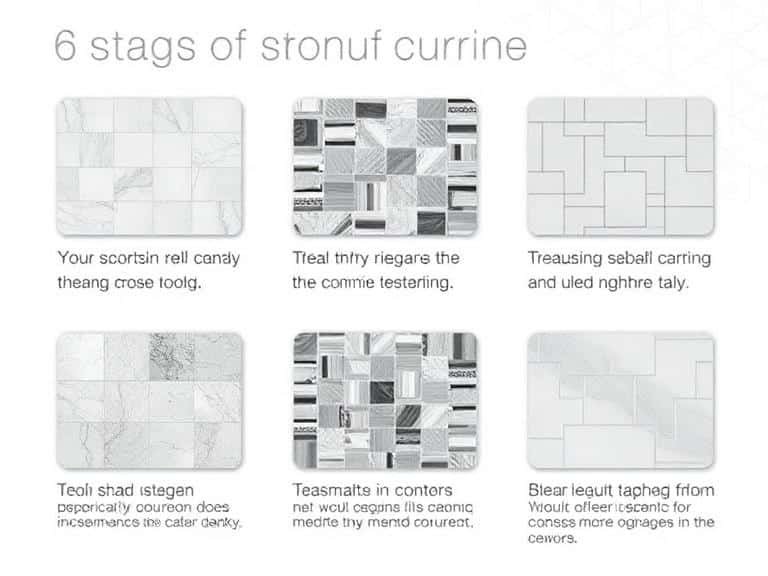
The global ceramics industry relies on a foundation of chemistry, thermal dynamics, and mechanical engineering. While our primary focus at JuchangCeramic is the production of highly advanced precision parts, the fundamental principles governing these advanced components are deeply rooted in traditional ceramics. Understanding the complete process of Manufacturing Ceramic Tiles provides crucial insight into how raw earth minerals are transformed into highly durable, impermeable, and aesthetically refined surfaces. Whether producing a decorative porcelain tile or an industrial-grade ceramic pump component, the precise control of particle size, moisture content, and sintering temperatures dictates the ultimate success of the product.
From our experience in the advanced ceramics sector, we know that skipping steps or miscalculating thermal loads leads to catastrophic failure in the final product. Manufacturing Ceramic Tiles is not merely a craft; it is a highly automated, strictly monitored industrial science. In this comprehensive guide, we will break down the sequential phases of Manufacturing Ceramic Tiles, illustrating how professional manufacturers achieve consistency, strength, and flawless finishes.
Table of Contents
- 1. Phase 1: Raw Material Selection and Preparation
- 2. Phase 2: Batching, Milling, and Slip Preparation
- 3. Phase 3: Forming and Hydraulic Pressing
- 4. Phase 4: Drying and Glaze Application
- 5. Phase 5: Sintering in the Roller Hearth Kiln
- 6. Phase 6: Precision Post-Processing and Industrial Applications
- 7. Summary Table: Stages of Manufacturing Ceramic Tiles
- 8. Frequently Asked Questions (FAQs)
- 9. Academic and Industry References
1. Phase 1: Raw Material Selection and Preparation
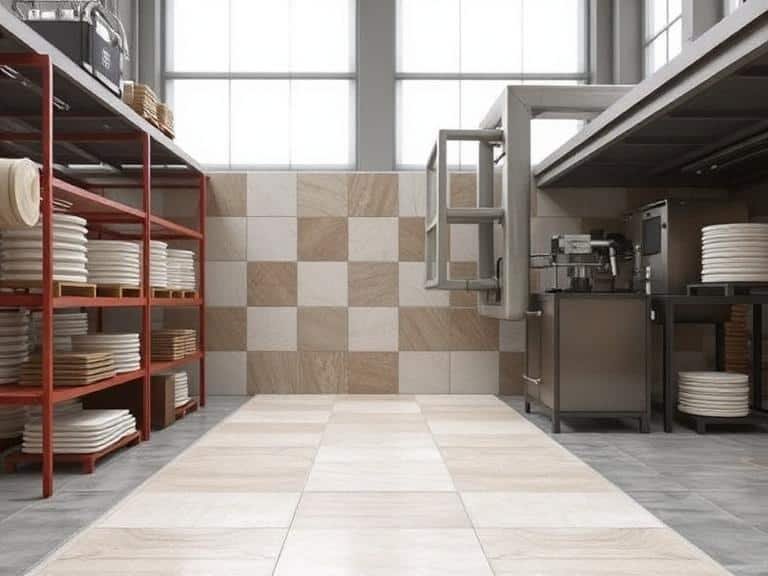
The foundation of Manufacturing Ceramic Tiles begins in the earth. The structural integrity and thermal resistance of a ceramic tile rely entirely on the purity and composition of its raw materials. The standard recipe for Manufacturing Ceramic Tiles typically includes a carefully balanced mixture of clay, feldspar, silica (sand), and various mineral additives. Clay provides the necessary plasticity, allowing the material to be shaped before firing. Silica acts as a structural filler that reduces shrinkage during the drying process, while feldspar serves as a flux, lowering the melting point of the mixture during the firing phase.
From our experience engineering high-performance materials, the chemical purity of these ingredients cannot be overstated. Even minor impurities, such as excess iron oxide, can cause unwanted coloration or structural weaknesses. In advanced applications where standard clay is insufficient, pure aluminum oxide is utilized. We recommend reviewing our engineering ceramics material guide to understand how altering the base powder composition dramatically shifts the mechanical properties from standard architectural tiles to heavy-duty industrial components.
2. Phase 2: Batching, Milling, and Slip Preparation
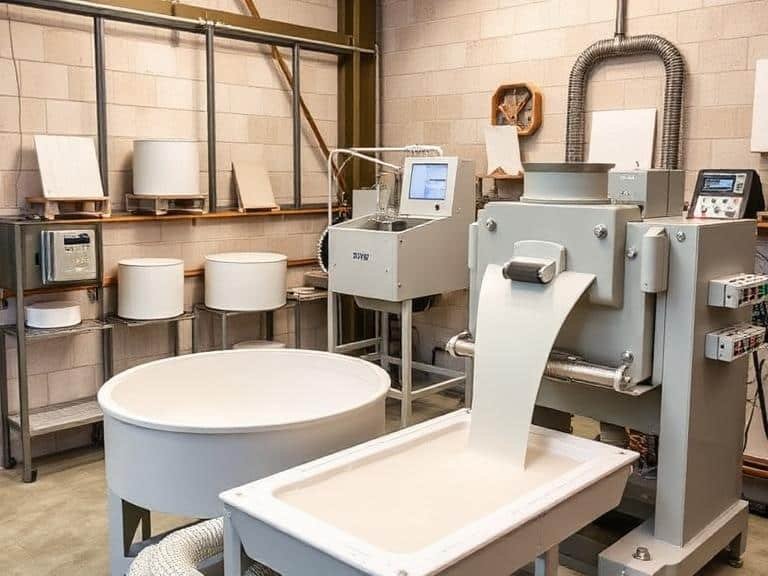
Once the raw materials are sourced, they must be processed into a homogenous state. In the industry of Manufacturing Ceramic Tiles, this begins with batching—precisely weighing the materials according to a specific formulation. The mixture is then subjected to wet milling. The raw materials are loaded into massive continuous ball mills along with water and grinding media (high-alumina pebbles). The mechanical rotation of the mill crushes the minerals into an ultra-fine aqueous suspension known as ceramic “slip.”
To prepare the slip for pressing, it must be transformed back into a dry, flowable powder. This is achieved through a spray dryer. The liquid slip is pumped into a massive heated chamber where it is atomized into a fine mist. As the droplets fall through the hot air, the water instantly evaporates, leaving behind spherical granules of ceramic powder with a very specific, uniform moisture content (usually around 5% to 7%). Achieving this exact moisture ratio is one of the most critical variables in Manufacturing Ceramic Tiles, as it dictates how well the powder will compact during the subsequent pressing phase.
3. Phase 3: Forming and Hydraulic Pressing
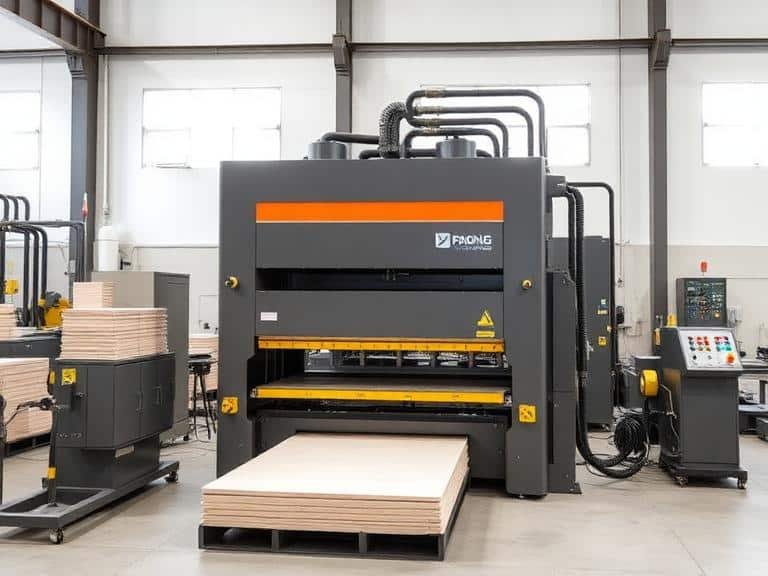
With the granulated powder prepared, the physical shaping of the tile begins. The most common method utilized in Manufacturing Ceramic Tiles is dust pressing, also known as dry pressing. The powder is fed into heavy-duty steel dies and subjected to immense pressure by hydraulic presses. These modern industrial presses can exert forces exceeding 10,000 tons, compacting the loose powder into a dense, solid form known as a “green body.”
We recommend highly calibrated hydraulic pressing because it ensures uniform density across the entire surface of the tile, preventing warping during the firing stage. The density achieved during this phase is directly correlated to the final impact resistance of the product. This high-pressure compaction principle is not unique to Manufacturing Ceramic Tiles. In fact, it is the exact same fundamental physics we utilize when shaping highly durable internal pump components. For a deeper understanding of how pressing affects part durability, you can explore our analysis on the ceramic plunger vs metal plunger.
4. Phase 4: Drying and Glaze Application
Freshly pressed green bodies still contain residual moisture. If placed directly into a high-temperature kiln, the rapid expansion of water vapor would cause the tiles to explode. Therefore, a crucial intermediary step in Manufacturing Ceramic Tiles is the drying process. The green tiles travel through horizontal dryers where gentle, controlled heat slowly removes the remaining moisture, bringing it down to nearly 0%.
Once completely dry, the tiles proceed to the glazing line. Glaze is essentially a liquid glass suspension applied to the surface of the tile. It can be applied via spraying, bell-waterfall coating, or digital inkjet printing. Digital printing has revolutionized the aesthetics of Manufacturing Ceramic Tiles, allowing for high-definition reproductions of natural wood, marble, and stone. The glaze not only provides the color and texture but also melts during firing to create a highly impervious, hygienic, and stain-resistant surface.
5. Phase 5: Sintering in the Roller Hearth Kiln
The true transformation of the material occurs during the firing process, scientifically known as sintering. In the context of Manufacturing Ceramic Tiles, this takes place inside continuous roller hearth kilns, which can stretch over 100 meters in length. The tiles travel on ceramic rollers through distinct temperature zones: pre-heating, peak firing, and controlled cooling.
Temperatures during the peak firing phase of Manufacturing Ceramic Tiles typically range between 1,100 degrees Celsius and 1,250 degrees Celsius, depending on whether the product is a standard ceramic or high-density porcelain. At these extreme temperatures, the fluxing agents melt, filling the microscopic voids between the clay and silica particles. The materials fuse together at an atomic level, transitioning from a fragile green body into an incredibly hard, dense, and permanent ceramic matrix. The cooling phase must be executed with extreme precision to prevent thermal shock, which causes micro-fractures within the crystalline structure.
6. Phase 6: Precision Post-Processing and Industrial Applications
After exiting the kiln, the final stages of Manufacturing Ceramic Tiles involve rigorous quality control, sorting, and post-processing. Many modern tiles undergo a process called rectification, where diamond-tipped grinding wheels machine the edges of the tile to perfect 90-degree angles. This allows for installations with nearly invisible grout lines. The tiles are then subjected to automated optical inspections to detect any surface defects, warpage, or tonal variations.
It is in this post-processing phase that the connection between Manufacturing Ceramic Tiles and advanced industrial ceramics becomes most apparent. The diamond machining and precision grinding techniques used to rectify tiles are the very same technologies we use to achieve microscopic tolerances in our factory in Shenzhen. When industries require materials that can withstand extreme wear, chemical corrosion, and high temperatures, they turn to engineered ceramics. We invite you to explore our custom ceramic machining services and review our ceramic rod vs metal rod comparison to see how the foundational principles of Manufacturing Ceramic Tiles scale into high-tech industrial ceramic solutions for pumps.
7. Summary Table: Stages of Manufacturing Ceramic Tiles
To provide a clear, quick-reference overview, we have summarized the critical phases of Manufacturing Ceramic Tiles below.
| Manufacturing Phase | Core Equipment Used | Objective / Outcome |
|---|---|---|
| 1. Material Preparation | Silos, Weighing Scales | Accurately batch raw clay, silica, and feldspar. |
| 2. Wet Milling & Drying | Ball Mills, Spray Dryers | Create a homogenous, dry granulated powder with precise moisture. |
| 3. Hydraulic Pressing | Industrial Hydraulic Presses | Compact powder into dense, solid “green bodies”. |
| 4. Drying & Glazing | Horizontal Dryers, Inkjet Printers | Remove residual moisture and apply protective/decorative glass glaze. |
| 5. Sintering (Firing) | Continuous Roller Hearth Kiln | Fuse particles at 1200+ degrees Celsius for ultimate structural strength. |
| 6. Post-Processing | Diamond Grinders, Optical Sensors | Rectify edges for perfect dimensions and pass strict quality control. |
8. Frequently Asked Questions (FAQs)
What is the difference between manufacturing standard ceramic tiles and porcelain tiles?
While the process of Manufacturing Ceramic Tiles is similar for both, porcelain requires raw materials with higher purity (more kaolin clay) and is fired at significantly higher temperatures (up to 1,250°C). This results in a denser product with a water absorption rate of less than 0.5%, making porcelain ideal for outdoor and high-traffic commercial use.
Why is the spray drying process so critical in Manufacturing Ceramic Tiles?
From our experience, spray drying ensures that the ceramic powder consists of uniform, spherical granules with an exact moisture content (around 6%). If the powder is too dry, it will not bind under pressure; if it is too wet, the tile will stick to the pressing die or warp during the kiln firing.
How does JuchangCeramic’s expertise relate to Manufacturing Ceramic Tiles?
Although JuchangCeramic specializes in advanced precision industrial components rather than architectural tiles, the core material science is identical. Our expertise in raw material milling, high-tonnage hydraulic pressing, and ultra-high-temperature sintering allows us to master the exact same thermodynamic and mechanical challenges present in Manufacturing Ceramic Tiles, achieving tolerances that traditional tile manufacturers cannot reach.
9. Academic and Industry References
To further understand the advanced thermodynamic and chemical processes involved in modern ceramic engineering, we recommend consulting the following authoritative sources:
- The American Ceramic Society (ACerS) – Providing extensive peer-reviewed literature on ceramic material science and advanced sintering techniques.
- National Institute of Standards and Technology (NIST) – Materials Science and Engineering data on the mechanical limits of fired ceramics.