
Compact equipment creates a difficult pump-design trade-off: engineers need accurate fluid delivery and dependable operation, but they have very little room for bulky components. Miniature ceramic pumps address this challenge by combining a small fluid-handling package with wear-resistant precision ceramic components. They are not automatically the right choice for every compact device, but when chemical compatibility, dimensional stability and repeatable metering matter, they can be a strong engineering investment.
Direct answer: Miniature ceramic pumps are valuable in compact equipment because they can offer precise fluid metering, excellent wear resistance, corrosion resistance against many compatible fluids, dimensional stability, low component deformation, and a compact integration footprint. Their biggest advantage is not simply their small size. It is the ability to maintain controlled fluid handling in applications where a worn, swollen or chemically damaged pump component can compromise the entire machine. The best results depend on selecting the right ceramic grade, seal arrangement, surface finish and pump architecture for the actual fluid and operating conditions.
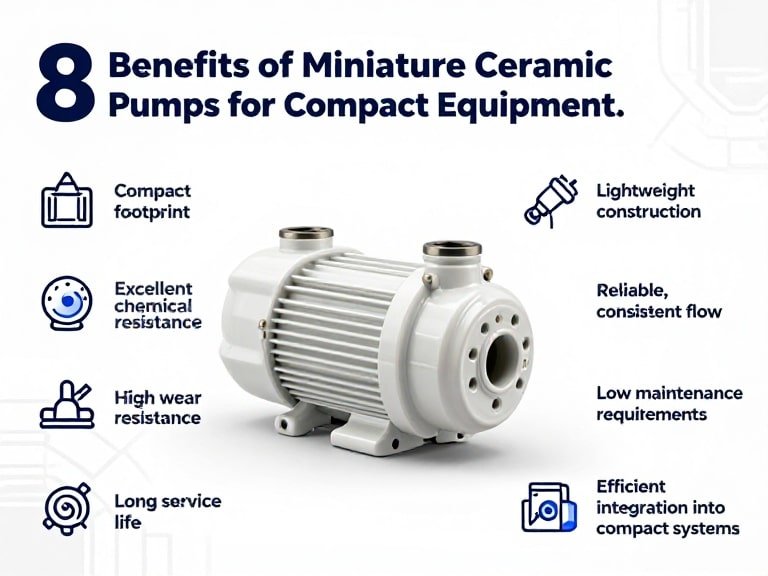
Quick Answer
Miniature ceramic pumps are worth considering when equipment requires repeatable small-volume dispensing, long service intervals or contact with fluids that are unsuitable for conventional metal or polymer wetted components. For high-volume, low-cost applications with clean, non-aggressive fluids, a polymer pump may be more economical. For precision instruments, medical equipment, analytical systems and compact industrial devices, a properly engineered ceramic pump can justify its higher initial cost.
| Benefit | Practical value | Best-fit applications |
|---|---|---|
| 1. Compact integration | Supports space-constrained equipment layouts. | Portable analyzers, instruments and compact automation. |
| 2. Precision metering | Helps deliver repeatable small fluid volumes. | Reagent dosing, dispensing and analytical systems. |
| 3. Wear resistance | Can reduce wear-related changes in clearances and performance. | Repeated-cycle dosing and continuous-duty mechanisms. |
| 4. Chemical compatibility | Selected ceramic grades resist many corrosive fluids. | Chemical dosing and laboratory equipment. |
| 5. Dimensional stability | Hard, stiff ceramic parts can maintain precision geometry. | Metering plungers, sleeves and valve components. |
| 6. Clean fluid handling | Can support low-contamination designs when properly finished and assembled. | Medical, diagnostic and analytical equipment. |
| 7. Lower maintenance potential | Wear-resistant wetted components may extend service intervals. | Equipment with costly maintenance access. |
| 8. Custom engineering flexibility | Allows material, geometry and interface choices to suit a device. | OEM equipment and specialized compact systems. |
In This Guide
- What miniature ceramic pumps are
- How miniature ceramic pumps work
- 8 benefits for compact equipment
- Ceramic vs polymer vs metal pumps
- Limitations and trade-offs
- Best use cases and who should use them
- Common design and purchasing mistakes
- How to choose a miniature ceramic pump
- Choosing a custom ceramic pump manufacturer
- JuchangCeramic expert recommendation
- Frequently asked questions
- References
What Are Miniature Ceramic Pumps for Compact Equipment?
A miniature ceramic pump is a small fluid-transfer or fluid-metering device that uses precision ceramic components in critical wetted or moving areas. Depending on its design, the ceramic parts may include a plunger, piston, cylinder, sleeve, valve seat, rotor or metering element. The pump body, seals, springs and drive mechanism may use other materials selected for the operating environment.
The word “ceramic” does not describe one universal material. Common engineering choices include alumina (Al₂O₃) and zirconia (ZrO₂). Alumina is widely used for its hardness, electrical insulation and chemical stability in suitable environments. Zirconia is often selected when higher fracture toughness and strength are important. The right choice depends on the fluid, temperature, mechanical loading, geometry and required surface finish.
Miniature ceramic pumps are different from ordinary small plastic pumps. Their purpose is not simply to reduce dimensions. They use engineered ceramic surfaces and geometries to manage wear, sealing and fluid displacement in a small assembly. For applications where a few microliters or a controlled dose matter, component precision can be more important than the pump’s external size.
How Do Miniature Ceramic Pumps Work?
Miniature ceramic pumps use a mechanical or electromechanical drive to move a defined volume of fluid through an inlet and outlet. The exact operating principle depends on the pump architecture.
Ceramic plunger and piston mechanisms
A ceramic plunger moves within a closely controlled cylinder or sleeve. During the intake stroke, fluid enters the pumping chamber. During the discharge stroke, the plunger displaces fluid through an outlet valve or flow path. The plunger’s dimensional accuracy, surface finish and alignment influence leakage, friction and repeatability.
For small-volume dosing, this architecture can be attractive because the displacement geometry is directly related to the amount of fluid moved. However, actual delivered volume also depends on pressure, fluid viscosity, valve behavior, seal design, trapped air and operating speed. A precision plunger alone does not guarantee a precise complete pump.
Rotary and valve-based mechanisms
Some compact systems use rotary elements or ceramic valves to direct fluid between ports. Ceramic valve surfaces can be useful where wear and chemical compatibility are important. The design must still account for contact pressure, lubrication conditions, particle contamination and sealing interfaces.
What determines real metering accuracy?
In most professional situations, engineers evaluate the complete fluid path rather than judging a pump by its ceramic material specification. Critical factors include chamber volume, plunger diameter, stroke length, clearances, valve response, leakage, drive resolution, fluid properties and calibration. A pump advertised as a microliter metering pump should be assessed using its actual accuracy, precision and repeatability data under representative test conditions.
8 Benefits of Miniature Ceramic Pumps for Compact Equipment
1. Compact Integration Without Sacrificing Critical Component Performance
The first benefit is the ability to fit controlled fluid handling into a restricted equipment envelope. Portable diagnostic instruments, benchtop analyzers, compact chemical dosing units and automated sampling devices often have strict limits on height, width, weight and power consumption.
A miniature ceramic pump can provide a compact pumping mechanism while retaining hard, precision-engineered components in the areas responsible for fluid displacement and sealing. This is especially useful when the equipment designer cannot simply increase pump size to obtain more robust internal parts.
From our experience, the most effective approach is to design the pump around the device’s available installation space early in product development. Waiting until the enclosure and tubing layout are finalized can force compromises in port orientation, mounting, service access and drive alignment.
Our recommendation: Specify the maximum envelope, mounting points, port positions and required service clearance before requesting a custom miniature pump quotation.
2. Accurate Small-Volume Fluid Metering
Compact equipment frequently needs to dispense a small, controlled quantity of reagent, lubricant, solvent or process fluid. In these applications, inaccurate dosing can affect test results, product quality or downstream process stability.
Precision ceramic plungers and sleeves can be manufactured with controlled dimensions and smooth working surfaces. When combined with an appropriate drive, valve system and calibration process, these components can support repeatable fluid displacement. This makes ceramic pump mechanisms relevant to analytical instruments, reagent dosing systems and precision dispensing equipment.
However, buyers should distinguish accuracy from repeatability. Accuracy describes how close the delivered volume is to the target; repeatability describes how consistently the pump delivers the same volume across repeated cycles. A pump can be repeatable but consistently deliver the wrong volume if it has not been calibrated correctly.
For applications involving very small doses, request performance data at the actual fluid viscosity, pressure, temperature and operating frequency. A headline microliter rating without test conditions is not enough to make a purchasing decision.
Explore microliter ceramic metering pumps when the application requires controlled small-volume dispensing.
3. High Hardness and Wear Resistance in Moving Components
Repeated movement creates friction and wear at plungers, sleeves, valve seats and other contact surfaces. As wear progresses, clearances may change, leakage can increase and metering performance can drift. In compact equipment, even a small dimensional change can become significant because the working clearances are already small.
Engineering ceramics such as alumina and zirconia offer high hardness and good wear resistance in appropriately designed applications. They can help reduce wear at critical contact surfaces compared with softer materials, particularly when the material pair, surface finish and operating conditions are correctly selected.
That does not mean ceramic parts are indestructible. Ceramics are hard but can be sensitive to impact, tensile stress, edge damage and poor assembly. Abrasive particles can also damage mating surfaces or seals. A ceramic pump must be designed to manage contact loads and prevent avoidable shock.
Practical advice: For high-cycle equipment, ask the manufacturer for wear-test conditions, cycle-life data and the failure criteria used. “High wear resistance” is not a substitute for application-specific evidence.
4. Corrosion Resistance for Compatible Chemical Fluids
Compact pumps are often used to move cleaning solutions, reagents, solvents and other process fluids. A material that reacts with the fluid can corrode, swell, contaminate the process or lose dimensional stability. Ceramic materials can offer excellent chemical resistance to many fluids, making them attractive for selected chemical-handling applications.
But chemical resistance is never universal. Performance depends on ceramic composition, purity, temperature, concentration, exposure time and the presence of other materials in the wetted assembly. Seals, adhesives, valve components and metal fittings may be less resistant than the ceramic parts themselves.
We recommend evaluating the complete wetted material set. Provide the pump manufacturer with the chemical name, concentration, temperature, cleaning procedure and expected exposure duration. If the fluid contains strong acids, alkalis or complex mixtures, request compatibility confirmation rather than assuming all alumina or zirconia grades behave identically.
For applications that require ceramic fluid-contact components, compare the available ceramic pump solutions and ceramic plunger pump designs against the fluid and operating requirements.
5. Dimensional Stability and Precision Geometry
Miniature pump performance depends on maintaining carefully controlled geometry. Plunger diameter, sleeve bore, roundness, straightness, surface finish and clearance all influence fluid displacement and leakage. Materials that deform or wear excessively can cause performance changes over time.
Technical ceramics have high stiffness and can retain their shape under suitable mechanical and thermal conditions. This makes them useful for precision components where dimensional stability matters. Ceramic manufacturing can also support fine grinding and lapping processes to achieve demanding surface and dimensional specifications.
The engineering trade-off is that ceramic components require careful handling and assembly. A rigid ceramic part may not tolerate misalignment or concentrated loads in the same way as a polymer component. The housing, support structure and drive system must be designed to avoid bending loads and stress concentrations.
For buyers, this means drawings should specify functional dimensions and tolerances—not simply a general request for “high precision.” Define the critical fit, surface roughness, concentricity and inspection method with the manufacturer.
6. Clean Fluid Handling for Analytical and Medical Equipment
In analytical, diagnostic and selected medical-device applications, contamination can affect measurement accuracy, reagent stability or process safety. Ceramic components can be useful because they are hard, dimensionally stable and resistant to many compatible chemicals. Properly manufactured and finished ceramic surfaces can support cleanable fluid paths.
However, the word “ceramic” does not automatically mean sterile, biocompatible or suitable for every medical application. Cleanliness depends on the complete pump design, surface condition, material traceability, cleaning validation, seals, assembly process and intended regulatory classification.
For medical equipment, the pump supplier should provide the material composition, manufacturing controls, traceability and validation information required by the device manufacturer. Do not treat a general industrial ceramic pump as a medical-grade component without reviewing the relevant evidence.
For specialized systems, review medical ceramic pump options and dialysis ceramic pump designs in the context of the device’s fluid path and validation requirements.
7. Potentially Longer Service Intervals and Lower Lifecycle Cost
A miniature pump may be inexpensive to purchase but costly to maintain if it requires frequent replacement, calibration or downtime. In automated equipment, service labor and lost production can quickly exceed the original component price.
Wear-resistant ceramic components may help maintain critical dimensions for longer in suitable applications. If this reduces leakage, performance drift or replacement frequency, the pump can offer a lower total cost of ownership even when its initial price is higher than a polymer alternative.
We do not recommend assuming a fixed service-life improvement without test data. Pump life depends on cycle rate, pressure, fluid cleanliness, temperature, dry-running events, assembly quality and maintenance. The correct cost comparison should use the expected operating profile and the actual cost of downtime.
For commercial users, compare the cost per operating hour or per million cycles—not just the unit price. Include replacement parts, calibration, labor, process interruption and inventory requirements.
8. Customization for OEM Equipment and Specialized Fluid Paths
Compact equipment rarely uses a one-size-fits-all pump. OEM designs may require a particular port arrangement, mounting pattern, stroke, displacement, plunger diameter, material grade or connection interface. Custom ceramic components allow the pump’s critical geometry and material selection to be aligned with the device rather than forcing the device around an unsuitable standard part.
Customization is particularly valuable when a pump must fit into an existing enclosure, connect to a proprietary fluid circuit or meet a specific dosing range. It can also help manufacturers consolidate components or optimize a new product design.
The trade-off is engineering time and validation cost. Customization is worthwhile when the standard product cannot meet a genuine performance or integration requirement. It is usually not worth paying for a fully custom design when a standard pump already meets the application’s pressure, flow, accuracy and interface requirements.
For OEM projects, prepare a technical brief that includes drawings, operating conditions, fluid compatibility, expected annual volume and inspection requirements. This helps the manufacturer quote the correct solution instead of pricing an incomplete concept.
Miniature Ceramic Pumps vs Polymer and Metal Pumps
Miniature ceramic pumps are not universally superior. The right comparison is based on the wetted fluid, operating pressure, required accuracy, cycle life, available space and total ownership cost. The table below is a practical screening guide; actual performance depends on the material grade and pump design.
| Evaluation factor | Miniature ceramic pump | Polymer pump | Metal pump |
|---|---|---|---|
| Wear resistance | Generally high for suitable ceramic grades and contact conditions. | Varies by polymer; softer materials may wear or creep under load. | Varies by alloy, hardness, coating and lubrication. |
| Chemical compatibility | Excellent against many fluids, but chemistry and grade must be checked. | Can be excellent for selected chemicals; swelling and temperature limits matter. | Depends strongly on alloy and fluid; corrosion may be a concern. |
| Dimensional stiffness | High stiffness and low elastic deformation. | Generally lower stiffness; creep may matter under sustained load. | Usually high stiffness and good structural strength. |
| Impact tolerance | More brittle; requires careful support and handling. | Often good impact tolerance, depending on polymer. | Generally more tolerant of impact and shock. |
| Small-volume precision | Can support precision metering with suitable grinding and assembly. | Can work well, but deformation and wear must be considered. | Can be precise, but corrosion, friction and surface treatment matter. |
| Initial cost | Often higher for precision custom components. | Often economical for high-volume, lower-load designs. | Varies by alloy, machining and finishing requirements. |
| Best fit | Precision dosing, wear-sensitive and chemically demanding applications. | Cost-sensitive, lightweight applications with compatible fluids. | Higher structural loads and applications where toughness is important. |
Limitations of Miniature Ceramic Pumps: What Buyers Must Understand
Ceramic pumps offer meaningful advantages, but ignoring their limitations can create expensive design failures.
- Brittleness: Ceramics can fracture under impact, tensile stress, edge loading or poor installation. The pump must provide appropriate support and alignment.
- Higher manufacturing cost: Precision ceramic forming, sintering, grinding and inspection can cost more than producing simple polymer parts.
- Material-specific chemical limits: No ceramic grade is resistant to every chemical at every concentration and temperature.
- Seal and interface limitations: The complete pump may contain elastomers, metals and adhesives whose compatibility is lower than that of the ceramic.
- Particle sensitivity: Abrasive contamination can damage clearances, seals and precision surfaces, even when the ceramic itself is highly wear-resistant.
- Design and assembly demands: Tight tolerances are valuable only when the housing, drive and assembly process preserve alignment.
For beginners, the main lesson is simple: do not select a ceramic pump based on hardness alone. For heavy-duty applications, pay particular attention to pressure, contact stress, particle content, thermal cycling and the risk of dry running.
Who Should Use Miniature Ceramic Pumps for Compact Equipment?
Medical and Diagnostic Equipment Developers
Designers of diagnostic analyzers, fluid-handling modules and selected medical devices may benefit when small-volume delivery, chemical compatibility and repeatability are important. The supplier must be able to support the required material documentation, manufacturing controls and validation process.
Laboratory and Analytical Instrument Manufacturers
Analytical systems often move small quantities of reagents, samples or solvents through compact fluid paths. Ceramic plungers and valves can be useful where wear, corrosion and dimensional consistency influence measurement reliability.
Industrial Automation and Precision Dispensing OEMs
Automated dosing, lubrication, coating and dispensing systems may need repeatable output over many cycles. A ceramic pump can be attractive when the fluid is compatible and maintenance access is limited.
Compact Chemical Dosing Equipment
Equipment that handles aggressive or high-purity fluids may benefit from ceramic wetted components. The complete material set must be checked, including seals, connectors and tubing.
Who Does Not Need a Ceramic Pump?
A ceramic pump may be unnecessary for a simple, low-cost device that transfers clean water at low pressure and does not require tight metering tolerances. It may also be a poor choice where severe shock, impact or poor alignment cannot be controlled. In these cases, a suitable polymer or metal pump can provide better value.
Our position is clear: use ceramic where its wear, chemical or precision advantages solve a measurable engineering problem. Do not specify it merely because ceramic sounds more advanced.
Common Mistakes When Specifying a Miniature Ceramic Pump
- Defining only the external dimensions: A pump can fit the enclosure but fail to meet flow, pressure or port requirements. Specify the complete operating envelope.
- Assuming every ceramic has the same properties: Alumina and zirconia differ in toughness, hardness, strength and cost. Specify the required grade and properties.
- Ignoring the seals: A ceramic plunger cannot compensate for an incompatible elastomer or leaking valve.
- Confusing repeatability with accuracy: Request both measurements and define the test method.
- Testing with water only: Viscosity, vapor pressure, lubricity and chemical compatibility can change pump behavior. Test with the actual process fluid where possible.
- Overlooking particles and filtration: Solid contaminants can damage precision interfaces. Define acceptable particle size and filtration requirements.
- Failing to consider dry running: Some pump designs rely on fluid for lubrication or cooling. Confirm whether dry operation is permitted and for how long.
- Choosing on unit price alone: A lower-cost pump may increase calibration, replacement and downtime costs.
How to Choose the Right Miniature Ceramic Pump
Before comparing quotations, create a technical specification that describes the real application. The following checklist is a practical starting point.
1. Define Flow Rate and Displacement
State the target flow rate, minimum and maximum dose, displacement per cycle and acceptable variation. If the application is intermittent, provide the required dosing frequency and duty cycle. Do not rely on a single nominal flow figure if the pump must operate across a wide range.
2. Specify Pressure and Fluid Properties
Provide inlet and outlet pressure, differential pressure, viscosity range, temperature, vapor pressure and whether the fluid contains suspended particles. These details affect valve response, leakage, drive load and material selection.
3. Identify All Wetted Materials
Request the ceramic grade and the materials used for seals, valve seats, springs, fittings and housing surfaces that contact the fluid. Check chemical compatibility for the full operating range, including cleaning and sterilization cycles where applicable.
4. Set Accuracy, Repeatability and Leakage Requirements
Define the measurement method and test conditions. Specify whether accuracy is measured by mass or volume, the number of repeated cycles, operating pressure, fluid temperature and allowable leakage. A useful supplier quotation should state the conditions behind its performance figures.
5. Confirm Mechanical and Electrical Interfaces
Provide mounting dimensions, port orientation, connector type, drive requirements, allowable vibration and available installation space. If the pump is motor-driven, specify the power supply, control signal, speed range and feedback requirements.
6. Request Validation and Quality Documents
Depending on the application, request material certificates, dimensional inspection reports, surface-finish records, leak-test results, performance curves and traceability documents. Medical and regulated equipment projects may require additional quality-system and regulatory evidence. Confirm the exact requirements with your device compliance team.
When comparing suppliers, consider their ability to manufacture the ceramic parts consistently—not just their ability to assemble a sample pump. Review their precision grinding, lapping, dimensional inspection and process-control capabilities. You can also compare the wider industrial ceramic products catalog and learn more about alumina ceramic material properties before finalizing a material specification.
Choosing a Custom Ceramic Pump Manufacturer
For an OEM project, the manufacturer has to do more than produce a ceramic part to a drawing. The supplier should understand the relationship between ceramic material, surface finish, dimensional tolerance, sealing, fluid properties and assembly conditions.
We recommend assessing a manufacturer across five areas:
- Material engineering: Can the supplier recommend appropriate alumina or zirconia grades based on fluid chemistry, loading and temperature?
- Precision processing: Does the factory have suitable forming, sintering, grinding, lapping and inspection processes for the required geometry?
- Application engineering: Can its engineers review flow, pressure, leakage, cycle rate and mechanical interfaces rather than simply quote a drawing?
- Quality assurance: Are inspection criteria, batch traceability, sample approval and production controls clearly defined?
- OEM support: Can the supplier manage prototypes, design revisions, pilot runs and repeat production with consistent specifications?
Do not award a project based on a low quotation before confirming what is included. One supplier may quote only a ceramic plunger, while another includes a complete pump assembly, seals, testing and documentation. Compare equivalent deliverables.
For additional supplier evaluation, see our guide to ceramic plunger manufacturers. If your project also requires non-pump precision components, review our custom precision ceramic parts supplier and manufacturing services.
Cost-Benefit Analysis: Is a Miniature Ceramic Pump Worth the Investment?
The commercial decision should be based on lifecycle cost rather than initial price. A polymer pump may be the right choice when the fluid is mild, pressure is low and replacement is inexpensive. A ceramic pump becomes more attractive when wear, corrosion, metering drift or maintenance access creates a meaningful operating cost.
Consider a compact analyzer operating throughout the day. If a pump’s output gradually changes as its internal components wear, the equipment may need recalibration or service. If the pump is difficult to access, even a short replacement procedure can interrupt production or testing. A more durable precision component may justify a higher purchase price if it reduces these costs.
For a project with low annual usage, the calculation may be different. If the pump runs only occasionally and the fluid is non-aggressive, the added cost of ceramic may not deliver enough measurable benefit. We recommend estimating the following over the expected service period:
- Initial pump and integration cost.
- Expected replacement frequency and spare-parts cost.
- Calibration, inspection and maintenance labor.
- Downtime cost per service event.
- Cost of inaccurate dosing, rejected product or unreliable test results.
- Validation and qualification costs for a material or design change.
A ceramic pump is worth upgrading to when its measurable contribution to accuracy, wear life, chemical compatibility or uptime exceeds its added cost. If the only justification is that ceramic is a premium material, the business case is incomplete.
JuchangCeramic Expert Recommendation
For compact equipment, we recommend miniature ceramic pumps when three conditions overlap: the available space is restricted, fluid delivery must remain controlled, and the application places meaningful demands on wear resistance or chemical compatibility. In those circumstances, precision ceramic components can provide an advantage that a basic polymer pump may not maintain over repeated operation.
Choose the material and pump architecture together. Alumina may be suitable for many general precision applications, while zirconia may be considered where toughness and mechanical properties are priorities. Neither should be selected without reviewing the actual fluid, load, temperature and manufacturing tolerances. Also remember that seals and valve interfaces often determine whether the complete pump succeeds.
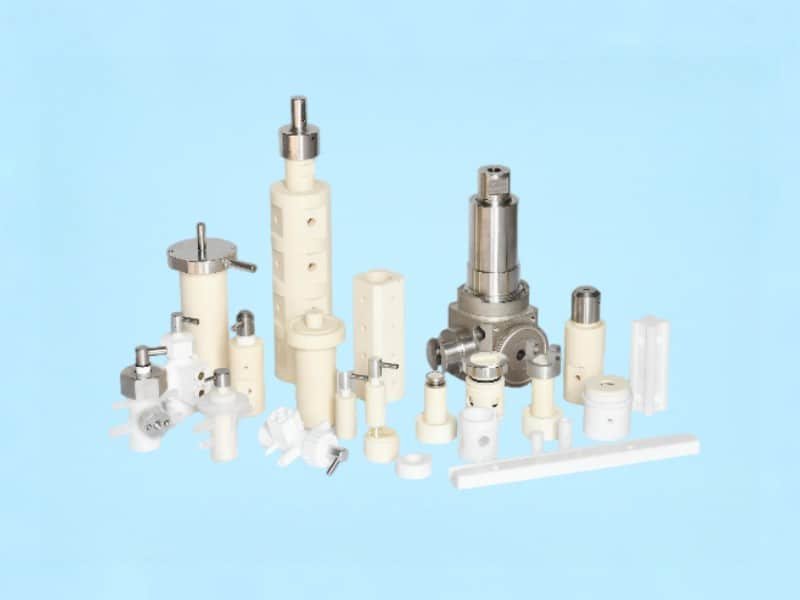
JuchangCeramic focuses on OEM and custom manufacturing solutions for precision ceramic parts, pumps and components. Whether your team has a complete engineering drawing or an early product concept, the project should begin with clear operating requirements and a review of the critical dimensions and material interfaces.
Custom Ceramic Manufacturing Services
JuchangCeramic supports custom precision ceramic manufacturing for OEM equipment and specialized industrial applications. Share your drawings or project requirements to discuss material selection, component geometry, tolerances and production feasibility.
Explore JuchangCeramic custom ceramic manufacturing services.
For a new project, we suggest starting with a prototype that uses the intended fluid and representative operating conditions. Validate flow accuracy, repeatability, leakage, wear and cleaning compatibility before approving mass production. This is more reliable than selecting a pump from a catalog description alone.
Frequently Asked Questions
1. What are miniature ceramic pumps used for?
Miniature ceramic pumps are used in compact equipment that needs controlled fluid transfer or small-volume metering. Typical applications include analytical instruments, diagnostic systems, chemical dosing devices, precision dispensing equipment and selected medical-device fluid systems.
2. Why use ceramic instead of plastic in a miniature pump?
Ceramic can offer higher hardness, wear resistance and dimensional stiffness than many polymers. It may also provide better chemical compatibility for selected fluids. Plastic can still be the better option when impact tolerance, low cost or simple high-volume manufacturing matters more than wear or precision.
3. Which ceramic material is best for miniature pumps?
There is no universal best material. Alumina is widely used for hardness, wear resistance and chemical stability in suitable environments. Zirconia may be selected where higher fracture toughness and strength are important. The choice should be based on fluid compatibility, mechanical loading, temperature and required tolerances.
4. Are miniature ceramic pumps suitable for medical equipment?
They can be suitable for selected medical and diagnostic applications, but the complete pump must meet the device’s material, cleanliness, biocompatibility, manufacturing and validation requirements. A ceramic component alone does not establish medical-grade suitability.
5. Do ceramic pumps provide more accurate dosing?
Precision ceramic plungers and sleeves can support accurate, repeatable displacement when their dimensions and surface finish are controlled. Actual dosing performance also depends on valves, seals, drive resolution, fluid properties, pressure, leakage and calibration.
6. Are ceramic pumps resistant to all chemicals?
No. Ceramic chemical resistance depends on the material grade, chemical concentration, temperature and exposure conditions. Seals, fittings and other wetted parts may have different compatibility limits. Always review the complete wetted material set.
7. Are miniature ceramic pumps more expensive?
They often have a higher initial cost than basic polymer pumps because precision ceramic processing can require specialized forming, sintering, grinding and inspection. They may still offer better lifecycle value when wear, maintenance, downtime or dosing errors are expensive.
8. What information is needed for a custom miniature ceramic pump quotation?
Provide the target flow rate or displacement, pressure, fluid type and viscosity, operating temperature, duty cycle, required accuracy, installation dimensions, port arrangement, drive requirements and expected annual quantity. Drawings and material compatibility requirements help the manufacturer assess feasibility and cost.
References
These technical resources provide background on engineering ceramic properties, material selection and precision ceramic manufacturing. Final material selection should still be confirmed against the exact grade datasheet and application conditions.
- The American Ceramic Society – Ceramic Materials and Engineering Resources. Technical background on advanced ceramics, material properties and engineering applications.
- CeramTec – Technical Ceramics. Manufacturer information on technical ceramic materials, properties and industrial component applications.
- KYOCERA – Fine Ceramics and Industrial Components. Technical ceramic material and component information relevant to precision engineering and industrial design.