
JuchangCeramic | Precision Ceramic Pump Technology | Application Guide
When a machine must dispense a few microliters of liquid repeatedly, a small variation in pump movement can become a major process problem. Diagnostic instruments may produce inconsistent results, laboratory automation can waste expensive reagents, and industrial dosing systems may drift outside their process tolerances. A microliter ceramic metering pump is designed for applications where controlled displacement, repeatability, and wear-resistant fluid-contact surfaces matter.
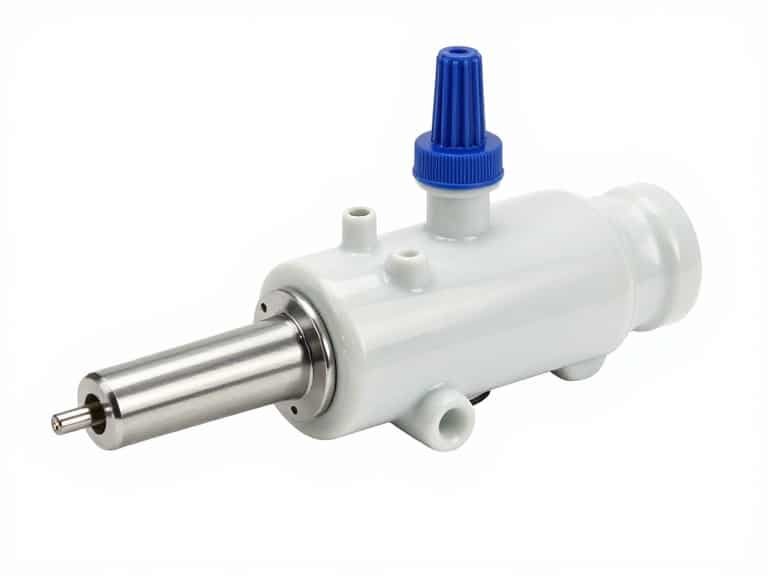
However, ceramic construction is not a shortcut to guaranteed accuracy. The pump must match the liquid, target volume, pressure, operating frequency, cleaning procedure, and control system. In this guide, JuchangCeramic explains ten practical applications, the advantages and limitations of ceramic metering technology, and the specifications engineers should confirm before selecting a pump.
Quick Answer: What Are the Applications of Microliter Ceramic Metering Pumps?
Microliter ceramic metering pumps are used to deliver small, controlled liquid volumes in medical diagnostic instruments, laboratory automation, pharmaceutical equipment, analytical chemistry, microfluidics, environmental monitoring, precision coating, chemical dosing, and specialized industrial systems.
They generally work through a positive-displacement mechanism. A precision plunger moves inside a closely matched metering chamber, drawing liquid in and then pushing a measured volume toward the outlet. Ceramic components can provide hard, wear-resistant surfaces and dimensional stability, helping the metering mechanism maintain its performance over repeated cycles.
Our recommendation: choose a microliter ceramic metering pump when repeatable small-volume dosing, wear resistance, and material compatibility are important to the process. Do not pay for a precision ceramic assembly if an ordinary pump already meets the required tolerance. First establish the dose range, accuracy, repeatability, wetted materials, pressure, and expected service life.
Table of Contents
- What Is a Microliter Ceramic Metering Pump?
- How Does It Work?
- 10 Main Applications
- Benefits of Ceramic Pump Technology
- Limitations and Trade-Offs
- Pump Technology Comparison
- How to Select the Right Pump
- Custom Ceramic Manufacturing
- Pros and Cons
- Common Specification Mistakes
- Expert Recommendation
- Quick Summary Table
- Frequently Asked Questions
- References
1. What Is a Microliter Ceramic Metering Pump?
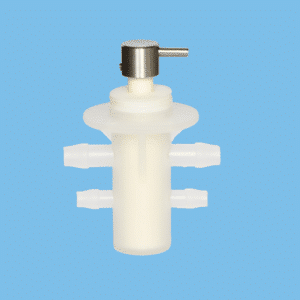
A microliter ceramic metering pump is a positive-displacement pump designed to transfer or dispense very small liquid volumes, commonly measured in microliters. Its metering mechanism often includes a precision ceramic plunger and a closely fitted cylinder or chamber. The plunger’s movement changes the chamber volume, drawing liquid in during one part of the cycle and discharging it during another.
The word “microliter” describes the scale of fluid delivery, not one universal pump specification. Different models can have different dose ranges, stroke lengths, cycle frequencies, valve designs, and pressure capabilities. A pump designed for a few microliters in an analytical instrument is not automatically suitable for a high-pressure chemical dosing system.
Why are ceramic components used?
Technical ceramics such as alumina and zirconia are used in precision pump components because they can offer high hardness, wear resistance, dimensional stability, and resistance to many chemicals. These properties are useful when a plunger and cylinder repeatedly move against one another and small changes in their fit can affect leakage or delivered volume.
Material selection still requires engineering review. Alumina and zirconia have different mechanical, thermal, and chemical characteristics. The seals, valves, springs, connectors, and tubing also contact the liquid and may become the limiting factor in the complete assembly.
For a closer look at the components used in these assemblies, see JuchangCeramic’s ceramic plunger pump components overview.
2. How Does a Microliter Ceramic Metering Pump Work?
Most microliter ceramic metering pumps use positive displacement. Rather than relying only on gravity or flow resistance, the pump moves a defined mechanical displacement to draw in and expel liquid. The delivered volume depends on the chamber geometry, plunger movement, valve performance, fluid properties, pressure conditions, and control accuracy.
The basic metering cycle
- Intake: The plunger retracts or the metering chamber expands, allowing liquid to enter through the inlet path.
- Isolation: The inlet path closes or is isolated to prevent reverse flow during discharge.
- Dispensing: The plunger advances, reducing chamber volume and pushing liquid through the outlet.
- Reset: The mechanism returns to its intake position and prepares for the next cycle.
Depending on the pump design, actuation may use a stepper motor, solenoid, or another controlled drive system. Valves coordinate intake and discharge. Electronic control determines the movement profile and, in programmable systems, may adjust the stroke or cycle timing.
Why do clearance and surface finish matter?
At microliter scale, small dimensional differences can have a noticeable effect. Excessive clearance may allow internal leakage or backflow. Insufficient clearance can increase friction, wear, or the risk of seizure, particularly when particles enter the fluid path or operating temperature changes.
For this reason, a precision ceramic pump needs more than a hard material. The plunger and cylinder require controlled dimensions, roundness, cylindricity, concentricity, and surface finish. These requirements should be defined during engineering review, not after a prototype fails a dosing test.
Recommended products
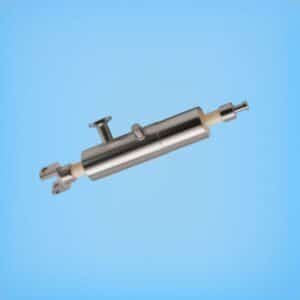
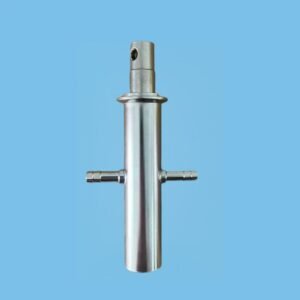
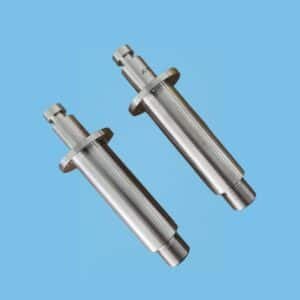
3. 10 Applications of Microliter Ceramic Metering Pumps in Precision Fluid Delivery
The most suitable applications share three requirements: small liquid volumes, consistent delivery, and a reason to control wear or material compatibility carefully. The following ten examples show where microliter ceramic metering pumps can provide practical value.
Application 1: Medical Diagnostic Instruments
Diagnostic analyzers transfer small quantities of reagents, buffers, wash solutions, and samples. In automated testing equipment, the delivered volume can influence reaction conditions, signal strength, and the consistency of analytical results.
A precision ceramic metering pump can be considered where repeatable dosing, stable dimensions, and resistance to selected cleaning or reagent chemicals are required. The complete fluid path must still be validated for the intended medical application. Ceramic construction alone does not establish biocompatibility, sterility, or regulatory compliance.
Our recommendation: prioritize dose repeatability, low carryover, cleaning validation, and compatibility with every wetted material. JuchangCeramic’s medical ceramic pump solutions are a relevant starting point for equipment developers evaluating this category.
Application 2: Dialysis Equipment and Fluid Management
Dialysis equipment manages fluid movement under tightly controlled operating conditions. Depending on the device architecture, metering components may be used in reagent delivery, fluid management, or supporting subsystems. Reliability and material compatibility are important, but safety requirements extend well beyond the pump itself.
A ceramic metering component may be useful where wear resistance and dimensional stability are relevant. A pump intended for a dialysis-related subsystem must nevertheless be assessed against its exact fluid path, pressure limits, cleaning requirements, and applicable medical-device requirements.
Engineering priority: do not assume a general-purpose microliter pump is suitable for blood-contacting or patient-connected circuits. Define the fluid contact and risk classification first. Review dialysis ceramic pump configurations as part of a project-specific technical discussion.
Application 3: Laboratory Automation and Liquid Handling
Automated laboratory platforms transfer reagents, standards, solvents, and samples between containers, reaction wells, and analytical modules. Small dispensing errors can accumulate across repeated operations or affect the comparability of test results.
Microliter ceramic metering pumps can be useful when a fixed or programmable volume must be delivered repeatedly. Suitability depends on viscosity, vapor pressure, surface tension, and the liquid’s tendency to crystallize or form deposits. A volatile solvent may behave differently from an aqueous buffer even when the nominal dose is identical.
For instrument designers, we recommend testing at the intended dispensing frequency with the actual tubing, valves, fittings, and reservoir arrangement. A pump that performs well on a benchtop may behave differently after integration into a compact automated instrument.
Application 4: Pharmaceutical and Reagent Dispensing
Pharmaceutical production and laboratory preparation can require controlled transfer of active ingredients, solvents, buffers, and process reagents. Metering pumps can automate small-volume dosing and reduce dependence on manual pipetting in suitable process stages.
Ceramic wetted components may be attractive where chemical resistance and wear stability matter. Pharmaceutical use also requires attention to extractables and leachables, cleaning validation, material traceability, and process qualification. The pump must be assessed as part of a validated fluid-handling system.
For manufacturers: ask for material declarations, surface-finish information, cleaning recommendations, and available validation support. A ceramic plunger by itself does not make an entire pump assembly compliant with pharmaceutical production requirements.
Application 5: Analytical Chemistry and Chromatography Systems
Analytical instruments may need small, repeatable volumes of mobile phases, reagents, standards, or sample solutions. In some systems, dosing stability influences measurement repeatability and the consistency of the analytical method.
Microliter pumps can support controlled fluid delivery when their output range and pressure characteristics match the instrument architecture. Selection must account for solvent compatibility, pressure, pulsation, degassing, and the sensitivity of downstream detectors or separation processes.
Where a system uses aggressive solvents or frequent solvent changes, review the complete wetted path. Ceramic may be suitable for the plunger and metering chamber while seals and valve materials require a different specification.
Application 6: Microfluidic Devices and Lab-on-a-Chip Systems
Microfluidic platforms move liquids through channels and chambers with very small internal volumes. Controlled injection, reagent addition, and sample transfer are common requirements in research and specialized analytical equipment.
A microliter ceramic metering pump can act as a controlled fluid source when its output range and pressure characteristics match the microfluidic design. However, excessive pressure pulses or flow variation may disrupt delicate channel behavior.
For this application, evaluate dose resolution, pulsation, response time, dead volume, and connection geometry. A lower-flow pump with smoother control may be more useful than a model with a higher maximum delivery rate.
Application 7: Environmental Monitoring and Water Analysis
Environmental instruments may automatically dispense calibration solutions, buffer reagents, colorimetric chemicals, or sample-conditioning fluids. Equipment installed in remote monitoring stations often needs to operate for extended periods with limited maintenance access.
Ceramic metering components can be worth considering where the fluid is chemically challenging or wear-related dimensional changes could affect repeated dosing. The pump still needs protection against suspended particles, deposits, freezing, and contamination from the sample stream.
Practical advice: specify filtration or sample conditioning where necessary, and test the pump with the actual reagent formulation. If the instrument operates outdoors, include temperature variation and service intervals in the qualification plan.
Application 8: Precision Ink, Coating, and Additive Dispensing
Specialized printing, coating, and manufacturing systems may require controlled delivery of inks, functional coatings, lubricants, or chemical additives. The challenge is not always the smallest possible dose. It is maintaining stable delivery as viscosity, temperature, and operating frequency change.
A ceramic metering pump may be suitable when the liquid is compatible with the selected materials and the system needs repeatable displacement over many cycles. Abrasive pigments or particles require particular attention because they can affect valve sealing and internal wear even when ceramic surfaces are hard.
Before upgrading, test the complete formulation rather than a clear carrier liquid. Pigment loading, particle size, and settling behavior can change pump performance substantially.
Application 9: Chemical Analysis and Laboratory Reagent Preparation
Analytical laboratories dispense small quantities of acids, bases, solvents, standards, and other chemical reagents. A pump used in this environment must maintain reliable delivery while resisting the chemicals that contact its internal surfaces.
Advanced ceramics can offer useful corrosion resistance in selected environments, but no ceramic grade is universally resistant to every chemical. Concentration, temperature, exposure time, and the presence of other materials all matter.
We recommend preparing a wetted-material compatibility matrix before selecting the pump. Include the ceramic grade, seals, valve seats, springs, tubing, connectors, and cleaning agents. This avoids choosing a chemically resistant plunger while overlooking a less resistant seal.
Application 10: Industrial Dosing and Precision Lubrication
Some industrial machines require controlled quantities of lubricants, process additives, catalysts, or specialty fluids. When a small dose must be repeated at a defined interval, a microliter metering pump can help standardize delivery and reduce manual adjustment.
Ceramic plungers may be useful where abrasive wear or chemical exposure is a concern. However, industrial fluids vary widely in viscosity and particulate content. A pump designed for clean, low-viscosity reagent may not handle a thick lubricant or particle-filled formulation reliably.
For commercial users: evaluate the full operating envelope, including minimum and maximum viscosity, temperature, pressure, cycle rate, and expected service life. If the task is intermittent lubrication rather than precision analytical dosing, another pump technology may offer better value.
4. Benefits of Ceramic Metering Pump Technology
In precision fluid delivery, pump performance depends on the stability of the metering geometry and the condition of moving surfaces. Ceramic materials are attractive because they can retain useful mechanical and surface properties under repeated contact, provided the material grade and design are appropriate.
Wear resistance and dimensional stability
The plunger and cylinder operate with a close fit. Wear can gradually change this fit, increasing internal leakage or affecting repeatability. Hard technical ceramics can help reduce wear in suitable operating conditions, supporting long-term dimensional consistency.
Corrosion resistance in selected environments
Alumina and zirconia are used in fluid-contact components because they resist many chemicals. The correct grade must be selected for the actual process. Strong acids, alkalis, elevated temperatures, and certain chemical combinations may require additional compatibility testing.
Precision surfaces and controlled clearances
With suitable surface finishing and a correctly designed mating pair, ceramic components can support smooth movement and controlled clearances. Surface roughness, roundness, and cylindricity should be specified according to the application’s performance requirements rather than treated as cosmetic details.
Potentially longer service intervals
Reducing wear in the metering pair can help limit performance drift and maintenance frequency. This is valuable in automated instruments where service interruptions are expensive. Actual service life still depends on fluid cleanliness, alignment, operating pressure, cycle count, and the condition of valves and seals.
Material choices for different designs
Alumina and zirconia are common choices for precision ceramic components, but they are not interchangeable in every application. Engineers should compare mechanical properties, chemical compatibility, thermal behavior, manufacturing tolerances, and cost. JuchangCeramic provides information about high-precision zirconia and alumina ceramic parts for metering pump applications.
5. Limitations: When Is a Microliter Ceramic Pump Not the Right Choice?
Precision ceramic metering pumps are not a universal replacement for every small-volume fluid pump. They are specialized components, and their value depends on the process. Buyers should understand the trade-offs before specifying one.
Higher manufacturing cost
Close tolerances, fine surface finishing, dimensional inspection, and controlled assembly increase manufacturing complexity. If an application only needs approximate dosing and has no meaningful wear or chemical-resistance challenge, a less specialized pump may be more economical.
Ceramics are hard but can be brittle
High hardness does not mean unlimited impact resistance. Ceramic parts can be damaged by improper handling, misalignment, excessive mechanical loading, or unsuitable assembly procedures. The housing and drive system must support the ceramic metering pair correctly.
Particles can still cause problems
Hard ceramic surfaces do not make a pump immune to contamination. Particles can obstruct valves, interfere with sealing, or cause scoring and abnormal wear in the assembled mechanism. If the liquid contains solids, define particle size, concentration, hardness, and filtration requirements.
Accuracy depends on the complete system
Even a precision pump cannot compensate for poor control electronics, trapped air, unstable inlet pressure, leaking connections, unsuitable tubing, or inconsistent fluid properties. Evaluate the pump inside the intended instrument or process rather than relying only on an isolated component test.
6. Microliter Ceramic Pump vs. Other Pump Technologies
Choosing a pump technology is a cost-performance decision. Ceramic metering pumps are attractive when wear resistance and precise displacement matter, but other technologies may be better for disposable fluid paths, flexible tubing, or applications that tolerate less exact dosing.
| Pump Technology | Main Strength | Important Limitation | Best-Fit Application | Our Recommendation |
|---|---|---|---|---|
| Microliter ceramic metering pump | Wear-resistant precision metering surfaces and controlled displacement | Higher precision manufacturing cost; requires careful material and clearance design | Repeated small-volume dosing in instruments and specialized equipment | Choose when repeatability, wear, and material stability justify the investment |
| Conventional metal plunger pump | Strong mechanical construction and broad industrial use | Wetted-metal compatibility and wear behavior depend on alloy and fluid | Higher-pressure dosing and industrial fluid transfer | Consider when pressure and mechanical robustness matter more than ceramic wetted surfaces |
| Peristaltic pump | Fluid contacts mainly the tubing, which can be replaced | Tubing fatigue, pulsation, and material compatibility can limit performance | Sample transfer and applications needing an isolated fluid path | Useful where easy cleaning or disposable tubing is a priority |
| Diaphragm metering pump | Can isolate the fluid from drive components and handle a range of liquids | Minimum dose and pulsation depend strongly on design | Reagent dosing and general chemical metering | Choose when the dose range and pressure profile fit the process |
| Solenoid micro-dosing pump | Compact actuation and straightforward electronic control in suitable designs | Performance can be sensitive to fluid properties, valve behavior, and operating conditions | Compact instruments and intermittent small-volume dosing | Compare actual repeatability and lifetime data before selecting |
For engineers already using ceramic plunger technology, the next decision may be whether to retain the existing pump architecture and upgrade the metering pair, or redesign the complete fluid module. JuchangCeramic’s ceramic plunger pump range and microliter ceramic metering pump category are useful starting points for this evaluation.
7. How to Select the Right Microliter Ceramic Metering Pump
A good specification starts with the fluid and the required dosing result. We recommend that purchasing teams and design engineers prepare a written application brief before requesting quotations.
1. Define the target volume and tolerance
State the nominal dose, minimum and maximum dose, allowable error, and required repeatability. These terms should not be used interchangeably. Accuracy describes how close the measured output is to the target; repeatability describes how consistently the pump delivers across repeated cycles under defined conditions.
Ask the supplier to explain the measurement method, test fluid, pressure, temperature, and sample size behind any quoted performance figure. A single test result is not enough to establish long-term production performance.
2. Identify the liquid and its properties
Provide the chemical name or formulation, concentration, viscosity range, density, temperature, vapor pressure where relevant, and whether the liquid contains particles. Also identify cleaning and sterilization agents. These details determine whether the ceramic grade, seals, valves, and other wetted materials are appropriate.
3. Confirm pressure, flow rate, and cycle frequency
Define the inlet and outlet pressure, required delivery rate, and number of cycles per minute or hour. A pump that meets a low-frequency laboratory requirement may not maintain the same performance at a much higher cycle rate. Pressure fluctuations and backpressure can also affect delivered volume.
4. Specify every wetted material
Do not specify only “ceramic.” Ask for the exact ceramic grade and the material of every wetted component, including seals, valve seats, springs, tubing, and connectors. If the fluid is chemically aggressive, request compatibility information and carry out testing where necessary.
5. Check geometry and surface quality
For a ceramic plunger and cylinder, relevant manufacturing parameters may include diameter tolerance, roundness, cylindricity, straightness, concentricity, surface roughness, and edge condition. The required values should be agreed according to the pump design and performance target.
JuchangCeramic’s custom precision ceramic parts manufacturing service is relevant when a project requires components made to customer drawings or application-specific requirements.
6. Evaluate service life and maintenance
Ask for expected cycle life under defined operating conditions, inspection intervals, replacement procedures, and recommended cleaning methods. Request information on failure modes such as seal wear, valve leakage, particle blockage, or damage caused by misalignment.
7. Review integration requirements
Confirm dimensions, mounting interface, drive method, electrical requirements, communication interface, tubing connections, and control sequence. In compact instruments, a pump may be mechanically suitable but difficult to integrate because of connector access or maintenance clearance.
8. Request a representative sample test
Where possible, test the pump with the actual liquid and intended system configuration. Record delivered volume over multiple cycles, startup behavior, leakage, response time, and performance after a defined operating period. This is a stronger basis for approval than a brochure specification alone.
8. Custom Ceramic Manufacturing: When Standard Parts Are Not Enough
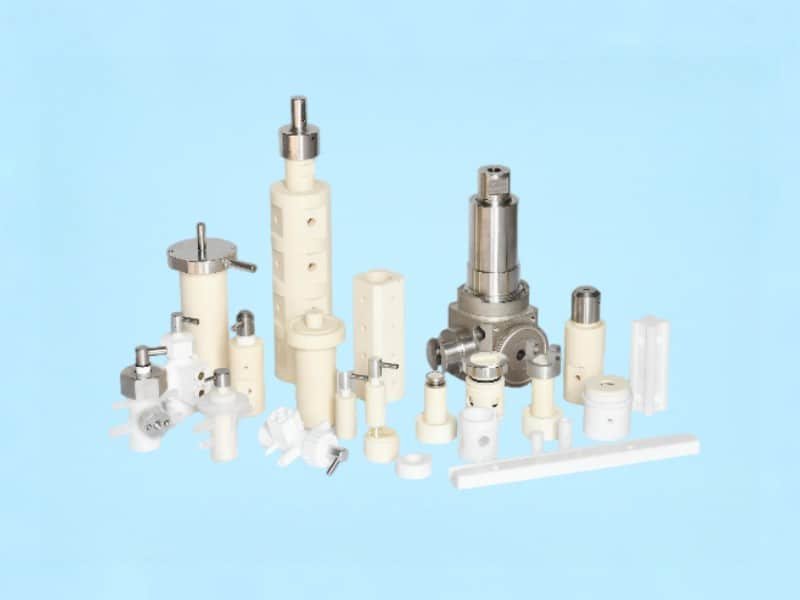
Standard pump components are sensible when their geometry, material, and interface match the application. Custom manufacturing becomes worthwhile when an instrument has a restricted installation envelope, a non-standard metering volume, a special chemical environment, or a specific plunger-cylinder geometry that cannot be met by an off-the-shelf component.
JuchangCeramic Custom Ceramic Manufacturing Services
JuchangCeramic delivers OEM and custom manufacturing solutions for precision ceramic parts, pumps, and components. Projects can begin with complete engineering drawings or an initial concept that needs technical review.
For microliter pump development, custom work may involve ceramic plungers, cylinders, valve components, structural parts, and other precision fluid-contact elements. The objective is to translate operating requirements into manufacturable geometry, material selection, and inspection criteria.
Explore JuchangCeramic custom precision ceramic manufacturing
What to provide for an accurate custom quotation
- 2D engineering drawings and 3D CAD files, if available.
- Required ceramic material or the intended chemical and mechanical operating conditions.
- Critical dimensions, tolerances, surface finish, and inspection requirements.
- Nominal metering volume, pressure, cycle frequency, and expected service life.
- Fluid composition, operating temperature, cleaning process, and contamination limits.
- Prototype quantity, annual demand, and target production schedule.
If drawings are not finalized, provide a functional description and the dimensions available in the existing assembly. A useful engineering discussion should identify which dimensions control metering performance and which can be adjusted to improve manufacturability.
For projects requiring other advanced ceramic components, JuchangCeramic also provides information on zirconia ceramic structural parts.
9. Pros and Cons of Microliter Ceramic Metering Pumps
The following comparison summarizes the practical trade-offs engineers should consider when deciding whether ceramic metering technology is justified.
| Advantages | Limitations and Trade-Offs |
|---|---|
| Hard ceramic surfaces can provide strong wear resistance in suitable operating conditions. | Precision ceramic components require controlled manufacturing and careful handling. |
| Dimensional stability can help maintain a close metering fit over repeated cycles. | Accuracy still depends on valves, seals, controls, fluid properties, and assembly. |
| Selected ceramic grades offer useful resistance to many chemicals. | No ceramic grade is compatible with every chemical, temperature, or concentration. |
| Suitable for repeated small-volume dosing in compact automated equipment. | Not every design supports every dose range, pressure, or operating frequency. |
| Can reduce wear-related performance drift in demanding applications. | Particles, poor alignment, and unsuitable operating conditions can still cause failure. |
| Custom geometry and material options can support specialized OEM designs. | Custom development may require prototypes, validation, and longer lead times. |
Our verdict: ceramic metering technology is worth the investment when the application places a real premium on repeatable small-volume delivery, wear resistance, or selected chemical compatibility. If the process is low precision, infrequent, and uses a benign fluid, a simpler pump may provide a better cost-benefit balance.
10. Common Mistakes When Specifying Microliter Ceramic Metering Pumps
Confusing accuracy with repeatability
A pump can deliver nearly the same volume on every cycle while consistently missing the target. Conversely, its average dose can be close to the target while individual cycles vary too much. Specify both accuracy and repeatability, along with the test conditions.
Choosing material based only on hardness
Hardness matters for wear, but it is not the only selection criterion. Fracture behavior, chemical compatibility, thermal expansion, surface finish, and manufacturing capability also affect performance. Select the ceramic grade for the application, not for one attractive material property.
Ignoring seals and valves
The plunger may be ceramic, but the pump is an assembly. A seal that swells in the process liquid or a valve that leaks under backpressure can undermine the entire metering system. Review every wetted material.
Testing with water when the real fluid is different
Water is convenient for initial checks, but it may not represent a viscous reagent, volatile solvent, concentrated chemical, or particle-bearing liquid. Fluid properties influence filling, discharge, leakage, and valve response. Qualify the pump with the actual process fluid whenever practical.
Overlooking air bubbles and inlet conditions
Trapped air is compressible and can interfere with positive-displacement metering. Long inlet tubing, poor reservoir placement, inadequate priming, and unstable supply pressure can all affect dosing. Review the complete fluid path during system design.
Assuming a higher cycle rate always means better productivity
Increasing frequency may improve theoretical throughput, but only if the pump can fill and discharge correctly at that speed. If the inlet cannot refill the chamber quickly enough or the valve response is too slow, delivered volume may become inconsistent. Validate performance at the intended cycle rate.
Leaving inspection criteria until production
Critical dimensions and surface quality should be agreed before mass production. A drawing that simply states “precision ceramic” is not an adequate manufacturing specification. Identify the dimensions and characteristics that directly affect fit, leakage, and metering performance.
11. Who Should Use a Microliter Ceramic Metering Pump?
Best suited to these users
- Medical and diagnostic instrument manufacturers: where a defined small volume must be delivered repeatedly and the complete fluid path can be validated.
- Analytical instrument OEMs: where dosing consistency and chemical compatibility influence instrument performance.
- Laboratory automation developers: where automated reagent or sample delivery needs controlled displacement.
- Pharmaceutical equipment manufacturers: where material traceability, cleaning validation, and process qualification can be addressed.
- Specialized industrial equipment builders: where small-volume dosing and wear resistance justify a precision component.
Who may not need one?
- Applications that require approximate fluid transfer rather than controlled metering.
- Systems where a disposable fluid path is more important than long-term wear resistance.
- Processes with large particles or highly abrasive suspensions that have not been evaluated for the pump design.
- Low-cost, low-cycle applications where a simpler pump already meets the performance requirement.
- Applications whose pressure, viscosity, temperature, or flow rate exceeds the selected pump’s verified operating range.
12. Expert Recommendation: Buy for the Application, Not the Material Name
From our experience with precision ceramic component requirements, the most successful pump projects begin with a clearly defined operating envelope. Engineers who provide only a target dose and ask for a ceramic pump recommendation leave too many important questions unanswered.
For beginners, start with four essentials: the liquid, required dose, operating pressure, and cycle frequency. Add temperature, cleaning method, particle content, and expected service life before finalizing the specification.
For medical and analytical equipment manufacturers, prioritize repeatability, low carryover, fluid-path compatibility, and documented validation. Test the pump as part of the assembled instrument rather than accepting it solely on the basis of a component drawing.
For commercial users, calculate total cost of ownership. Include purchase price, assembly cost, qualification effort, expected service interval, replacement parts, downtime, and the cost of rejected or inconsistent doses. A precision ceramic pump may cost more initially, but it can be the better investment when it prevents repeated maintenance or process variation.
For heavy-duty applications, do not assume that a microliter pump is suitable simply because its ceramic components are wear resistant. Confirm pressure, fluid viscosity, solids loading, temperature, and continuous-duty capability. If operating conditions are outside the verified range, select a different pump architecture or request a purpose-designed assembly.
JuchangCeramic recommendation: If your project requires a precision ceramic plunger, metering cylinder, valve component, or custom pump solution, provide your drawings and operating conditions for a technical review. Confirm critical tolerances, wetted materials, performance test methods, and inspection criteria before moving from prototype to production.
13. Quick Summary: Applications and Selection Priorities
| Application | Why Microliter Metering Matters | Key Specification Priority |
|---|---|---|
| Medical diagnostics | Repeatable reagent and sample delivery | Accuracy, repeatability, cleaning, fluid-path validation |
| Dialysis-related systems | Controlled fluid management in specialized equipment | Application-specific safety, compatibility, pressure limits |
| Laboratory automation | Consistent automated transfer of small volumes | Dose repeatability, cycle rate, integration |
| Pharmaceutical dispensing | Controlled reagent and process-fluid dosing | Material traceability, cleaning, validation |
| Analytical chemistry | Stable delivery of standards, solvents, and reagents | Chemical compatibility, pressure, pulsation |
| Microfluidics | Controlled injection into small-volume channels | Low pulsation, response time, dead volume |
| Environmental monitoring | Automated reagent dosing in monitoring equipment | Reliability, temperature range, maintenance interval |
| Ink and coating systems | Consistent delivery of functional fluids | Viscosity, particles, valve performance |
| Chemical analysis | Small-volume dosing of laboratory chemicals | Full wetted-material compatibility |
| Industrial lubrication and dosing | Repeatable delivery of additives and specialty fluids | Pressure, viscosity, cycle life, wear |
The practical decision is straightforward: choose a microliter ceramic metering pump when small-volume repeatability and long-term metering stability are essential. Select the material, geometry, valves, and control system as one complete solution. This approach is more reliable than choosing a pump based on a single advertised feature.
14. Frequently Asked Questions About Microliter Ceramic Metering Pumps
1. What is a microliter ceramic metering pump?
It is a positive-displacement pump designed to deliver small, controlled liquid volumes, commonly measured in microliters. Precision ceramic components such as plungers and cylinders provide wear-resistant metering surfaces. Actual performance depends on pump geometry, valves, drive system, fluid properties, and operating conditions.
2. What are the main applications of microliter ceramic metering pumps?
Common applications include medical diagnostic instruments, dialysis-related equipment subsystems, laboratory automation, pharmaceutical reagent dispensing, analytical chemistry, microfluidics, environmental monitoring, ink and coating systems, chemical analysis, and industrial precision dosing.
3. Why are ceramic plungers used in precision metering pumps?
Ceramic plungers can provide high hardness, wear resistance, dimensional stability, and resistance to many chemicals. These properties can help maintain a stable metering fit over repeated cycles. The correct ceramic grade and complete wetted-material combination must still be checked for the application.
4. Are ceramic metering pumps more accurate than conventional pumps?
Not automatically. Ceramic construction can support wear resistance and dimensional stability, but accuracy depends on the complete pump design, clearances, valves, drive control, fluid properties, pressure, and system integration. Compare measured accuracy and repeatability under equivalent test conditions.
5. Which is better for a microliter pump: alumina or zirconia?
Neither material is universally better. Alumina and zirconia have different mechanical, thermal, chemical, and manufacturing characteristics. The choice should be based on required strength, wear conditions, fluid compatibility, dimensional requirements, and total component cost.
6. Can a ceramic metering pump handle corrosive liquids?
Some ceramic grades offer good resistance to many corrosive liquids, but compatibility depends on the exact chemical, concentration, temperature, and exposure time. Seals, valves, springs, and tubing must also be compatible. Request a complete wetted-material review before use.
7. What affects the repeatability of microliter fluid delivery?
Important factors include plunger and cylinder tolerances, surface finish, valve sealing, trapped air, inlet pressure, backpressure, liquid viscosity, temperature, drive control, and operating frequency. Testing should use the actual fluid and intended system configuration.
8. Can microliter ceramic metering pumps be customized?
Yes. Depending on manufacturing capability, custom solutions may include plunger dimensions, cylinder geometry, ceramic grade, surface finish, valve components, mounting interfaces, and other assembly features. Provide drawings, target dose, fluid information, and operating conditions for an engineering review.
9. What information is needed to request a custom ceramic pump quotation?
Provide 2D drawings or 3D CAD files, ceramic material requirements, critical tolerances, surface finish, fluid composition, dose range, pressure, cycle frequency, temperature, service-life target, and prototype or production quantity. If drawings are unavailable, provide a functional description and available assembly dimensions.
10. How can I reduce maintenance problems in a ceramic metering pump?
Use a suitable filter where particles are not permitted, prevent air from entering the fluid path, maintain correct alignment, follow the specified cleaning procedure, and operate within the verified pressure and temperature range. Inspect valves and seals as well as the ceramic plunger and cylinder.
15. References and Technical Resources
The following authoritative resources provide background for medical-device quality systems, measurement traceability, and quality management. They support engineering evaluation but do not certify any specific pump or establish its performance.
- U.S. Food and Drug Administration (FDA) – Quality Management System Regulation. Regulatory information relevant to medical-device manufacturers and quality management systems. Read the FDA QMSR information.
- National Institute of Standards and Technology (NIST) – Calibration Services. Reference information on measurement traceability and calibration, relevant when validating small-volume dispensing performance. Explore NIST calibration resources.
- International Organization for Standardization (ISO) – ISO 13485. Quality management system requirements for organizations involved in medical-device design and manufacture. Review ISO 13485.
Developing a precision ceramic metering pump?
JuchangCeramic supports OEM and custom manufacturing projects for precision ceramic pumps and components. Share your drawings, fluid properties, target metering volume, operating pressure, and production requirements to start a technical discussion.
Contact JuchangCeramic for custom precision ceramic manufacturing
Application suitability and pump performance must be confirmed through engineering review and testing under intended operating conditions. Medical, pharmaceutical, and other regulated applications require appropriate system-level validation and regulatory assessment.