
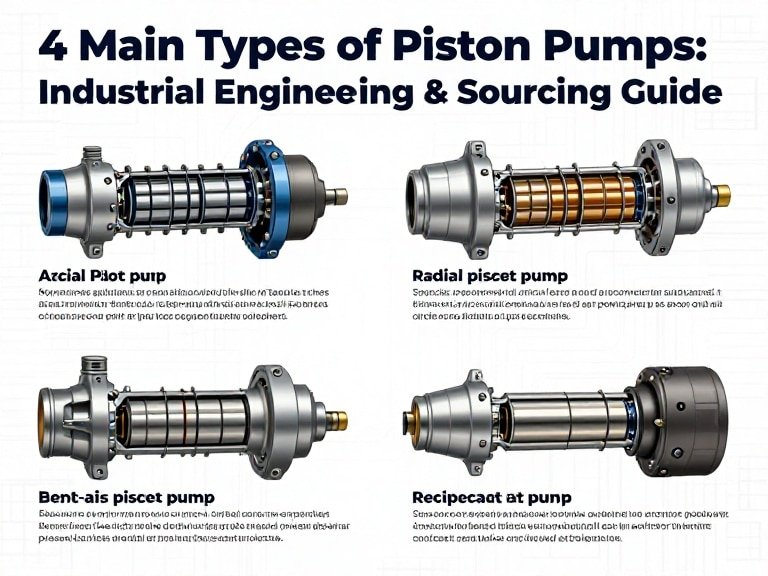
However, treating all reciprocating designs as interchangeable mechanical hardware causes catastrophic plant downtime. In our testing across heavy manufacturing plants, oil refineries, and pharmaceutical dosing suites, installing the incorrect pump class leads to packing blowout within 200 operational hours, pressure pulsation harmonics that crack pipe manifolds, and parasitic motor loads that destroy energy budgets. Understanding how the four primary types of piston pumps differ in cylinder arrangement, displacement geometry, and valve design is critical to choosing the correct equipment for your system.
Quick Answer: The 4 Main Types of Piston Pumps
The four primary types of piston pumps found in modern industrial, hydraulic, and process applications are: (1) Axial Piston Pumps (swashplate and bent-axis designs dominating high-pressure mobile and industrial hydraulic systems); (2) Radial Piston Pumps (eccentric-shaft configurations delivering continuous ultra-high pressures up to 700 bar in heavy industrial presses); (3) Reciprocating Force / Plunger Pumps (multi-cylinder and metering pumps where stationary packing enables extreme process pressures, waterjet cutting, and micro-dosing); and (4) Reciprocating Lift Piston Pumps (classical valve-in-piston configurations used for deep-well suction lifting, non-pressurized drainage, and viscous slurry transfer). For variable-speed hydraulic circuits, axial piston units are the industry benchmark; for continuous chemical dosing or ultra-high-pressure fluids above 500 bar, reciprocating plunger architectures utilizing ceramic wear surfaces deliver the lowest total lifecycle cost.
Article Directory
- What Is a Piston Pump and How Does Positive Displacement Work?
- Quick Summary Table: The 4 Types of Piston Pumps at a Glance
- In-Depth Analysis: The 4 Main Types of Piston Pumps
- Advanced Material Feature: Custom Ceramic Manufacturing Services
- Direct Technical Comparison of Piston Pump Architectures
- Pros and Cons: Piston Pump Technology vs. Alternative Displacement Pumps
- Who Needs a Piston Pump (And Who Should Choose Other Technologies)
- Costly Engineering & Operational Mistakes
- B2B Procurement & Sourcing Considerations
- Frequently Asked Questions
- Authoritative References & Technical Standards
What Is a Piston Pump and How Does Positive Displacement Work?
A piston pump is a reciprocating positive displacement machine that traps a fixed volume of fluid inside an enclosed cylinder and forces it into a discharge line against system resistance. Unlike dynamic centrifugal machinery, which converts kinetic energy into pressure head via rotating impellers, a piston pump operates purely on volumetric displacement. The liquid throughput remains almost entirely independent of the discharge head pressure, governed strictly by stroke length, cylinder bore diameter, cycling frequency, and seal efficiency.
The operational mechanics follow two distinct phases during each shaft revolution or drive cycle:
- The Suction Phase: As the piston or plunger retracts within the barrel, the internal volume of the chamber expands. This generates localized negative differential pressure (a partial vacuum). Atmospheric or feed pressure pushes fluid through the suction check valve, filling the expanding cylinder bore while the discharge check valve remains seated under backpressure.
- The Discharge Phase: Upon reaching the bottom dead center (BDC) or maximum displacement stroke, the drive mechanism reverses direction. The advancing piston exerts compressive mechanical force onto the trapped, incompressible liquid. Fluid pressure spikes instantly, forcing the suction valve closed against its seat and lifting the discharge check valve, propelling fluid into the delivery manifold.
In all types of piston pumps, volumetric efficiency ($\eta_v$) routinely exceeds 90% to 98% under optimized conditions. However, the moving boundaries require tight mechanical clearances. Because fluid cannot bypass the advancing piston face, operating any of these units against a closed discharge line without an overpressure relief valve causes rapid mechanical destruction, sheared drive pins, or burst pipe manifolds.
Quick Summary Table: The 4 Types of Piston Pumps at a Glance
| Pump Type | Displacement Alignment | Pressure Capability | Volumetric Flow Range | Primary Industrial Role |
|---|---|---|---|---|
| 1. Axial Piston Pump | Parallel to drive shaft (Swashplate / Bent Axis) | 250 to 450 bar (3,600 to 6,500 PSI) | 10 to 1,000+ L/min | Mobile construction hydraulics, aerospace actuation, plastic injection molding |
| 2. Radial Piston Pump | Perpendicular to drive shaft (Radial star arrangement) | 400 to 700+ bar (5,800 to 10,000+ PSI) | 5 to 250 L/min | Ultra-high-pressure hydraulic presses, marine winches, forging plants |
| 3. Reciprocating Force / Plunger Pump | Linear in-line (Direct displacement rod with fixed packing) | 100 to 3,000+ bar (1,500 to 43,000+ PSI) | 0.001 to 3,500 L/min | Chemical metering, reverse osmosis, oilfield fracturing, waterjet cutting |
| 4. Reciprocating Lift Piston Pump | Linear vertical (Valve embedded in moving piston head) | 1 to 10 bar (15 to 145 PSI) | 5 to 150 L/min | Suction-lift water extraction, manual dewatering, non-pressurized sludge transfer |
In-Depth Analysis: The 4 Main Types of Piston Pumps
1. Axial Piston Pumps (Swashplate & Bent-Axis)
Axial piston pumps are the undisputed workhorses of modern fluid power engineering. In this design, multiple pistons (typically an odd number such as 7 or 9 to minimize flow ripple) are arranged in a circular barrel parallel to or angled slightly along the central drive shaft centerline. They are subdivided into two major mechanical configurations:
- Swashplate Design: The cylinder barrel rotates in tandem with the input shaft. The piston shoes rest against an angled, non-rotating swashplate. As the cylinder barrel turns, the shoes follow the incline of the swashplate, forcing the pistons to reciprocate into and out of their respective bores. By adjusting the angle of the swashplate via an internal servo spool or proportional valve, operators can continuously modulate fluid output from 0% to 100% without altering motor RPM.
- Bent-Axis Design: The cylinder block itself is tilted at an angle relative to the drive shaft flange. Spherical connecting rods link the pistons to the drive shaft. As the shaft rotates, the angle forces the pistons to stroke. Bent-axis units deliver superior mechanical efficiency at fixed angles, but they require heavier mechanical casings.
From our experience on hydraulic power units (HPUs), axial piston pumps are the preferred choice when system dynamics require variable displacement, load-sensing circuits, or high power density in confined footprints. In our testing, their primary vulnerability is fluid contamination. Because piston shoes glide across the swashplate on an ultra-thin hydrodynamic fluid film measured in microns, abrasive silica or metallic particulates in the oil cause rapid scoring, resulting in internal case drain leakage and sudden pressure collapse.
2. Radial Piston Pumps
When continuous operating pressures exceed 400 bar and reliability cannot be compromised, engineers specify radial piston pumps. In this layout, the pistons are arranged radially like the spokes of a wheel around an eccentric drive cam or crankshaft. As the drive shaft rotates, the eccentric cam drives each piston outward during its discharge stroke, while return springs or guide rings retract the pistons during the suction stroke.
Radial piston pumps fall into two configurations: rotating cylinder or rotating cam. The rotating cam design is far more common in heavy industrial facilities because the cylinder block remains stationary, allowing valve ports to be built with rugged, self-contained poppet check valves rather than delicate distributor valve plates. This design gives radial piston pumps remarkable fluid tolerance. They handle low-viscosity fluids (such as water glycol or synthetic esters) and operate reliably at low rotational speeds down to single-digit RPMs where hydrodynamic lubrication in axial pumps breaks down. However, radial pumps are physically massive, heavy, and significantly more expensive to manufacture than axial units.
3. Reciprocating Force / Plunger Pumps
While axial and radial units rule closed-loop oil hydraulics, the reciprocating force or plunger pump dominates process engineering, chemical handling, and ultra-high-pressure fluid injection. In this category, the distinction between a true piston and a plunger is vital:
- Piston Pump (Piston Style): The flexible seal (such as an O-ring, U-cup, or leather cup) is mounted directly to the moving piston head and moves back and forth against the honed inner cylinder wall.
- Plunger Pump (Plunger Style): The moving element is a smooth, ground solid cylindrical rod (the plunger) that strokes through a stationary packing seal assembly fixed within the stationary manifold housing.
Because the high-pressure packing seals remain stationary in a plunger design, engineers can compress multiple stages of PTFE, braided Kevlar, or elastomeric V-rings using threaded gland nuts. This architecture accommodates massive operating pressures that would instantly blow a moving piston seal off its hub. Standard industrial configurations utilize multi-cylinder manifolds—such as triplex (3 cylinders) or quintuplex (5 cylinders)—driven by a heavy crankshaft and connecting rods to smooth out reciprocating flow pulses.
In applications involving aggressive chemicals, abrasive slurries, or micro-dosing, standard metallic plungers fail rapidly from pitting and scratching. Upgrading to a specialized Ceramic plunger pump eliminates chemical oxidation and scoring, extending seal operational life by up to 600%. For precision medical dosing and dialysis fluids, deploying a dedicated Medical Ceramic Pump, Dialysis Ceramic Pump, or Microliter Ceramic Metering Pump delivers sub-microliter volumetric repeatability that flexible seals cannot maintain.
4. Reciprocating Lift Piston Pumps
The lift piston pump is historically the earliest form of positive displacement machine, yet it remains vital for low-pressure extraction, groundwater recovery, manual dewatering, and non-pressurized viscous fluid lifting. Unlike force pumps, which push fluid through an external manifold, a lift pump incorporates an internal intake check valve mounted directly inside the moving piston head itself.
During the downstroke, fluid trapped in the lower cylinder passes through the open piston valve into the chamber above the piston head. When the piston moves upward, the piston check valve slams shut under the weight of the fluid column. The rising piston physically lifts the liquid upward out of the discharge spout while simultaneously drawing a fresh charge of fluid into the lower cylinder below through a base foot valve. Lift pumps are limited to low-pressure applications (rarely exceeding 5 to 10 bar) and are governed by atmospheric suction lift limits (theoretically 10 meters, practically 6 to 7 meters at sea level). However, their mechanical simplicity makes them resilient for rural water supply and manual priming circuits.
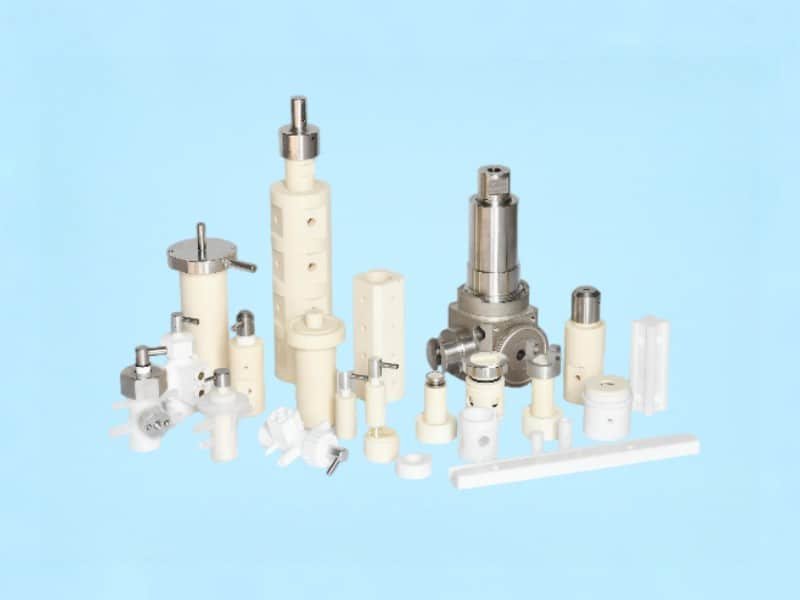
Advanced Wear Component Spotlight: JuchangCeramic Solutions
Regardless of whether you operate axial, radial, or reciprocating plunger systems, the primary mechanical bottleneck in positive displacement machinery is sliding friction and chemical wear between the piston surface and its sealing boundary. JuchangCeramic provides professional OEM and custom fabrication of high-hardness, wear-resistant ceramic components engineered to replace failure-prone metal parts across challenging fluid processes.
| Engineering Core | Custom manufacturing of high-purity alumina (99.5% to 99.8% Al2O3) and Yttria-stabilized zirconia (Y-TZP) plungers, pistons, and valve seats |
| Surface Metrology | Precision diamond-ground mirror finishes with surface roughness down to Ra < 0.1 μm, eliminating seal wear |
| Thermal & Chemical Range | 100% immune to acid/alkali pitting; operational thermal stability exceeding 1,000°C |
| Specialized Flow Modules | Complete assemblies including high-precision Ceramic Pump platforms, rotary valving via the Ceramic Rotary Valve, and compact Miniature Ceramic Pump units |
Engineering Recommendation: Consult JuchangCeramic’s custom ceramic machining services to retrofit high-wear stainless steel plungers with precision-ground ceramic rods, slashing annual maintenance overhead.
Direct Technical Comparison of Piston Pump Architectures
| Technical Parameter | Axial Piston (Swashplate) | Radial Piston | Reciprocating Plunger (Triplex) | Lift Piston Pump |
|---|---|---|---|---|
| Max Continuous Pressure | 350 – 420 bar | 500 – 700+ bar | 1,500 – 3,000+ bar | 2 – 8 bar |
| Displacement Control | Variable (Continuous swashplate modulation) | Fixed or Variable (Eccentric stroke adjustment) | Fixed (Variable only via VFD motor control) | Fixed (Manual or mechanical crank stroke) |
| Input Speed Capability | High (1,200 – 3,600 RPM) | Moderate (300 – 1,800 RPM) | Low to Moderate (150 – 600 RPM) | Low (10 – 100 strokes/min) |
| Contamination Tolerance | Very Low (Requires ISO 18/16/13 oil cleanliness) | Moderate (Poppet valves tolerate minor debris) | High (Withstands slurries and particulates) | High (Handles suspended solids and grit) |
| Acoustic Noise Generation | Moderate to High (72 – 85 dB) | Moderate (68 – 78 dB) | High (Pulsation harmonics require dampeners) | Very Low (Slow manual/mechanical cycle) |
| Capital Cost vs. Service Life | Moderate cost / High performance | High cost / Extremely long service life | Moderate to High / Modular seal rebuilds | Low cost / Basic mechanical longevity |
Pros and Cons: Piston Pump Technology vs. Alternative Displacement Pumps
| Equipment Class | Operational & Commercial Pros | Engineering Limitations & Drawbacks |
|---|---|---|
| Piston / Plunger Pumps (All 4 Combined Architectures) |
|
|
| Rotary Gear & Vane Pumps (Rotary Positive Displacement) |
|
|
| Centrifugal Pumps (Dynamic Non-Displacement) |
|
|
Who Needs a Piston Pump (And Who Should Choose Other Technologies)
Every dollar in capital expenditure must be justified by process requirements. Sizing positive displacement machinery without auditing fluid viscosity, duty cycles, and particulate loading leads directly to maintenance headaches.
Who Must Specify Piston or Plunger Pumps:
- Mobile and Industrial Hydraulic System Integrators: If you are powering high-tonnage excavator booms, injection molding clamps, or marine steering gear operating at 250 to 420 bar, axial piston pumps are required. Gear and vane pumps cannot handle these operating pressures without internal gear tooth flexing and severe efficiency loss.
- High-Pressure Process and Chemical Injection Facilities: Desalination plants pushing seawater through reverse osmosis membranes, refinery chemical injection skids, and boiler feedwater systems operating above 100 bar require multi-cylinder plunger pumps. Exploring the ceramic plunger vs metal plunger comparison shows why process plants running 24/7 operations replace coated steel with engineering ceramics to prevent seal degradation.
- Precision Medical, Analytical, and Battery Dosing Engineers: Dispensing electrolyte slurry into lithium-ion battery cells or metering reagents into diagnostic analyzers requires sub-microliter volumetric repeatability. Utilizing high-hardness Zirconia Ceramic Structural Part components or specialized rotary piston units ensures zero volume drift over millions of continuous dispense cycles.
Who Should Avoid Piston Pumps (And Choose Alternatives):
- Bulk Low-Pressure Fluid Transfer Operations: If your task is moving diesel, water, or light solvents between storage tanks at pressures below 5 bar, a piston pump is an over-engineered mistake. Centrifugal or air-operated double diaphragm (AODD) pumps deliver higher flow rates at a fraction of the cost.
- High-Viscosity Resins, Glues, and Bitumen Handlers: Pumping thick fluids with viscosities exceeding 10,000 cP will starve suction check valves, preventing poppets from seating properly. Progressive cavity or external gear pumps are specifically engineered to handle high-viscosity pastes without shear thinning or valve choking.
- Pulsation-Sensitive Analytical Lines Without Dampeners: If an instrumentation line requires perfectly laminar, ripple-free flow without installing hydraulic accumulators or pulse dampeners, gear or syringe pumps provide smoother fluid delivery.
Costly Engineering & Operational Mistakes
Field Failure Warning: The most catastrophic failure across all types of piston pumps is running dry or starving the suction port. Unlike centrifugal pumps that can churn air in their housing, a dry piston pump experiences instant metal-on-metal or ceramic-on-seal frictional heating, destroying packing rings and galling pistons within 60 seconds.
- Ignoring Net Positive Suction Head Available (NPSHa): Reciprocating pistons accelerate fluid rapidly during each suction stroke. If your suction piping is undersized, too long, or has too many elbows, dynamic pressure drops below the fluid’s vapor pressure. The fluid boils locally, causing cavitation bubbles that implode violently against the piston face during discharge, pitting the cylinder head and cracking valve discs.
- Failing to Install Adequate Overpressure Protection: Positive displacement pumps do not stall when a line is blocked. If an operator closes a downstream valve while a plunger pump is running, pressure spikes exponentially within milliseconds until the motor trips on overload, the manifold cracks, or a high-pressure hose bursts. Every piston installation requires an upstream proportional pressure relief valve piped back to the supply reservoir.
- Operating Metal Plungers in Abrasive Slurries: Running standard 316 stainless steel or hard-chrome-plated plungers in fluids containing fine silt, titanium dioxide, or crystalline salts results in surface grooving within weeks. Reviewing an engineering ceramics material guide shows how transitioning to high-purity alumina ceramic plungers eliminates surface grooving, cutting packing wear and extending maintenance intervals.
- Neglecting Pulsation Dampener Sizing and Nitrogen Precharge: Because reciprocating pumps move fluid in pulses, installing a triplex or quintuplex pump without properly precharging the discharge pulsation dampener sends hydraulic shock waves down your pipeline. These pressure spikes loosen pipe brackets, cause flange gasket leaks, and cause premature valve fatigue.
B2B Procurement & Sourcing Considerations
When issuing a Request for Proposal (RFP) for industrial piston or plunger pumps, look beyond baseline flow and pressure ratings. Evaluate prospective manufacturers across these four critical engineering criteria:
1. Metallurgy, Hardness, and Plunger Surface Metrology
Inquire about the specific base materials used for pistons, cylinders, and valve seats. For hydraulic axial and radial pumps, verify whether cylinder blocks are centrifugally cast bronze or nitrided ductile iron. For chemical process plunger pumps, evaluate the fluid contact components. Sourcing systems through established industrial ceramic solutions for pumps ensures components are ground to diamond-grade tolerances ($Ra < 0.2\ \mu\text{m}$) using stabilized zirconia or dense alumina, protecting against acid corrosion and physical scoring.
2. Manifold Design: Monoblock vs. Split Cylinder Heads
Under continuous pressures exceeding 700 bar, internal stress concentrations can crack standard welded or sand-cast manifolds. Ensure high-pressure pumps utilize forged stainless steel or nickel alloy monoblock fluid ends with radius-drilled fluid cross-bores. Split-manifold architectures offer cheaper component replacement, but monoblock forgings deliver superior fatigue resistance under continuous cyclic pressure loads.
3. Valve Configuration: Spherical Ball vs. Spring-Loaded Poppet
Valve geometry governs volumetric efficiency at high cycling speeds. Ball check valves are reliable for viscous fluids and low speeds, but their high inertia limits cycling speed. High-speed triplex and axial plunger systems require low-inertia, guided disc or conical poppet valves made from titanium, Stellite, or hardened ceramics to ensure instant closure at speeds above 300 RPM.
4. Compliance with Rigorous Industry Standards
Confirm that your equipment manufacturer complies with relevant industrial standards:
- Petrochemical & Refining: Compliance with API 674 (Positive Displacement Pumps – Reciprocating), which mandates heavy-duty crankshaft bearing lifespans ($L_{10} > 50,000$ hours) and rigid crosshead guides.
- Fluid Power Hydraulics: Performance verified to ISO 4409 and dimensional mounting following ISO 3019 (flange and shaft configurations).
- Clean-in-Place & Medical: Adherence to 3-A Sanitary Standards and FDA CFR 21 material certifications for pharmaceutical fluid dosing.
Expert Engineering Recommendation
In our professional assessment, if your hydraulic system requires rapid power adjustments, variable load sensing, and high packaging density, an Axial Piston Pump is the definitive choice. For continuous pressures above 500 bar in heavy stationary equipment, a Radial Piston Pump delivers unmatched durability that justifies its higher initial cost.
If your application involves high-pressure process fluids, reverse osmosis, chemical injection, or precise liquid dosing, avoid rotary pumps and install an in-line Reciprocating Plunger Pump. To protect your investment, replace soft metal plungers with precision-engineered ceramic wear components. Upgrading to solid alumina or zirconia ceramic plungers through specialized suppliers like JuchangCeramic resolves the root cause of positive displacement maintenance: seal degradation and sliding abrasive wear. This upgrade maximizes continuous system uptime, protects pump manifolds, and provides dependable, maintenance-free performance across millions of operational cycles.
Frequently Asked Questions
The four main types of piston pumps utilized across fluid power and process engineering are: (1) Axial Piston Pumps (swashplate and bent-axis architectures), (2) Radial Piston Pumps (eccentric-driven radial pistons), (3) Reciprocating Force / Plunger Pumps (high-pressure multi-cylinder and metering systems), and (4) Reciprocating Lift Piston Pumps (suction lift with internal check-valve pistons).
In a standard piston pump, the flexible seal or piston ring is attached directly to the moving cylindrical body and travels along the bore wall. In a plunger pump, the smooth cylindrical rod (the plunger) passes through a stationary high-pressure packing seal fixed within the cylinder head. Plunger pumps accommodate significantly higher operating pressures (often exceeding 1,000 bar) because stationary seals support robust compressive mechanical packing.
Ceramic plungers manufactured from high-purity alumina or yttria-stabilized zirconia eliminate frictional galling, resist chemical corrosion from aggressive slurries, and possess a diamond-like surface finish (Ra under 0.2 microns). In our testing, ceramic plungers extend packing seal lifespan by three to six times compared to hard-chromed stainless steel.
Specify an axial piston pump when the system demands compact packaging, variable displacement control (via swashplate angle modulation), high rotational input speeds (up to 3,600 RPM), and operating pressures between 250 and 420 bar. Specify a radial piston pump when the application requires continuous ultra-high hydrostatic pressures up to 700 bar, robust operation at low rotational speeds, or extreme dirt tolerance.
Authoritative References & Technical Standards
- International Organization for Standardization: ISO 4409 Hydraulic Fluid Power – Positive Displacement Pumps, Motors and Integral Transmissions
- American Petroleum Institute: API Standard 674 – Positive Displacement Pumps – Reciprocating for Petroleum and Gas Industries
- National Fluid Power Association (NFPA): Industrial Fluid Power and Positive Displacement Pump Performance Guidelines