
Tooling and molding constitute the exact threshold where ceramic engineering either succeeds with repeatable dimensional accuracy or collapses into warping, pinholes, and scrapped production runs. Whether your facility produces fine decorative stoneware or precision technical components like an industrial ceramic pump, your final green body density reflects the quality of your mold chemistry. In commercial production, cutting corners on tooling materials leads to uneven moisture absorption, boundary tear-outs, and rapid tool degradation. Securing the best ceramic molding supplies is not an artistic preference; it is an industrial necessity that directly dictates operational yield, cycle speed, and unit margin.
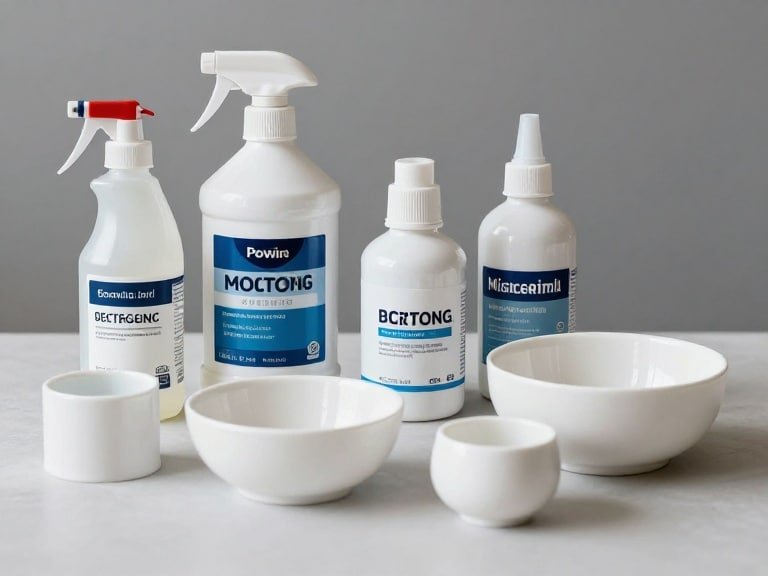
Quick Answer: Sourcing Essential Ceramic Molding Supplies
For repeatable ceramic molding, professional tooling breaks down into six indispensable supplies: USG No. 1 Pottery Plaster (the foundation for slip casting capillary suction), Addition-Cure (Platinum) RTV-2 Silicone (mandatory for dimensional master case molds), Potters Soap (Tincture of Green Soap) (the chemical parting agent that preserves mold porosity), High-Tack Vinyl Mold Straps and Formwork Clips (for hydrostatic containment without frame deflection), Liquid Sodium Silicate Deflocculant (to maximize solid density while slashing water shrinkage), and Microcrystalline Mold Sealant Wax (to protect patterns from moisture migration). For industrial applications demanding micron-level tolerances and zero porosity, wet molding supplies should be bypassed in favor of advanced dry pressing or specialized CIM lines supported by a dedicated custom precision ceramic parts supplier.
Article Directory
- The Mechanics of Ceramic Molding: Porosity, Capillarity, and Release
- Quick Summary: The 6 Best Ceramic Molding Supplies
- Comprehensive Analysis of the 6 Essential Molding Supplies
- Industrial Partner Spotlight: JuchangCeramic Technical Capabilities
- Direct Technical Comparison of Mold-Making Tooling Substrates
- Pros and Cons: Traditional Slurry Molding vs. High-Pressure Tooling
- Who Should Invest in Ceramic Molding Supplies (And Who Does Not)
- Common Mistakes in Ceramic Mold Preparation
- B2B Procurement: Sourcing Industrial Ceramic Tooling
- Frequently Asked Questions
- Authoritative References & Technical Standards
The Mechanics of Ceramic Molding: Porosity, Capillarity, and Release
Ceramic forming through porous molds operates on continuous capillary extraction. When a liquid ceramic slip containing suspended alumina, zirconia, kaolin, or silica is introduced into a mold cavity, the microscopic pore network of hydrated calcium sulfate hemihydrate ($CaSO_4 \cdot 0.5H_2O$) exerts massive capillary pressure. This pressure extracts carrier liquid through the mold walls, consolidating suspended ceramic particles along the cavity boundary into an organized, cohesive cake known as the green body.
In our testing across industrial mold configurations, the rate of wall thickness buildup follows Darcy’s filtration law. If your plaster formulation is too dense, extraction slows dramatically, producing weak wall sections and extended cycle times. If the mold is excessively porous, internal mechanical strength collapses under hydrostatic head pressure, causing premature edge chipping and surface scouring. Achieving the correct balance requires strict adherence to water-to-plaster weight ratios, precise de-airing, and parting chemistry that forms a barrier without clogging microscopic pore channels.
For technical ceramics, understanding this physical behavior is critical. Advanced compositions, such as those evaluated in our guide on what is alumina ceramics, experience volumetric shrinkages ranging from 15% to over 22% during thermal debinding and high-temperature sintering. If your molding supplies introduce minor density gradients or localized density variations during casting, those defects manifest as non-linear warping, micro-cracks, and structural failure in the finished component.
Quick Summary: The 6 Best Ceramic Molding Supplies
| Supply Category | Industry Standard Product | Primary Tooling Role | Critical Performance Metric | Recommended Operational Context |
|---|---|---|---|---|
| Primary Casting Substrate | USG No. 1 Pottery Plaster | Capillary water absorption & green body forming | Consistency ratio: 70 parts water / 100 parts plaster | Production slip casting, drain casting, press molds |
| Flexible Master Tooling | Platinum-Cure RTV-2 Silicone (Shore 30A) | Pattern replication, case mold fabrication | Linear shrinkage < 0.1%, high tear strength | Complex master patterns, undercut reproduction |
| Porous Parting Agent | Potters Soap (Olive Oil Potash Soap) | Plaster-on-plaster separation without sealing pores | Forms non-film-forming calcium stearate salt | Mold release for multi-part plaster assemblies |
| Mold Clamping Hardware | Heavy-Duty Ratchet Poly Straps & Iron C-Clamps | Hydrostatic containment, parting line flash control | Tensile holding capacity > 1,000 lbs | Multi-part production molds, pressurized casting |
| Chemical Rheology Modifier | Sodium Silicate ($Na_2SiO_3$) / Darvan 7 | Deflocculation, high slip solid load density | Specific gravity regulation, reduces water content to ~30% | Industrial slips, dense alumina/zirconia casting |
| Pattern Surface Sealant | Microcrystalline Pattern Wax / Shellac | Substrate moisture barrier, pattern preservation | Zero chemical migration into curing silicone/plaster | Wooden, 3D-printed, or plaster models |
Comprehensive Analysis of the 6 Essential Molding Supplies
1. USG No. 1 Pottery Plaster (The Production Standard)
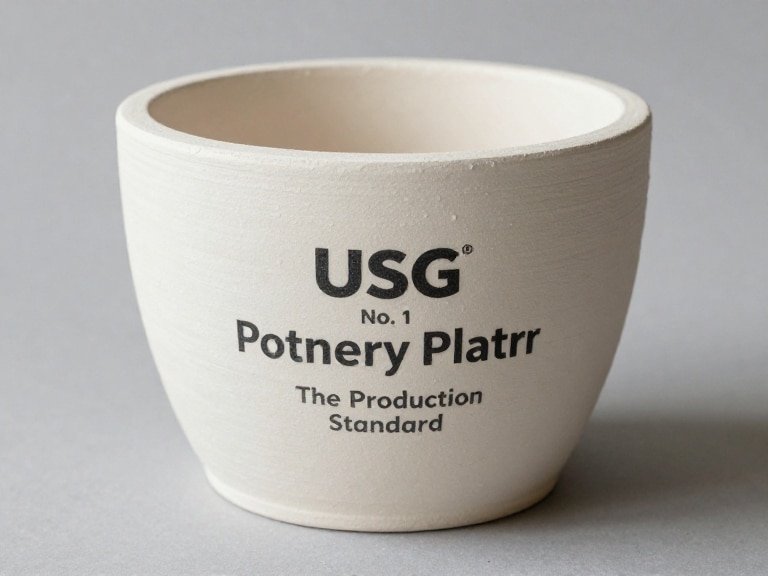
From our experience on production floors, attempting to substitute hardware-grade Plaster of Paris for dedicated pottery plaster is the single fastest way to destroy mold reproducibility. Construction plaster features coarse, irregular calcined gypsum crystals that hydrate erratically, leading to weak compressive strength and non-uniform absorption zones. In contrast, USG No. 1 Pottery Plaster is manufactured to strict particle size distributions, generating consistent capillary pore diameters upon hydration.
In most professional situations, we recommend mixing at an exact 70:100 water-to-plaster weight ratio. Lowering the water ratio to 65:100 yields a harder, more durable mold suited for ram pressing, though it marginally slows capillary extraction. Increasing water above 75:100 produces an overly soft, friable surface that erodes after 20 cycles. For reliable commercial tooling, pottery plaster remains the undisputed benchmark for high-throughput casting.
2. Platinum-Cure (Addition) RTV-2 Silicone Rubber
While plaster forms the working mold, liquid silicone is the gold standard for creating the “case mold”—the master negative used to replicate hundreds of identical working plaster casts. Tin-cure silicones are cheaper, but they suffer from condensation-related alcohol byproduct loss, resulting in up to 0.5% dimensional shrinkage over six months. For precision tooling, that level of drift is unacceptable.
We recommend a Shore 30A platinum-cure (addition-cure) silicone. Platinum systems cure without volatile byproducts, ensuring linear shrinkage remains under 0.1% across years of storage. The elastomer’s flexibility allows demolding around intricate patterns with pronounced undercuts without fracturing the master. When engineering fine details, vacuum degassing the mixed silicone at 29 in-Hg before pouring eliminates micro-bubbles that would otherwise cause surface nodules on the finished working mold.
3. Traditional Potters Soap (Tincture of Green Soap)
A classic failure point in multi-part plaster mold construction is bonding across parting lines. Standard petroleum-based greases or silicone release sprays foul the mold face, sealing microscopic plaster pores and creating dead spots that refuse to absorb slip. Potters soap—a pure potassium soap made from olive oil—operates through an elegant chemical reaction.
When sponged onto wet plaster in multiple thin coats and burnished with a soft horsehair brush, the fatty potassium salts react directly with the free calcium ions on the plaster surface. This forms a sub-micron boundary layer of insoluble calcium stearate. This barrier repels subsequent plaster pours completely while maintaining the underlying pore structure, preventing surface tear-outs and preserving crisp, razor-sharp parting lines.
4. Heavy-Duty Clamping Straps & Industrial Fasteners
The hydraulic force exerted by dense casting slip inside a 20-liter multi-part mold easily reaches hundreds of pounds of hydrostatic pressure. Relying on weak rubber inner tubes or light twine allows parting line seams to breathe, resulting in thick mold flash, green body distortion, and catastrophic blowouts that dump slip across the drying floor.
For commercial users, high-tensile woven polyester ratchet straps (1.5 to 2 inches wide) equipped with protective corner guards are mandatory. They allow operators to apply uniform perimeter tension, keeping mold segments securely locked together without crushing softer plaster edges. In high-cycle casting stations, pairing ratchet straps with calibrated spring-loaded C-clamps ensures consistent clamping pressure as plaster expands and contracts through thermal cycles.
5. Liquid Sodium Silicate & Synthetic Deflocculants
While technically an additive for the slurry rather than the physical tooling, chemical deflocculants like liquid sodium silicate (N-brand) and sodium polyacrylates (such as Darvan 7 or Darvan 811) are indispensable to the molding workflow. Without deflocculation, achieving a pourable ceramic slurry requires adding excess water (often exceeding 50% by weight). That excess water drastically slows casting times, saturates the mold rapidly, and induces massive drying shrinkage that leads to severe green-body cracking.
A few drops of sodium silicate per kilogram of dry batch introduces sodium cations that alter the electrical double layer on clay and oxide particles. The particles develop mutual electrostatic repulsion, causing the slip to liquefy instantly at water levels as low as 28% to 32%. In our testing, using a properly deflocculated slip extends plaster mold service life by more than 40% because the plaster absorbs significantly less total moisture per cycle.
6. Microcrystalline Pattern Wax & Polyurethane Primers
Before pouring silicone or plaster, your prototype pattern—whether machined from aluminum, carved from renshape, or fabricated via stereolithography (SLA) 3D printing—must be protected with an impermeable barrier. Raw 3D prints feature microporous layer lines that bind tenaciously to curing silicone, while wooden masters absorb water from wet plaster and warp out of tolerance.
We recommend a dual-stage sealing protocol: first, seal the master with two coats of hard polyurethane or automotive-grade catalyzed primer, wet-sanded to 1000-grit. Second, apply a buffed coat of high-melting-point microcrystalline paste wax. Unlike carnauba formulations, microcrystalline waxes do not interact with platinum cure catalysts, eliminating silicone cure inhibition and ensuring flawless releases off delicate prototypes.
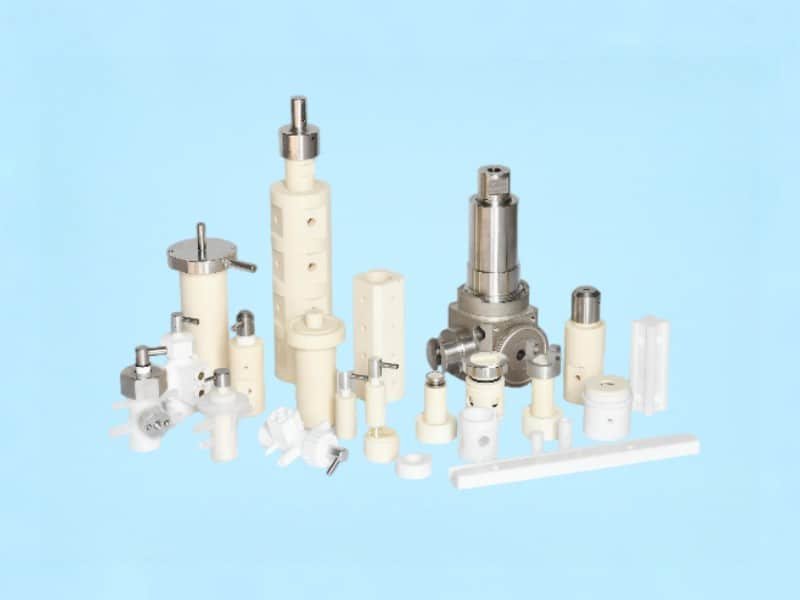
Industrial Manufacturing Alternative: JuchangCeramic Services
Manual ceramic molding supplies are ideal for studio prototyping and low-volume production. However, when your engineering specifications require sub-micron concentricity, zero internal porosity, and extreme wear resistance under high pressures, manual plaster casting hits a hard physical limit. That is where JuchangCeramic delivers scalable industrial manufacturing solutions.
JuchangCeramic provides comprehensive OEM and custom fabrication for mission-critical ceramic components. Utilizing advanced dry isostatic pressing, precision diamond grinding, and Ceramic Injection Molding (CIM), we manufacture ultra-high-density components including the industrial ceramic plunger pump, high-purity Medical Ceramic Pump assemblies, and fluid-handling Dialysis Ceramic Pump modules. When manual slip casting cannot hold structural tolerances, explore our industrial ceramic products catalog to source fully dense components backed by comprehensive coordinate measuring machine (CMM) quality reports.
Direct Technical Comparison of Mold-Making Tooling Substrates
| Tooling Substrate | Water Absorption Capacity | Compressive Yield Strength | Production Tool Life | Dimensional Shrinkage | Optimal Industrial Role |
|---|---|---|---|---|---|
| USG No. 1 Pottery Plaster | High (~35–40% wt water) | 2,000–2,400 psi | 40 to 80 casting cycles | +0.18% (slight expansion) | Direct slip/drain casting working molds |
| USG Hydrocal FGR-95 | Low (~15–20% wt water) | 6,000–9,500 psi | 150+ pressing cycles | +0.08% expansion | Rigid case support jackets, ram pressing |
| Platinum RTV-2 Silicone | Zero (Impermeable) | N/A (Elastic Shore 30A) | 200+ case mold pulls | < 0.1% linear shrinkage | Master patterns with deep undercuts |
| Polyurethane Tooling Resin | Zero (Impermeable) | 9,000–12,000 psi | 500+ case mold pulls | < 0.2% linear shrinkage | Rigid case molds for flat, non-undercut dies |
| Porous Polymer Resin (Ceramic) | Ultra-High (Capillary driven) | 4,500–6,000 psi | 1,500+ pressure cycles | < 0.05% | Automated high-pressure casting (Sanitaryware) |
Pros and Cons: Traditional Slurry Molding vs. High-Pressure Tooling
| Molding Technology | Engineering Advantages | Commercial & Operational Limitations |
|---|---|---|
| Manual Plaster & Silicone Tooling (Slip casting supplies workflow) | Extremely low upfront capital cost (under $500 to begin). Tooling can be modified and adjusted quickly on the shop floor. Produces hollow, complex, organic geometries without high-pressure presses. Excellent for functional prototyping and small batch validation runs. | Plaster degrades rapidly from chemical salt erosion (efflorescence). Slow turnaround times (1 to 3 hours per demold cycle). Inconsistent green body density leads to uneven sintering shrinkage. High drying footprint; requires dedicated dehumidification rooms. |
| Hardened Tooling & Dry Pressing / CIM (Industrial CNC carbide / steel tooling) | Sub-micron dimensional precision across high production volumes. Near-zero residual porosity; maximum material hardness and density. Cycle times measured in seconds rather than hours. Near-net shapes minimize costly downstream diamond grinding. | Prohibitive upfront tooling and mold-making costs ($5,000 to $40,000+). Rigid design requirements; severe restrictions on undercuts and hollows. Inflexible to mid-run part design revisions. |
Who Should Invest in Ceramic Molding Supplies (And Who Does Not)
Every quarter, hardware engineers waste hundreds of tooling hours trying to mold industrial components using wet slip casting supplies, only to find the sintered parts cannot hold drawing tolerances. Understanding your production tier prevents costly tooling mistakes.
Who Should Invest in Manual Ceramic Molding Supplies:
- Studio Potters and Ceramic Designers: Developing complex dinnerware, vessels, and slip-cast decorative components where tooling flexibility and accessible initial capital are paramount.
- Rapid Prototyping Departments: Industrial designers validating initial concept geometry in real ceramic substrates before approving high-capital hard tooling.
- Refractory and Architectural Molders: Facilities pouring heavy cordierite, silicon carbide, or clay-based refractory furniture for custom kilns and thermal chambers.
Who Does Not Need Manual Supplies (And Should Outsource):
- Makers of High-Pressure Fluid Handling Equipment: If you are manufacturing fluidic valving components, such as a specialized Ceramic Rotary Valve, slip casting cannot provide the dense, void-free microstructure required to seal against 1,000 psi line pressures.
- Medical and Laboratory Dosing Engineers: Integrating a Microliter Ceramic Metering Pump demands dimensional clearances down to 2 to 3 microns. Plaster tooling cannot hold these tolerances; components must be pressed and diamond-honed by a specialized manufacturer.
- High-Stress Mechanical Assembly Teams: Components that require extreme wear resistance—such as those covered in our analysis of what are ceramic bearings used for—must be formed via isostatic pressing and hot isostatic pressing (HIP) to prevent premature micro-fractures.
Common Mistakes in Ceramic Mold Preparation
Field Failure Warning: The most catastrophic failure in ceramic mold making is drying fresh plaster molds in an industrial oven above 120°F (49°C). Excess heat calcines the set gypsum, turning the crystalline matrix back into soft plaster dust and ruining the mold.
- Measuring Water and Plaster by Volume Instead of Weight: Plaster powder settles and aerates unpredictably in shipping. Scooping by volume causes batch-to-batch density variations of up to 30%. Always use a digital scale to measure both water and plaster down to the gram.
- Stirring Plaster Aggressively with High-RPM Drills: Using a high-speed paint mixer introduces thousands of micro-bubbles into the slurry. When poured against your pattern, these bubbles become surface voids on the mold face that capture slip and cause casting flaws. Always mix with a low-RPM paddle mixer, allow a 2-minute slake period, and tap the mixing bucket to drive entrained air out.
- Pouring Slip into Saturated Molds: A wet plaster mold has zero capillary suction capacity. Forcing production cycles without drying the mold between casts results in paper-thin walls, localized soft spots, and parts that adhere tenaciously to the mold face. Maintain dedicated mold drying rooms with continuous dehumidification at 95°F to 105°F.
- Neglecting Sulfur Inhibition on Platinum Silicone: Many 3D-printing resins and common modeling clays contain trace sulfur compounds. Sulfur irreversibly poisons platinum silicone catalysts, leaving a sticky, uncured layer of liquid rubber permanently bonded to your master pattern. Always use sulfur-free clay and apply an approved barrier primer to 3D prints before pouring addition-cure silicones.
B2B Procurement: Sourcing Industrial Ceramic Tooling
When transitioning from lab-scale molding supplies to industrial production contracts, procurement teams must evaluate manufacturers across four operational dimensions:
1. Raw Powder Purity & Particle Size Distribution
If you source ready-to-press spray-dried granules or pre-mixed casting slips, verify chemical purity via trace glow discharge mass spectrometry (GDMS). For wear-critical parts, such as alumina ceramic parts for metering pumps, sub-micron alumina ($Al_2O_3$) purity must exceed 99.5% to 99.8% to prevent grain boundary corrosion under harsh chemical exposure.
2. Tooling Wear Rates and Sintering Shrinkage Factors
Ensure your supplier’s engineering department uses finite element analysis (FEA) to model shrinkage dynamics. As detailed in our industry analysis of top ceramic plunger manufacturers, tooling must be scaled up precisely (often by 1.20 to 1.25) to account for furnace consolidation. Inquire about their tooling refurbishment frequency to avoid receiving parts with progressive dimensional drift.
3. Tooling Amortization and Unit Cost Economics
Never review unit prices in isolation from tooling investments. Review our breakdown of ceramic plunger price trends to understand how high initial tooling expenses are quickly offset by low piece prices once production scales past 1,000 units. A low initial tooling bid often signals soft tooling that will wear out and require costly replacements mid-contract.
4. Validation Protocols: Green Density vs. Sintered Density
Demand non-destructive testing verification of green body density before sintering. Parts exhibiting density gradients greater than 2% across their cross-section should be rejected before firing, saving high furnace energy expenses and preventing internal structural failures in service.
Frequently Asked Questions
Why is No. 1 Pottery Plaster preferred over hardware store Plaster of Paris?
Plaster of Paris expands unpredictably, cures with inconsistent capillary porosity, and exhibits low compressive strength. USG No. 1 Pottery Plaster is formulated with uniform hemihydrate crystals, delivering controlled water absorption rates crucial for slip casting wall buildup and release.
What is the best mold release agent for ceramic slip casting tooling?
Potters soap (pure potash olive oil soap) is the industrial gold standard for plaster-on-plaster master tooling because it forms an insoluble calcium stearate barrier without sealing plaster pores. For silicone-to-model casting, high-grade fluorocarbon or microcrystalline paste wax is ideal.
Can silicone rubber molds be used for ceramic slip casting?
Silicone rubber cannot absorb water and therefore cannot be used directly for aqueous slip casting. However, platinum-cure RTV silicone is indispensable for making master block molds and cases, from which reusable absorbent plaster working molds are cast.
How does sodium silicate function in ceramic casting slips?
Sodium silicate acts as an electro-chemical deflocculant. It introduces sodium ions that impart negative charges to clay and mineral platelets, causing them to repel each other. This drops slip viscosity significantly while keeping water content low, minimizing green body drying shrinkage and warping.
Authoritative References & Technical Standards
- ASTM International: ASTM C11 Standard Terminology Relating to Gypsum and Related Building Materials and Systems
- The American Ceramic Society (ACerS): Capillary Action and Microstructural Densification in Technical Ceramics
- International Organization for Standardization (ISO): ISO/TC 206 Fine Ceramics Standards & Test Methods