
Every toolmaker, fixture designer, and manufacturing engineer has experienced the costly headache of a seized, galled, or fractured alignment pin. You design an automated stamping die, robotic welding fixture, or precision pump housing to micrometer tolerances, send it to the assembly floor, and within weeks the machine jams: hardened steel locating pins have cold-welded to stamped sheet metal workpieces, stainless steel dowels have galled irreversibly inside reamed bores, or electrical currents have arced through metal pins, destroying sensitive sensors and ruining production batches. A dowel pin appears to be the simplest mechanical component in an engineering drawing, yet specifying the wrong metallurgy or crystal structure is the primary cause of unbudgeted downtime in high-cycle tooling. Identifying the best material for dowel pins is not an academic exercise in comparing generic tensile charts; it is a critical commercial decision balancing tribology, shear resistance, electrical conductivity, and thermal expansion. As technical ceramics manufacturers and precision machinists who grind sub-micron tolerances, test fracture toughness, and troubleshoot high-wear fixtures daily, we evaluate the six best materials for dowel pins, cutting through marketing fluff to help you choose the right substrate for your operating conditions.
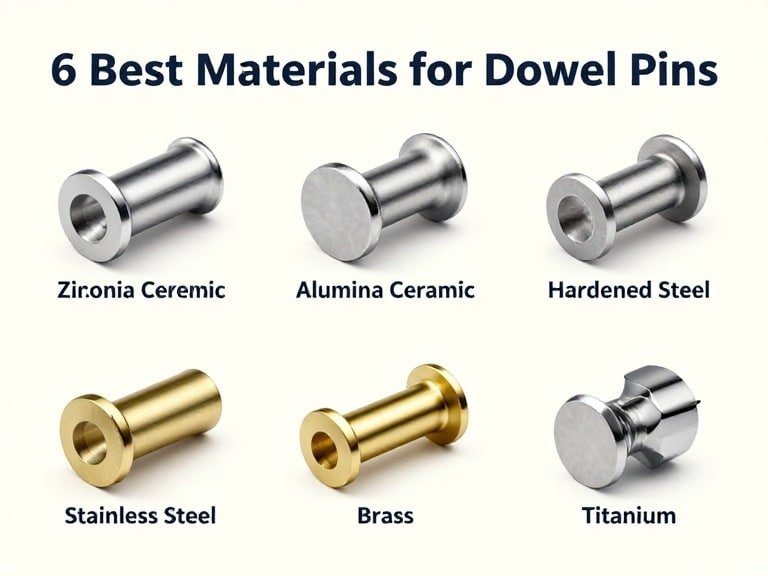
Quick Answer: What Is the Best Material for Dowel Pins?
The definitive best material for dowel pins depends on your operational failure mode: (1) Yttria-Stabilized Zirconia (Y-TZP Ceramic) is the undisputed champion for automated locating, projection welding fixtures, and cleanrooms, delivering unmatched anti-galling performance, non-magnetic properties, dielectric insulation, and 10x to 30x the sliding wear life of steel; (2) High-Purity Alumina Ceramic ($Al_2O_3$) is the premier choice for extreme heat (up to 1,600°C), corrosive chemical baths, and high-voltage electrical isolation; (3) Hardened Alloy Tool Steel (AISI D2 / A2 / 4140) remains the structural benchmark for heavy pure mechanical shear loads and standard machine tool alignment where electrical or galling issues are absent; (4) Martensitic & Austenitic Stainless Steel (440C / 316) is best for food-grade washdown, marine, and medical environments requiring moderate corrosion defense; (5) Tungsten Carbide (Cobalt-Bonded WC) provides extreme compressive rigidity and deflection resistance in high-pressure punch dies; and (6) Titanium Alloy (Ti-6Al-4V Grade 5) serves specialized aerospace applications requiring high strength-to-weight ratios and non-magnetic mass reduction. In our testing across high-speed robotic cells, replacing metal dowels with zirconia ceramic pins eliminates downtime caused by weld spatter and adhesive galling entirely.
Article Directory
- The Mechanical Role of Dowel Pins: Shear, Datums & Contact Stress
- Quick Summary Table: The 6 Best Materials for Dowel Pins
- In-Depth Analysis: The 6 Best Materials for Dowel Pins
- Manufacturer Spotlight: JuchangCeramic Precision Dowel Pins
- Direct Engineering Comparison: Hardness, Toughness & Thermal Ceilings
- Pros and Cons: Technical Ceramics vs. Traditional Tool Steels
- Who Needs Ceramic Dowel Pins vs. Who Should Stick with Steel
- Costly Engineering & Installation Mistakes Plant Managers Make
- Essential Buying Considerations: Fits, Chamfers & Surface Roughness
- Expert Sourcing Verdict & Material Selection Roadmap
- Frequently Asked Questions
- Authoritative References & Engineering Standards
The Mechanical Role of Dowel Pins: Shear, Datums & Contact Stress
To choose the best material for dowel pins, you must first define what the pin is physically doing inside your mechanical assembly. Engineers frequently make the mistake of using a single pin material across every station in a facility, ignoring the fundamentally different mechanical jobs a pin performs.
In precision manufacturing, dowel pins fulfill two distinct engineering functions:
- Static Structural Alignment (Semi-Permanent Datums): In split gearboxes, machine tool bases, and progressive stamping die shoes, two dowel pins establish the primary geometric datum ($X-Y$ Cartesian coordinates) between mating plates. Bolts supply the clamping force (tensile preload), while the dowel pins absorb transverse shear forces and maintain absolute positional repeatability after maintenance teardowns. For pure, static lateral shear loading with zero sliding friction, ductile fracture toughness and yield strength are the governing metrics.
- Dynamic Locating and Guiding (High-Cycle Friction): In robotic welding fixtures, automated transfer lines, and mold cavity guide bushings, workpieces are loaded, clamped, and unloaded thousands of times per shift. Here, the pin does not act as a static bolt; it functions as a sliding datum. As metal sheet stock or cast components slide over the pin, intense Hertzian contact stress occurs. Under unlubricated friction, metals cold-weld at the micro-level, leading to adhesive wear, galling, and dimensional failure.
From our experience on production lines, when a pin fails, it rarely fails from simple shear overload; it fails because the material was vulnerable to galling, electrical pitting, thermal softening, or chemical corrosion. Determining the best material for dowel pins requires matching the substrate’s tribology directly to the working environment.
Quick Summary Table: The 6 Best Materials for Dowel Pins
| Dowel Pin Material | Surface Hardness | Fracture Toughness | Anti-Galling Rating | Max Operating Temp | Primary Commercial Advantage |
|---|---|---|---|---|---|
| 1. Zirconia Ceramic (Y-TZP) | HRA 87 – 90 | 6.0 – 10.0 MPa·m½ | Exceptional (Zero galling) | 400°C – 500°C | Best material for dowel pins in welding, robotics & high-cycle fixtures |
| 2. Alumina Ceramic ($Al_2O_3$) | HRA 88 – 92 | 3.5 – 4.5 MPa·m½ | Exceptional (Zero galling) | 1,500°C – 1,600°C | Best material for dowel pins in extreme furnace heat & dielectric isolation |
| 3. Hardened Tool Steel (D2 / A2) | HRC 58 – 62 | 20.0 – 30.0 MPa·m½ | Poor (Galls easily without oil) | 200°C – 250°C | Best material for dowel pins under heavy mechanical shear & standard tooling |
| 4. Stainless Steel (440C / 316) | HRC 25 – 58 | 30.0 – 50.0 MPa·m½ | Very Poor (Severe cold-welding) | 300°C – 450°C | Best material for dowel pins in food, pharmaceutical & marine washdown |
| 5. Tungsten Carbide (WC-Co) | HRA 89 – 93 | 8.0 – 12.0 MPa·m½ | Moderate (Can gall under load) | 450°C – 600°C | Best material for dowel pins under extreme compressive loads & rigid punches |
| 6. Titanium Alloy (Ti-6Al-4V) | HRC 36 – 42 | 40.0 – 60.0 MPa·m½ | Extremely Poor (Prone to seizing) | 350°C – 400°C | Best material for dowel pins in lightweight aerospace & non-magnetic frames |
In-Depth Analysis: The 6 Best Materials for Dowel Pins
1. Yttria-Stabilized Zirconia (Y-TZP): The Modern Engineering Benchmark
In most professional situations involving high-speed automation, repetitive component locating, and electrical resistance welding, Yttria-Stabilized Zirconia (Y-TZP) is uncontested as the best material for dowel pins. While traditional engineers often dismiss ceramics as fragile, Y-TZP operates on a unique metallurgical principle known as stress-induced transformation toughening. When a micro-crack initiates under stress, the metastable tetragonal zirconia crystals at the crack tip transform into a monoclinic phase, expanding by 3% to 5% in volume. This volumetric expansion clamps the crack tip shut, giving zirconia a fracture toughness (6 to 10 MPa·m½) and flexural bending strength (>1,000 MPa) that approach hardened metals.
Zirconia pins solve three fatal flaws of metal pins:
- Total Elimination of Galling: Because zirconia is an inorganic, non-metallic crystal, it cannot form metallurgical adhesive bonds with mating steel or aluminum parts. Even in unlubricated cleanroom sliding contacts, zirconia exhibits low friction coefficients (Ra 0.05 to 0.2 μm) and will never cold-weld.
- Complete Electrical Insulation: In automotive projection nut welding (such as welding M6 to M12 nuts onto vehicle chassis), using a metal pin creates an electrical short-circuit that diverts secondary welding current, causing severe arcing and molten weld spatter that destroys the pin threads. Zirconia is an electrical insulator (resistivity >$10^{11}$ Ω·cm); it forces 100% of the welding current through the nut projections, while weld spatter simply bounces off without sticking.
- Non-Magnetic and Chemically Inert: It will not attract ferrous grinding dust or pit when exposed to industrial coolants. Explore specialized structural components in our Zirconia Ceramic Structural Part catalog.
For commercial users running robotic stamping or automotive lines, upgrading to zirconia pins routinely eliminates daily line shutdowns, delivering immediate operational payback.
2. High-Purity Alumina ($Al_2O_3$): The High-Temperature & Dielectric Champion
When operating environments exceed 500°C, or when budget constraints require a more economical technical ceramic than zirconia, 95% to 99.8% pure Alumina ($Al_2O_3$) is the best material for dowel pins. Synthesized from aluminum oxide, alumina delivers diamond-like hardness (Vickers ~15 to 18 GPa) and extreme compressive strength.
Alumina excels in thermal and electrical extremes:
- Unmatched Thermal Stability: Alumina retains structural geometry and dimensional hardness at continuous operating temperatures up to 1,600°C, a threshold where hardened tool steels, carbide binders, and stainless steels soften or melt completely. Sourcing from experienced high temperature ceramic tubes suppliers confirms alumina’s dominance in furnace fixtures and brazing jigs.
- Superior Dielectric Strength: Alumina provides exceptional electrical resistance, preventing high-voltage breakdown across automated electronics test fixtures (ATE). For high-voltage applications, review options with ceramic tube insulator manufacturers.
- Corrosion Immunity: Alumina is virtually immune to attack by strong acids (such as nitric, sulfuric, and hydrochloric acids), making it the premier pin material for pickling baths and chemical etching equipment.
The trade-off is mechanical brittleness: with a fracture toughness of 3.5 to 4.5 MPa·m½, alumina pins will chip if struck by an uncalibrated robotic arm delivering a violent lateral impact blow. We recommend alumina for static locating fixtures, vacuum chambers, and high-heat brazing stations.
3. Hardened Alloy Tool Steel (AISI D2, A2, O1 & 4140): The Heavy Shear Classic
For standard machine design, die sets, and heavy structural assemblies, hardened alloy tool steel remains the foundational industry baseline when evaluating the best material for dowel pins. Steels such as AISI D2 (high-carbon, high-chromium cold-work die steel) and AISI A2 (air-hardening tool steel) heat-treated to HRC 58–62 deliver immense yield strength and shear resistance.
Tool steel is the correct engineering choice when:
- Primary Failure Mode is Direct Shear: In massive industrial gearboxes, split engine casings, and heavy press dies, dowel pins absorb thousands of foot-pounds of transverse shearing forces. The ductile nature of steel allows it to flex elastically without catastrophic fracture.
- Cost-Sensitive Static Fixtures: If a pin is pressed into a fixture once, bolted securely, covered in lubricating oil, and never subjected to sliding wear or electrical current, tool steel dowel pins cost a fraction of engineered ceramics or carbides.
However, in high-cycle sliding environments, tool steel is a liability. Without continuous lubrication, steel-on-steel contact leads to rapid scoring. Furthermore, tool steels corrode readily in humid environments and soften rapidly above 200°C.
4. Stainless Steel (440C, 316, 304): Food-Grade & Washdown Corrosion Defense
When operating in food processing, pharmaceutical packaging, marine equipment, or medical diagnostic devices, standard carbon tool steels are prohibited due to rust. Here, stainless steel is frequently specified as the best material for dowel pins.
Two distinct metallurgical grades dominate the market:
- Martensitic Stainless Steel (AISI 440C): Heat-treatable to a respectable HRC 58–60, 440C balances moderate corrosion resistance with high surface hardness, making it common in medical assemblies and surgical tools.
- Austenitic Stainless Steel (AISI 316 / 304): Delivers exceptional chemical corrosion resistance against chlorine and washdown chemicals due to high molybdenum and nickel content. However, austenitic stainless steel cannot be hardened by heat treatment (remaining at a soft HRC 25–30).
The catastrophic flaw of stainless steel dowel pins is severe adhesive galling. Stainless steel forms a microscopic chromium oxide passive layer. Under sliding pressure against another stainless steel hole, this passive layer strips away; the clean metallic surfaces friction-weld instantly, tearing out threads and permanently seizing the pin. Stainless steel pins should never be used for repetitive sliding location unless coated with diamond-like carbon (DLC) or paired with dissimilar bushings.
5. Tungsten Carbide (Cemented WC-Co): Extreme Compressive Rigidity
Composed of sub-micron tungsten carbide grains bonded inside a metallic cobalt matrix (typically 6% to 15% cobalt), cemented tungsten carbide is selected when absolute deflection resistance and compressive strength are required.
Carbide delivers specific high-end capabilities:
- Extreme Elastic Modulus: With a Young’s modulus of 550 to 650 GPa (nearly three times that of structural steel), carbide dowel pins will not bend under immense side-loads, ensuring sub-micron positional rigidity in high-speed progressive punching dies.
- Abrasive Resistance: Outstanding resistance to pure abrasive wear from sand, mineral slurry, or fiberglass-reinforced plastics. Explore high-wear structural components across our industrial ceramic products catalog.
However, carbide has major commercial drawbacks: it is heavy, carries a high raw material cost, can fracture under sharp bending shock, and its metallic cobalt binder dissolves when exposed to acidic fluids. Furthermore, like steel, carbide is electrically conductive, making it unsuited for welding fixtures.
6. Titanium Alloy (Ti-6Al-4V Grade 5): Lightweight Aerospace Datums
While rarely seen on standard machine shop floors, Ti-6Al-4V (Grade 5 titanium) is the best material for dowel pins in weight-critical aerospace mechanisms, non-magnetic satellite instrumentation, and medical bone-fixation implants.
Titanium provides specific niche advantages:
- Strength-to-Weight Efficiency: With a density of only 4.43 g/cm³ (nearly half that of tool steel) and a tensile strength exceeding 950 MPa, titanium dowels shed critical ounces in flight hardware.
- Paramagnetic Behavior: Completely non-magnetic, making titanium pins mandatory near high-field MRI imaging suites and sensitive magnetometer housings.
However, titanium possesses terrible tribological properties: its unlubricated sliding wear performance is among the worst of any structural metal. Titanium galls against virtually every counter-face material, requiring specialized anodizing or PVD ceramic coatings if used in dynamic locating holes.
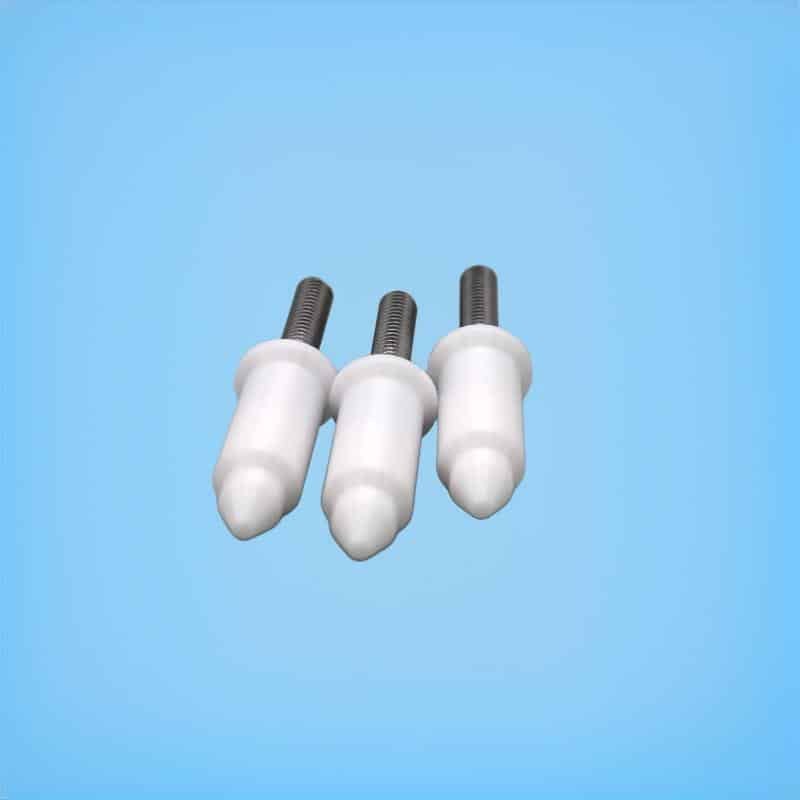
Manufacturer Spotlight: JuchangCeramic Precision Ceramic Dowel Pins
When selecting the best material for dowel pins to eliminate tooling galling, weld spatter adhesion, and electrical short-circuits, JuchangCeramic delivers high-reliability technical ceramic locating pins, dowel pins, and guide shafts engineered to exacting tolerances.
| Available Ceramic Formulations | High-Purity Alumina ($Al_2O_3$, 95% / 99%) & Yttria-Stabilized Zirconia (Y-TZP $ZrO_2$) |
| Surface Hardness Spectrum | Alumina: HRA 88 – 92 | Zirconia: HRA 87 – 90 (Diamond-wheel ground) |
| Density Parameters | Alumina: 3.7 – 3.95 g/cm³ | Zirconia: 6.0 – 6.05 g/cm³ |
| Precision Machining Tolerances | Diameter: ±0.002 mm to ±0.01 mm | Length: ±0.01 mm to ±0.02 mm |
| Surface Roughness (Ra) | Mirror lapped to target Ra 0.05 – 0.2 μm (Zero galling, anti-friction) |
| Geometric Configurations | Cylindrical dowels, stepped locator pins, grooved ejector pins, chamfered tips |
| Target Commercial Applications | Automotive resistance welding, automated jig alignment, precision fluidic pumps |
Engineering Recommendation: Consult our engineering team through our custom precision ceramic parts supplier portal, or discover high-precision alignment components across our best ceramic honing rod options and top ceramic plunger manufacturers portfolios.
Direct Engineering Comparison: Hardness, Toughness & Thermal Ceilings
| Engineering Metric | Zirconia (Y-TZP) | Alumina (99% $Al_2O_3$) | Alloy Steel (D2) | Stainless (316) | Tungsten Carbide | Titanium (Gr. 5) |
|---|---|---|---|---|---|---|
| Density (g/cm³) | 6.05 | 3.90 | 7.70 | 8.00 | 14.80 | 4.43 |
| Elastic Modulus (GPa) | 210 | 380 | 210 | 193 | 600 | 114 |
| Compressive Strength (MPa) | 2,500 | 3,000 | 2,200 | 600 | 4,500 | 970 |
| Electrical Conductivity | Zero (Insulator) | Zero (Insulator) | High Conductor | Moderate Conductor | Moderate Conductor | Low Conductor |
| Thermal Expansion (10&sup6;/K) | 10.5 | 7.2 | 12.0 | 16.0 | 5.0 | 8.6 |
| Magnetic Permeability | 1.0 (Non-mag) | 1.0 (Non-mag) | Ferromagnetic | Non-mag / Weak | Ferromagnetic (Co) | 1.0 (Non-mag) |
| Weld Spatter Sticking | None | None | Severe | Severe | Moderate | Severe |
| Relative Cost Factor | $$$ (3x–5x) | $$ (2x–3x) | $ (Baseline 1x) | $$ (1.5x–2x) | $$$$ (4x–6x) | $$$$ (5x–7x) |
Pros and Cons: Technical Ceramics vs. Traditional Tool Steels
| Material Category | Commercial & Technical Advantages (Pros) | Operational Limitations & Cautions (Cons) |
|---|---|---|
| Advanced Technical Ceramics (Zirconia & Alumina Formulations) | Virtually immune to adhesive wear, galling, and metal pick-up. Zero electrical conductivity eliminates welding shorts and arcing. Outlasts alloy tool steel pins by 10x to 30x in dynamic sliding. Immune to rust, pitting, and industrial coolants. Maintains certified micron dimensions across millions of cycles. | Higher initial purchase price than catalog commercial steel pins. Zero plastic yield ductility; will not bend if severely overloaded. Requires transition or adhesive press-fits to prevent hoop stress cracking. |
| Traditional Hardened Tool Steels (D2, A2, 4140 Grades) | Maximum shear strength and ductile shock tolerance. Extremely low upfront acquisition cost with instant availability. Tolerates aggressive interference press-fits without fracturing. Easy to machine or modify in-house using conventional toolroom grinders. | Prone to severe adhesive galling when run unlubricated. Welding current arcs through pins, destroying threads and sensors. Rapid abrasive wear under continuous sheet metal loading. Vulnerable to rust, pitting, and thermal softening above 200°C. |
Who Needs Ceramic Dowel Pins vs. Who Should Stick with Steel
Every engineering dollar spent on tooling must deliver measurable return on investment. Sourcing the best material for dowel pins requires matching mechanical duty cycles to your factory’s specific pain points.
Who Must Upgrade to Ceramic Dowel Pins (Zirconia / Alumina):
- Automotive Tier-1 & Tier-2 Resistance Welding Facilities: If you operate automated nut and stud projection welders, continuing to use steel pins is a major operational drain. Spatter-related downtime, stuck nuts, and burnt sensor electronics cost thousands per shift. Upgrading to zirconia pins pays for itself within days.
- Medical Device, Pharmaceutical & Analytical Instruments: Precision fluidic assemblies—such as those utilizing a Medical Ceramic Pump, Dialysis Ceramic Pump, or Ceramic Rotary Valve—require locating pins that cannot shed metallic particulate or leach ions into biological fluids. Chemically inert technical ceramics guarantee cleanroom biosecurity.
- High-Speed Automated Sheet Metal Stamping & Transfer Lines: Where robots cycle thousands of stamped steel or aluminum body panels daily, unlubricated sliding friction destroys steel pins within weeks. Mirror-polished zirconia dowel pins eliminate galling and maintain datum repeatability indefinitely. Explore micro-fluidic solutions via our Microliter Ceramic Metering Pump and Miniature Ceramic Pump lines.
- Semiconductor & Electronics Assembly Fixtures: In automated pick-and-place lines and vacuum test fixtures where magnetic field distortion or electrostatic discharge (ESD) will ruin delicate silicon wafers, non-magnetic, dielectric ceramic pins are mandatory.
Who Should Stay with Traditional Hardened Tool Steel:
- Heavy Bolted Structural Joints & Split Gearboxes: If your pins serve solely to locate two heavy cast-iron transmission housings or progressive die shoes subjected to violent lateral shock loads, hardened tool steel (D2/A2) is the proper choice. Steel’s ductility prevents catastrophic brittle fracture under shear overload.
- Low-Volume Toolrooms & Manual Drill Jigs: If a machinist is manually drilling twenty holes a week in mild steel at ambient room temperature, standard $1.50 hardened steel dowel pins will function reliably for years. Paying for technical ceramic or carbide pins provides zero commercial advantage in low-cycle manual operations.
Costly Engineering & Installation Mistakes Plant Managers Make
Toolroom Advisory: The most catastrophic mistake made on production floors is maintenance technicians attempting to drive a ceramic dowel pin into an undersized steel bore using a standard steel hammer. Striking technical ceramics with hard steel creates microscopic surface fractures, causing the pin to shatter on its first operating cycle. Always use brass, nylon, or arbor presses, and adhere strictly to transition fits.
- Applying Steel Interference Press-Fits to Ceramic Pins: Toolmakers routinely ream holes with a standard interference fit of +0.015 to +0.025 mm for steel dowels. Steel yields and stretches elastically to accommodate this interference; technical ceramics do not. Pressing a ceramic dowel into an undersized metal bore generates intense tensile hoop stress that splits the ceramic or cracks the surrounding die plate. For technical ceramics, always specify a transition fit (+0.002 to -0.005 mm) paired with high-strength retaining compound (e.g., Loctite 680), or use thermal expansion shrinking.
- Omitting Generous Lead-In Chamfers: A sharp 90-degree edge on a dowel pin is an accident waiting to happen. When a robotic arm feeds a workpiece into a fixture with slight misalignment, a sharp corner on the pin concentrates impact forces, chipping the edge. Always specify a 15-degree to 30-degree lead-in chamfer with polished, blended corner radii (R 0.2 to 0.5 mm) to guide workpieces smoothly into position.
- Using Stainless Steel on Stainless Steel Without Anti-Seize: Inserting a 316 stainless steel pin into a 316 stainless steel reamed hole under a light press fit causes immediate, irreversible galling. The parts will cold-weld before the pin is even seated. If corrosion resistance is required, pair a stainless housing with a zirconia ceramic pin, or apply a dissimilar PVD coating.
- Ignoring Galvanic Corrosion in Wet Assemblies: Pairing an aluminum fixture plate with a carbon tool steel dowel pin in the presence of water-soluble coolants creates an active galvanic couple. The aluminum surrounding the pin corrodes rapidly, turning the precision reamed hole into an oversized, out-of-round cavity that destroys datum accuracy. Zirconia ceramic pins eliminate galvanic couples entirely.
Essential Buying Considerations: Fits, Chamfers & Surface Roughness
Before issuing a formal purchase order or drawing release for precision pins, verify these four engineering benchmarks with your supplier:
1. Certified Dimensional Fits and Geometric Tolerances
Dowel pins are precision reference datums. Ensure your drawing specifies standardized ISO fits:
- ISO m6 (+0.004 to +0.012 mm): Standard commercial interference fit for permanent semi-fixed installation in steel plates.
- ISO h6 (0.000 to -0.008 mm): Precision slip/sliding fit for dynamic locating stations and removable tooling inserts.
- Demand verified air-gage or Coordinate Measuring Machine (CMM) inspection data proving cylindricity and roundness within 0.0015 mm.
2. Surface Roughness (Ra) and Grinding Quality
Surface roughness dictates sliding wear life. A standard ground finish (Ra 0.8 μm) possesses microscopic ridges that act like cutting tools against mating workpieces. Demand precision diamond-wheel centerless grinding and cylindrical lapping that achieves a surface finish of Ra 0.05 to 0.2 μm. A mirror-polished finish minimizes friction, eliminates particulate generation in cleanrooms, and maximizes fatigue life.
3. Ceramic Powder Sourcing and Theoretical Sintering Density
If purchasing technical ceramic pins, inquire about raw powder sourcing. High-performance pins require high-purity sub-micron powders achieving a theoretical density exceeding 99.0% to 99.5%. Cheap ceramics sintered at improper temperatures contain internal microscopic voids that act as crack initiation sites, causing the pin to fail prematurely under cyclical shear stress.
4. Total System Integration Support
A dowel pin rarely operates in isolation; it functions within complex mechanical or fluidic systems. Ensure your component manufacturer understands systemic mechanical integration. If your application involves high-pressure fluid displacement alongside precision alignment, evaluate complementary hardware across our Ceramic Pump and Ceramic plunger pump divisions.
Expert Sourcing Verdict & Material Selection Roadmap
In our professional assessment across decades of tooling design, precision machining, and technical ceramics manufacturing, continuing to use hardened tool steel or stainless steel dowel pins in dynamic, high-cycle, or electrified manufacturing environments is an unnecessary operational bottleneck. The cycle-time losses, rejected assemblies, and maintenance costs caused by galled, spatter-caked metal pins dwarf the initial investment of upgrading to high-performance technical ceramics.
Here is your definitive engineering roadmap for selecting the best material for dowel pins:
- For Automated Locating, Robotic Cells & Resistance Welding: Specify Yttria-Stabilized Zirconia (Y-TZP). Its high fracture toughness, non-magnetic nature, complete electrical insulation, and anti-galling properties eliminate tool jams and weld spatter adhesion, outlasting steel by up to 30 times.
- For Furnace Fixtures, High-Heat Brazing & Acid Baths (>500°C): Specify 99% High-Purity Alumina ($Al_2O_3$) for its unmatched thermal ceiling (1,600°C), extreme surface hardness, and cost-effective dielectric strength.
- For Heavy Structural Alignment & Pure Mechanical Shear Loads: Stick with Hardened Alloy Tool Steel (AISI D2 / A2). Steel’s ductile yield strength provides the shear safety factor needed to absorb violent lateral mechanical shocks in heavy die sets and split gearboxes.
- For Food-Grade, Pharmaceutical & Marine Washdown: Deploy 440C Martensitic Stainless Steel (with DLC coating if sliding) or transition directly to Zirconia Ceramic to eliminate galling and washdown corrosion permanently.
Partnering with a proven, vertically integrated manufacturer like JuchangCeramic ensures your precision dowel pins arrive diamond-ground to ±0.002 mm tolerances, mirror-lapped to Ra 0.05 μm finishes, and backed by the metallurgical and ceramic engineering expertise required to keep your automated production lines running smoothly.
Frequently Asked Questions
What is the best material for dowel pins in automated manufacturing fixtures?
For automated assembly, robotic locating, and welding fixtures, Yttria-Stabilized Zirconia (Y-TZP ceramic) is the best material for dowel pins. Unlike tool steel, zirconia cannot gall or weld to metal workpieces, provides complete electrical insulation to eliminate weld arcing, is non-magnetic, and outlasts hardened steel pins by 10 to 30 times in continuous sliding friction.
Why do standard steel dowel pins fail in high-cycle locating operations?
Standard alloy steel dowel pins fail primarily through adhesive wear and galling. When steel workpieces repeatedly slide over steel pins without lubrication, microscopic surface asperities cold-weld and tear away material. This creates gouges, shifts datum tolerances beyond acceptable limits, and eventually seizes the mating parts.
Can ceramic dowel pins withstand high mechanical shear loads?
Ceramic dowel pins exhibit immense compressive strength (over 2,000 MPa for zirconia) but possess lower tensile and shear ductility than hardened tool steels. Zirconia dowel pins absorb significant mechanical shock due to stress-induced transformation toughening, making them exceptional for precision alignment. However, for structural bolted joints subject to violent, unguided lateral shear impact, hardened alloy steel remains the proper choice.
When should alumina ceramic be selected over zirconia for dowel pins?
Alumina ceramic should be selected when operating temperatures exceed 500°C (up to 1,600°C continuous), in aggressive acid-immersion environments, or where maximum dielectric electrical resistance is required at lower material cost. Zirconia is preferred when higher mechanical impact toughness and edge-chipping resistance are mandatory.
Authoritative References & Engineering Standards
- International Organization for Standardization: ISO 8734 Parallel Pins of Hardened Steel and Martensitic Stainless Steel (Dowel Pins)
- ASTM International: Standard Test Method for Flexural Strength of Advanced Ceramics at Ambient Temperature (ASTM C1161)
- ASM International (Materials Information Society): Tool Materials Handbook – Tribological Wear and Galling Characteristics of Steels and Ceramics