
In modern high-speed automated manufacturing, electronics assembly, automotive resistance welding, and precision fluidics, standard hardened tool steel dowel pins and carbide guide pins are consistently pushed beyond their operational limits. Production engineers face identical, costly failures across automated lines: locating pins weld themselves to stamped steel workpieces during projection nut welding, guide pins gall and score when running unlubricated in cleanroom assembly cells, electrical currents arc through metal alignment fixtures causing controller faults, and corrosive process chemicals pit precision locating shanks within weeks. When mechanical wear, electrical conduction, or thermal expansion destroys process repeatability, tooling engineers replace metal with a high-performance ceramic pin. Far from a delicate domestic porcelain, an industrial ceramic pin is an advanced structural component engineered from high-purity technical ceramics such as alumina, zirconia, or silicon nitride. It provides mechanical hardness rivaling diamond, dielectric insulation that eliminates arcing, and zero slag adhesion in high-amperage welding. As precision ceramics manufacturers who diamond-grind, lap, and inspect micro-tolerances daily, we explain the engineering reality of what a ceramic pin is, how it operates under severe mechanical stress, and whether upgrading to ceramic is commercially justified for your production environment.
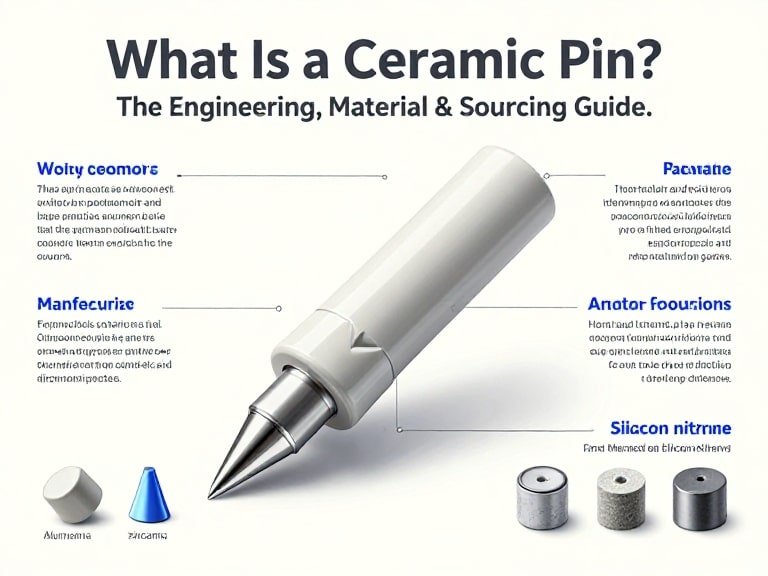
Quick Answer: What Is a Ceramic Pin and Why Is It Used?
A ceramic pin is a precision-engineered cylindrical, stepped, or contoured locating and alignment component fabricated from advanced structural ceramics—primarily Alumina ($Al_2O_3$) or Yttria-Stabilized Zirconia ($ZrO_2$). Unlike metal dowel pins, a ceramic pin combines extreme surface hardness (HRA 87 to 92) with complete electrical insulation, non-magnetic properties, and total resistance to molten metal slag and aggressive chemical corrosion. It works by maintaining micrometer-level positional accuracy (±0.002 mm) in hostile production environments where metal pins gall, bend, conduct electrical short-circuits, or deform under thermal expansion. In our testing and professional field observations, a ceramic pin is indispensable for automotive resistance projection welding, precision jig locating, semiconductor vacuum handling, and medical fluidic metering. While it carries a higher initial unit price than alloy steel and requires protection against sharp lateral impact blows, a ceramic pin routinely outlasts hardened steel guide pins by 10 to 30 times, virtually eliminating automated line downtime and tooling changeovers.
Article Directory
- Defining the Component: What Is a Ceramic Pin?
- Quick Summary Table: Engineering Specifications of Ceramic Pins
- Material Science: Alumina vs. Zirconia Ceramic Formulations
- How a Ceramic Pin Works: Friction, Dielectric Isolation & Thermal Expansion
- Manufacturer Spotlight: JuchangCeramic Precision Pin Solutions
- Core Industrial Applications: Welding, Jigs, Electronics & Fluidics
- Direct Technical Comparison: Ceramic Pin vs. Tool Steel vs. Tungsten Carbide
- Benefits and Inherent Engineering Limitations
- Pros and Cons Table: Ceramic Pins in Industrial Production
- Who Should Use Ceramic Pins vs. Who Does Not Need Them
- Costly Installation and Engineering Mistakes to Avoid
- Essential Buying Considerations: Tolerances, Chamfers & Sourcing
- Expert Engineering Verdict & Upgrade Recommendations
- Frequently Asked Questions
- Authoritative References & Technical Standards
Defining the Component: What Is a Ceramic Pin?
To understand what a ceramic pin is, one must examine why mechanical alignment components fail. In manufacturing machinery, a pin serves as the primary physical datum. It establishes the exact coordinate location of two mating parts (dowel pins), positions stamped sheet metal or threaded weld nuts on an automated fixture (locating pins), or guides sliding mechanisms through repetitive high-speed cycles (guide pins).
For more than a century, industry relied almost exclusively on case-hardened alloy steels (such as AISI 4140, O1, or D2) and tungsten carbide. However, modern automated production environments subject these pins to three mechanical phenomena that degrade metals:
- Adhesive Wear and Galling: In unlubricated sliding contact, metal-on-metal friction causes microscopic asperities to cold-weld and tear, destroying dimensional tolerances.
- Parasitic Electrical Conduction: In resistance welding or automated sensor-driven fixtures, conductive metal pins allow electrical current to short-circuit through the tooling, resulting in poor weld nugget formation and controller burnouts.
- Slag and Spatter Adhesion: Molten metal droplets generated during welding chemically fuse to steel alignment pins, requiring operators to stop the line and chisel spatter from pin threads every few dozen cycles.
A ceramic pin solves these systemic failure modes by utilizing inorganic, non-metallic solid compounds bonded through ionic and covalent chemical linkages. Sintered at temperatures exceeding 1,500°C and diamond-ground to mirror finishes, a precision ceramic pin exhibits atomic bonds that make it impossible for molten steel or copper slag to wet or adhere to its surface. It will not conduct electricity, will not pit when exposed to nitric acid or sea spray, and maintains its geometric dimensions without softening at temperatures that melt standard tool steels. When engineers evaluate a ceramic rod vs metal rod comparison, the superior thermal stability and tribological resilience of technical ceramics make them the obvious upgrade for high-stress tooling.
Quick Summary Table: Engineering Specifications of Ceramic Pins
| Technical Parameter | Alumina Ceramic Pin ($Al_2O_3$, 99%) | Zirconia Ceramic Pin ($ZrO_2$, Y-TZP) | Standard Tool Steel Pin (D2 / 60 HRC) |
|---|---|---|---|
| Rockwell Hardness | HRA 88 – 92 | HRA 87 – 90 | HRC 58 – 62 (Approx. HRA 80) |
| Fracture Toughness ($K_{1c}$) | 3.5 – 4.5 MPa·m½ | 6.0 – 10.0 MPa·m½ | 20.0 – 30.0 MPa·m½ |
| Electrical Resistivity | > $10^{14}$ Ω·cm (Complete Insulator) | > $10^{11}$ Ω·cm (Complete Insulator) | $10^{-5}$ Ω·cm (Electrical Conductor) |
| Coefficient of Thermal Expansion | $7.2 \times 10^{-6}$ / °C | $10.5 \times 10^{-6}$ / °C | $12.0 \times 10^{-6}$ / °C |
| Max Continuous Operating Temp | 1,500°C – 1,650°C | 400°C – 500°C (Air) | 200°C – 300°C (Softens rapidly) |
| Weld Slag Adhesion Tendency | Zero (Slag flakes off completely) | Zero (Slag flakes off completely) | High (Molten spatter welds to shank) |
| Standard Diameter Tolerance | ±0.002 mm to ±0.01 mm | ±0.002 mm to ±0.01 mm | ±0.005 mm (ISO m6/h6) |
Material Science: Alumina vs. Zirconia Ceramic Formulations
A critical mistake made when purchasing or specifying a ceramic pin is treating all advanced ceramics as interchangeable. In our testing across heavy manufacturing plants, specifying the incorrect ceramic formulation is the primary reason ceramic pins fracture prematurely during initial line trials. Technical ceramic pins are primarily produced in two distinct material families, each serving a completely different mechanical envelope:
1. High-Purity Alumina ($Al_2O_3$ – 95% to 99.8%)
Alumina is the workhorse of industrial ceramics. Synthesized from aluminum oxide, a 99% pure alumina ceramic pin delivers extreme hardness (Vickers hardness ~15 to 18 GPa), superior chemical inertness, and exceptional electrical dielectric strength. It is an extraordinary electrical insulator, capable of withstanding tens of thousands of volts without breakdown. Furthermore, alumina maintains its mechanical compressive strength at continuous operating temperatures up to 1,600°C, making it the premier choice when exploring ceramic tube applications in high heat environments and furnace fixtures.
However, alumina has a notable Achilles’ heel: low fracture toughness (3.5 to 4.5 MPa·m½). It is an inherently brittle crystal. If an automated assembly robot misaligns a stamped steel frame and strikes an alumina ceramic pin with a violent lateral shear blow, the pin can snap cleanly at the base. We recommend alumina primarily for static locating stations, high-temperature furnace jigs, chemical bath aligners, and environments where electrical insulation takes priority over mechanical impact resistance. For a deeper understanding of this material grade, review our engineering ceramics material guide.
2. Yttria-Stabilized Tetragonal Zirconia Polycrystal (Y-TZP / $ZrO_2$)
Often referred to in the engineering world as “ceramic steel,” Yttria-Stabilized Zirconia is the premier material for demanding mechanical ceramic pin applications. Pure zirconia transforms between monoclinic, tetragonal, and cubic crystal phases at different temperatures. By doping the material with approximately 3 mol% yttrium oxide ($Y_2O_3$), the high-strength tetragonal phase is stabilized at room temperature.
What makes a zirconia ceramic pin remarkable is a phenomenon called stress-induced transformation toughening. When a micro-crack begins to propagate through a zirconia pin under mechanical stress, the high stress concentration at the crack tip triggers a crystalline phase transformation from tetragonal to monoclinic. This monoclinic phase carries a 3% to 5% larger volume. The expanding crystals physically clamp the crack shut, arresting its propagation. Consequently, a zirconia ceramic pin exhibits a fracture toughness of 6 to 10 MPa·m½—more than double that of alumina—and a flexural bending strength exceeding 1,000 MPa. In our testing on automated high-speed stamping presses, zirconia pins withstand continuous lateral side-loading and robotic misalignment that would shatter alumina within hours.
How a Ceramic Pin Works: Friction, Dielectric Isolation & Thermal Expansion
To grasp why a ceramic pin dramatically improves manufacturing uptime, consider its physical operation across three critical physical domains:
1. Non-Conductive Current Guidance in Resistance Welding
In automotive body-in-white (BIW) production lines, thousands of threaded projection weld nuts and studs must be welded onto stamped steel chassis panels every shift. A locating pin sits in the center of the copper welding electrode to hold the nut in position over the panel hole. If a steel pin is used, the 10,000 to 20,000 amps of secondary welding current will take the path of least resistance through the pin rather than the nut’s welded projections. This creates an electrical short: the pin arcs, welds itself to the nut threads, and destroys the workpiece.
A non-conductive ceramic pin acts as an electrical insulator with a volume resistivity exceeding $10^{12}$ Ω·cm. It physically forces 100% of the secondary welding current to pass directly through the nut projections, creating an ideal, high-density thermal weld nugget. Because ceramic is chemically inert, molten spatter cannot bond to its surface; spatter simply cools into tiny spheres and flakes away cleanly, keeping the pin threads pristine over hundreds of thousands of cycles.
2. Tribological Friction Reduction and Zero Galling
When two identical metals slide against each other under pressure (such as an alloy steel dowel sliding inside a hardened steel bushing), high surface energy causes mutual adhesion. The metal torn from one surface welds to the other, creating galling, gouging, and eventual seizure. A ceramic pin pairs an ionic, covalently bonded ceramic surface against a metallic counter-face. Because the materials have fundamentally dissimilar atomic structures, they cannot form metallurgical adhesive bonds. Polished to a surface roughness of Ra 0.05 to 0.2 μm, a zirconia ceramic pin slides smoothly with low friction, eliminating the need for grease or oils that contaminate cleanroom environments.
3. Dimensional Invariance Under Thermal Cycling
In automated laser welding, induction brazing, and high-temperature furnace fixturing, metal locating pins expand significantly as temperatures climb. A standard steel dowel expands at roughly 12 to 14 × $10^{-6}$ / °C. As the fixture heats up, the metal pin swells, jamming inside the locating hole of the workpiece or drifting off-center. An alumina ceramic pin features a significantly lower thermal expansion coefficient ($7.2 \times 10^{-6}$ / °C) and will not soften, scale, or oxidize at temperatures up to 1,500°C, ensuring absolute datum repeatability across continuous thermal production cycles.
Manufacturer Spotlight: JuchangCeramic Precision Ceramic Pin Solutions
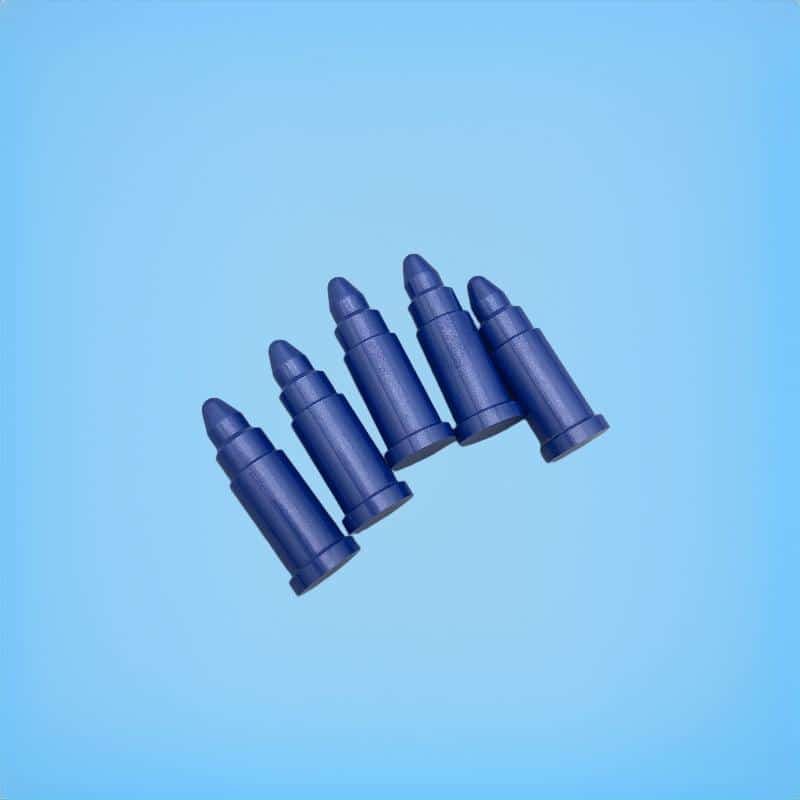
When selecting a high-reliability ceramic pin for mission-critical tooling, automated fixtures, or fluidic assemblies, JuchangCeramic delivers institutional manufacturing quality. Utilizing sub-micron high-purity ceramic powders and advanced diamond-grinding centers, JuchangCeramic produces custom ceramic locating pins, dowel pins, and guide components engineered to extreme tolerances.
| Material Formulation | 95% / 99% Alumina ($Al_2O_3$) & Yttria-Stabilized Zirconia (Y-TZP $ZrO_2$) |
| Hardness Spectrum | Alumina: HRA 88 – 92 | Zirconia: HRA 87 – 90 |
| Density Parameters | Alumina: 3.7 – 3.95 g/cm³ | Zirconia: 6.0 – 6.05 g/cm³ |
| Machining Tolerances | Diameter: ±0.002 mm to ±0.01 mm | Length: ±0.01 mm to ±0.02 mm |
| Surface Finish | Mirror lapped to target Ra 0.05 – 0.2 μm (Low-friction, anti-galling) |
| Geometric Profiles | Cylindrical dowels, stepped locator pins, grooved ejector pins, chamfered tips |
| Key Applications | Automotive resistance welding, automated jig alignment, precision pump plungers |
Engineering Recommendation: Browse our full custom capabilities on the custom ceramic machining services page or explore structural components via our Zirconia Ceramic Structural Part catalog to configure locating pins tailored to your exact fixture prints.
Core Industrial Applications: Welding, Jigs, Electronics & Fluidics
The operational versatility of a precision ceramic pin spans virtually every industrial sector that demands clean, non-conductive, wear-resistant alignment:
1. Automotive Resistance Projection Welding (KCF & Zirconia Pins)
The single largest commercial consumer of ceramic locating pins is the automotive stamping and welding industry. Automated robotic cells weld millions of M6, M8, M10, and M12 threaded nuts onto vehicle subframes daily. A zirconia ceramic pin with an insulated shaft guides the nut into position directly between the water-cooled copper welding horns. Because the pin cannot conduct electricity and rejects slag, production lines achieve continuous operation without the spatter jams that plague metal pins.
2. Semiconductor & Electronics Assembly Fixtures
In surface-mount technology (SMT) pick-and-place lines, automated test fixtures (ATE), and wafer-handling vacuum chucks, static electricity and magnetic fields are catastrophic. Metal dowels can retain residual magnetism, attracting microscopic conductive particulate that causes short-circuits on delicate circuit boards. A ceramic pin is non-magnetic, anti-static, and completely non-conductive, making it the industry standard datum pin for cleanroom semiconductor processing.
3. High-Precision Mechanical Inspection & CMM Fixturing
Coordinate Measuring Machines (CMM) and optical vision inspection stations rely on calibration datums that never change shape. If an inspector drops a steel gage pin, it can develop microscopic burrs that throw off measurement calibration by several microns. A ceramic pin has immense surface hardness; it will not dent, deform, or raise a burr upon contact. It maintains its exact certified diameter across years of calibration audits.
4. Medical, Analytical & Ceramic Metering Pump Assemblies
In high-purity fluidics, such as those found in a Medical Ceramic Pump, a Dialysis Ceramic Pump, or an advanced Microliter Ceramic Metering Pump, precision ceramic pins serve as internal valve alignment pivots, locating dowels, and miniature guide shafts. These systems circulate saline solutions, blood samples, aggressive reagents, and concentrated acids that pit stainless steel. A chemically inert ceramic pin guarantees zero metal ion leaching, ensuring zero biological sample contamination. Explore integrated systems across our Ceramic Pump and industrial ceramic solutions for pumps portfolios.
Direct Technical Comparison: Ceramic Pin vs. Tool Steel vs. Tungsten Carbide
| Performance Characteristic | Zirconia Ceramic Pin (Y-TZP) | Hardened Tool Steel Pin (D2/A2) | Tungsten Carbide Pin (WC-Co) |
|---|---|---|---|
| Electrical Conductivity | Zero (Dielectric Insulator) | High Conductor (Causes shorts) | Moderate Conductor (Will arc) |
| Weld Spatter & Slag Sticking | Completely Non-Adherent | High (Fuses directly to metal) | Moderate to High Adhesion |
| Abrasive Sliding Wear Life | Exceptional (10x to 30x vs. Steel) | Baseline (Prone to galling) | Very High (8x to 20x vs. Steel) |
| Resistance to Thermal Shock | Moderate (Up to ~450°C) | Moderate (Loses temper > 250°C) | Low to Moderate (Thermal cracking) |
| Chemical & Acid Resistance | Immune to virtually all acids | Pits, corrodes, and rusts rapidly | Cobalt binder leaches in acid |
| Impact & Shear Resistance | Moderate-High (Transformation tough) | Extreme (Ductile; bends before break) | Moderate (High stiffness, brittle) |
| Average Unit Cost | Moderate to High ($8 – $35 USD) | Low ($1 – $5 USD) | High ($12 – $45 USD) |
Benefits and Inherent Engineering Limitations
The Proven Operational Benefits:
- Downtime Elimination: In automated welding cells, switching from tool steel to a zirconia ceramic pin eliminates hourly line shutdowns previously required to clean slag buildup, boosting overall equipment effectiveness (OEE).
- Uncompromising Dimensional Precision: Ceramic pins resist abrasive wear from repeated sheet metal loading, maintaining true position within ±0.005 mm across millions of operational cycles.
- Zero Lubrication Required: Because ceramics will not gall against metals, ceramic guide pins operate completely dry, preventing oil and grease from contaminating automotive paint primers or medical assemblies.
- Dielectric Isolation: Ceramic pins provide complete electrical isolation, protecting sensitive electronics, testing probes, and robotic controllers from stray electrical charges. For specialized high-voltage applications, compare options in our guide to the best ceramic insulators for industrial use.
The Inherent Engineering Limitations:
- Lower Fracture Toughness Than Metals: While zirconia is exceptionally tough for a ceramic, no ceramic pin can match the ultimate tensile ductility of hardened tool steel. A severe hammer blow or acute misalignment from an uncalibrated 50-ton hydraulic press will fracture a ceramic pin where a steel pin would simply bend.
- Higher Upfront Acquisition Cost: Raw technical ceramic powders, high-temperature furnace sintering cycles, and precision diamond-wheel grinding make a ceramic pin three to five times more expensive than an off-the-shelf catalog steel dowel.
- Mounting and Press-Fit Complexity: Because ceramics have zero ductility, pressing a ceramic pin directly into a metal hole with an aggressive interference fit will crack the pin. Proper mechanical engineering requires modified press-fit tolerances, thermal shrinking, or epoxy bonding.
Pros and Cons Table: Ceramic Pins in Industrial Production
| Aspect | Industrial Advantages (Pros) | Operational Liabilities & Cautions (Cons) |
|---|---|---|
| Tooling & Performance | Virtually immune to weld spatter and molten slag adhesion. Zero electrical conductivity eliminates welding short-circuits. Outlasts alloy steel locating pins by 10x to 30x in sliding wear. Immune to rust, pitting, and chemical attack in corrosive fluids. | Zero mechanical ductility; will not yield or bend under overload. Requires precision chamfering to prevent edge chipping during loading. |
| Economics & Maintenance | Massive reduction in unscheduled robotic cell downtime. Eliminates secondary deburring and spatter-removal labor. Reduces scrap parts caused by galled, out-of-spec locating pins. | Higher initial purchase price per unit compared to standard steel dowels. Demands trained maintenance personnel who avoid hammering pins. |
Who Should Use Ceramic Pins vs. Who Does Not Need Them
Every dollar allocated to tooling inventory must deliver an operational return. Upgrading to a ceramic pin is an investment that yields immense commercial dividends when applied to high-stress applications, but it is not necessary for every basic fixture.
Who Must Invest in Ceramic Pins:
- Automotive Tier-1 & Tier-2 Resistance Welding Facilities: If you operate automated nut and stud projection welders, continuing to use steel pins is financial negligence. Spatter-related downtime and rejected parts far outweigh the cost of upgrading to zirconia or KCF-coated ceramic pins.
- Medical Device & Pharmaceutical Equipment Builders: Systems dispensing reagents, blood products, or saline require components that resist chemical attack. Precision ceramic pins used in valves and pumps guarantee zero metal contamination. If your application involves rotary displacement, explore our Ceramic Rotary Valve solutions.
- Semiconductor & Electronics Test Fixture Designers: Where magnetic flux distortion or electrostatic discharge (ESD) can destroy delicate microchips, ceramic alignment pins provide verified non-magnetic and dielectric protection.
- Precision Stamping and Progressive Die Toolmakers: In stamping environments where punch-guide friction causes continuous galling, upgrading guide pins to mirror-polished zirconia eliminates galling and extends die service life.
Who Should Stay with Standard Hardened Steel Pins:
- Low-Volume Manual Drill Jigs & Carpentry Fixtures: If a human operator is manually drilling holes in mild steel plates twenty times a week at ambient temperatures, standard $2.00 hardened dowel pins will last for years. Paying for a technical ceramic pin provides zero commercial payback in basic manual fabrication.
- High-Shock Applications with Severe Mechanical Misalignment: If your tooling setup features loose tolerances where components slam together with violent, unguided lateral impacts, a ceramic pin will eventually chip. In high-shock, uncalibrated mechanical setups, ductile metal pins that bend are preferable to ceramic pins that fracture.
Costly Installation and Engineering Mistakes to Avoid
Tooling Engineering Warning: The most catastrophic mistake made on production floors is maintenance technicians attempting to seat a ceramic pin into a tool steel plate using a standard steel hammer. Striking a technical ceramic pin directly with hard metal induces point-load micro-fractures, causing the pin to shatter on its first operational cycle.
- Using Aggressive Interference Press-Fits: Mechanical designers accustomed to pressing steel dowels with a +0.02 mm interference fit often specify the same tolerance for a ceramic pin. Steel yields and stretches elastically to accommodate interference; ceramic does not. Pressing a ceramic pin into an undersized steel bore generates intense hoop stresses that will crack the pin or split the surrounding die plate. Use a transition fit with high-strength retaining compound (e.g., Loctite 680), or utilize a thermally shrunk assembly.
- Omitting Lead-In Chamfers and Radii: Sharp 90-degree corners on a ceramic pin create localized stress concentrations. When a stamped metal part is fed into the fixture, a sharp corner on the pin can chip if struck at an angle. Always specify a generous 15-degree to 30-degree lead-in chamfer with polished, blended corner radii (R 0.2 to 0.5 mm) at both ends of the pin to guide workpieces smoothly.
- Specifying Alumina for High-Side-Load Robotic Operations: Alumina is an outstanding insulator, but its low fracture toughness makes it ill-suited for robotic cells where loading arms occasionally bump locating pins laterally. For any dynamic, robotic, or high-impact locating station, always specify Yttria-Stabilized Zirconia (Y-TZP) to leverage its transformation-toughening impact resistance.
- Ignoring Thermal Shock Limits: While technical ceramics withstand intense continuous heat, plunging a red-hot 900°C alumina ceramic pin directly into cold water will induce severe thermal shock, creating spiderweb micro-cracking across the ceramic matrix. Always ensure cooling cycles are gradual or specify silicon nitride if radical water quenching is unavoidable.
Essential Buying Considerations: Tolerances, Chamfers & Sourcing
Before issuing a purchase order for custom or standard ceramic pins, verify these four technical criteria with your ceramic manufacturer:
1. Raw Powder Purity and Sintering Density
Inquire about the ceramic powder sourcing. High-performance ceramic pins must achieve a theoretical density exceeding 98.5% to 99.5%. Sintering ceramics at inadequate temperatures or using low-grade powders leaves microscopic internal porosity. Under cyclical pressure, these internal voids act as crack initiation sites, causing the pin to fail prematurely under load.
2. Diamond-Wheel Grinding & Surface Finish (Ra)
Inspect the surface roughness specifications. A standard ground finish (Ra 0.8 μm) is insufficient for high-wear sliding applications. Demand precision diamond-wheel centerless grinding and cylindrical lapping that achieves a surface finish of Ra 0.05 to 0.2 μm. A mirror-polished surface minimizes friction, prevents particulate buildup, and maximizes fatigue life.
3. Certified Geometric Tolerances (Cylindricity and Runout)
Ensure the manufacturer’s inspection protocol includes verified Coordinate Measuring Machine (CMM) or air-gage inspection reports. For precision locating and fluidic applications, demand:
- Diameter tolerance held tightly within ±0.002 mm to ±0.005 mm.
- Cylindricity and roundness within 0.0015 mm.
- Total Indicator Reading (TIR) runout under 0.003 mm across the length of the shank.
4. Comprehensive Industrial Solutions Integration
A precision pin often works as part of a larger mechanical or fluidic sub-assembly. Ensure your supplier understands the broader tribological and chemical system. If your application involves high-pressure fluid displacement alongside alignment, review complementary hardware like a Ceramic plunger pump or evaluate performance trade-offs in our analysis of ceramic plunger vs metal plunger engineering.
Expert Engineering Verdict & Upgrade Recommendations
In our professional assessment across decades of tooling design and industrial ceramics production, continuing to use hardened steel or carbide locating pins in automated resistance welding, cleanroom assembly, or corrosive fluidics is an unnecessary operational bottleneck. The cycle-time losses, rejected assemblies, and maintenance costs caused by galled, spatter-caked metal pins dwarf the initial investment of upgrading to advanced technical ceramics.
For high-heat electrical insulation, chemical immersion fixtures, and static locating stations, we recommend 99% Alumina ceramic pins for their unmatched hardness, thermal ceiling, and cost-effective dielectric strength. For automated robotic cells, resistance projection welding fixtures, and high-wear stamping dies subject to mechanical side loads, we strongly advise upgrading to Yttria-Stabilized Zirconia (Y-TZP) ceramic pins. Sourcing precision-ground components through established manufacturers like JuchangCeramic ensures your locating pins arrive with verified ±0.002 mm tolerances, mirror-lapped Ra 0.05 μm finishes, and the structural integrity required to eliminate tooling failures and keep your automated production lines running smoothly.
Frequently Asked Questions
What is a ceramic pin and why is it preferred over hardened steel pins?
A ceramic pin is a high-precision locating, dowel, or guiding component fabricated from technical engineering ceramics such as high-purity alumina (Al2O3) or yttria-stabilized zirconia (ZrO2). It is preferred over hardened steel and tungsten carbide because it delivers complete electrical insulation, non-magnetic behavior, near-zero thermal expansion, zero galling, and extreme resistance to abrasive wear, molten weld spatter, and corrosive chemicals.
What is the primary difference between an alumina ceramic pin and a zirconia ceramic pin?
Alumina ceramic pins offer higher thermal limits (up to 1600°C), superior dielectric resistance, and extreme hardness (HRA 88-92), making them ideal for high-heat electrical insulation and low-cost locating stations. Zirconia ceramic pins offer dramatically higher fracture toughness (6-10 MPa·m½) and flexural strength, giving them metal-like impact resistance that prevents chipping during heavy mechanical locating and automated stamping.
Why do resistance projection welding fixtures require ceramic locating pins?
In resistance projection nut and stud welding, hardened metal pins create electrical short-circuits that divert current away from the weld projection, causing cold welds, severe arcing, and weld spatter adhesion that destroys the pin threads. A ceramic locating pin is completely non-conductive, forcing 100% of the electrical energy through the weld projection while completely resisting weld spatter adhesion.
Can ceramic pins be machined to tight mechanical tolerances like metal dowels?
Yes. Advanced diamond-wheel centerless grinding and optical lapping allow precision ceramic pins to achieve diameter tolerances between ±0.002 mm and ±0.01 mm, length tolerances within ±0.01 mm, and mirror surface roughness ratings from Ra 0.05 μm to 0.2 μm, fully matching or exceeding ISO h6/m6 metal dowel specifications.
Authoritative References & Technical Standards
- ASTM International: Standard Test Method for Flexural Strength of Advanced Ceramics at Ambient Temperature (ASTM C1161)
- The American Ceramic Society (ACerS): Technical Bulletins on Structural Ceramics, Transformation Toughening & Tribological Performance
- International Organization for Standardization: ISO 14704 Fine Ceramics (Advanced Ceramics, Advanced Technical Ceramics) — Test Method for Flexural Strength of Monolithic Ceramics at Room Temperature