
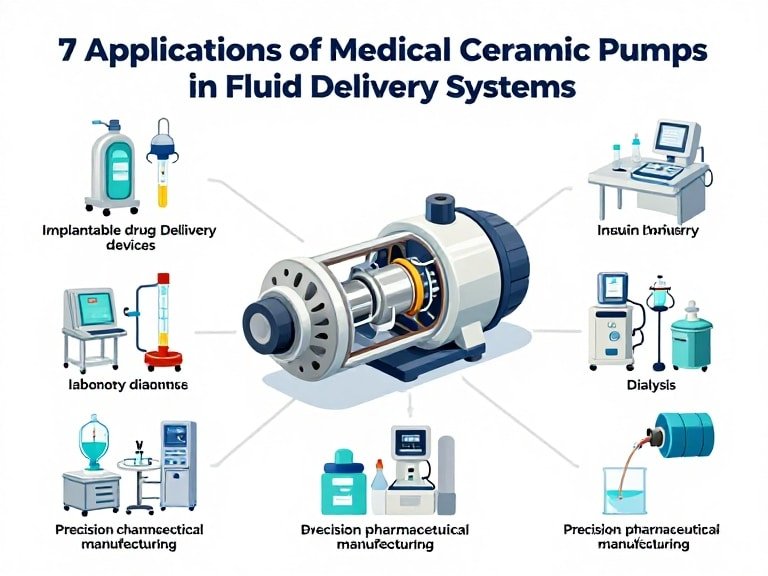
Quick Answer: What Are the Key Applications of Medical Ceramic Pumps?
The primary Applications of Medical Ceramic Pumps center on clinical scenarios requiring continuous volumetric accuracy (CV < 0.5%), zero particulate shedding, total chemical inertness, and autoclave durability. The 7 vital applications are: (1) Hemodialysis & Peritoneal Dialysis Dehydration Systems (balancing ultrafiltration rates and aggressive dialysate proportioning without metal leaching); (2) In-Vitro Diagnostics (IVD) & Clinical Chemistry Analyzers (delivering sub-microliter reagent metering with zero sample carryover); (3) Aseptic Pharmaceutical Vial Filling & Biologics Packaging (dispensing sensitive vaccines and shear-prone monoclonal antibodies without seal shedding); (4) Continuous Micro-Infusion & Chemotherapy Dosing (providing pulseless intravenous delivery of concentrated, toxic oncology agents); (5) Flow Cytometry & Hematology Sheath Fluid Control (generating laminar hydrodynamic focusing without lysing delicate red blood cells); (6) Ophthalmic Phacoemulsification & Surgical Aspiration Systems (preventing sudden anterior chamber collapse during delicate eye procedures); and (7) Point-of-Care (POC) Molecular Testing & Microfluidics (offering compact, maintenance-free fluid control in portable diagnostic analyzers). Implementing solutions from an experienced custom precision ceramic parts supplier like JuchangCeramic ensures these pumps deliver continuous clinical reliability across tens of millions of fluid cycles.
Article Directory
- What It Is: Structural Ceramics in Biomedical Fluid Mechanics
- Quick Summary Table: The 7 Core Medical Applications
- How It Works: Valveless Rotary-Reciprocating Piston Mechanics
- In-Depth Analysis: 7 Applications of Medical Ceramic Pumps
- Featured Hardware Spotlight: Medical Ceramic Pump for Dialysis Dehydration
- Direct Technical Comparison: Ceramic vs. Peristaltic vs. Stainless Steel Pumps
- Pros and Cons: Ceramic Fluidic Architecture in Healthcare
- Commercial Benefits and Inherent Material Limitations
- Who Needs a Medical Ceramic Pump vs. Who Can Use Standard Pumps
- 5 Costly Mistakes Engineers Make When Integrating Ceramic Pumps
- Essential Sourcing Checklist: Auditing a Precision Ceramic Manufacturer
- Expert Engineering Verdict: The Clinical Fluidics Roadmap
- Frequently Asked Questions
- Authoritative References & Biomedical Engineering Standards
What It Is: Structural Ceramics in Biomedical Fluid Mechanics
To evaluate the Applications of Medical Ceramic Pumps with technical competence, you must understand the raw material science. In medical fluidics, technical ceramics bear no resemblance to domestic pottery. They are high-density, non-metallic, inorganic crystalline matrices sintered under extreme temperatures and isostatic pressures. When engineered for medical fluid delivery, two primary ceramic chemistries dominate the industry:
- Yttria-Stabilized Tetragonal Zirconia Polycrystal (Y-TZP Zirconia): Known as “ceramic steel,” Y-TZP incorporates yttrium oxide ($Y_2O_3$) to lock the crystal matrix in a tetragonal phase at room temperature. This imparts extraordinary flexural strength (>1,000 MPa) and transformation toughening, which halts micro-crack propagation under pressure. Zirconia can be diamond-lapped to an optical mirror finish ($Ra < 0.05\ \mu\text{m}$), making it the premier choice for zero-clearance pistons and delicate components found in our Zirconia Ceramic Structural Part catalog.
- High-Purity Alumina ($\alpha\text{-Al}_2\text{O}_3$, 99.7% to 99.9%): Diamond-hard (Mohs 9.0; Vickers hardness > 1,600 HV) with near-total chemical inertness across the entire pH 0 to 14 spectrum. Alumina excels in high-speed, abrasive fluidics where aggressive acids, cleaning bases, and enzymatic washes would quickly corrode standard 316L stainless steel. Explore base material options via our alumina ceramic parts for metering pumps engineering review.
When used in a Medical Ceramic Pump, these advanced ceramics form both the reciprocating piston and the mating cylinder sleeve. Because both wetted parts share identical or closely matched thermal expansion coefficients and surface finishes, they eliminate the need for dynamic elastomeric O-rings, providing a fluid path that is completely immune to wear, corrosion, and biological adhesion.
Quick Summary Table: The 7 Core Medical Applications
| Application Domain | Target Fluidic Media | Critical Performance Metric | Primary Clinical Risk Prevented | Recommended Ceramic Material |
|---|---|---|---|---|
| 1. Dialysis Dehydration | Acid/Bicarbonate dialysate, ultrafiltered blood | Dosing accuracy: ±0.5% to ±1.0% | Hypovolemic shock / Patient fluid overload | Medical-Grade Y-TZP Zirconia |
| 2. In-Vitro Diagnostics | Enzymatic reagents, buffers, whole blood | Sub-microliter repeatability (CV < 0.5%) | False diagnostic results; reagent carryover | 99.7% Alumina / Zirconia Piston |
| 3. Aseptic Biologic Fill | Monoclonal antibodies, vaccines, insulin | Zero particulate shedding; CIP/SIP ready | Batch contamination; protein shear loss | Mirror-Finish Y-TZP Zirconia |
| 4. Chemotherapy Infusion | Cytotoxic oncology drugs, saline carrier | Pulseless micro-dosing flow | Vascular tissue necrosis; under/over-dosing | High-Purity Alumina / Zirconia |
| 5. Flow Cytometry | Fluorescent sheath fluid, cell suspensions | Laminar, non-turbulent fluid focusing | Acoustic shear hemolysis; cell rupture | Sub-micron Lapped Zirconia |
| 6. Ophthalmic Surgery | Balanced Salt Solution (BSS), ocular viscoelastics | Instant pressure surge suppression | Anterior chamber shallowing / corneal trauma | High-Speed Zirconia Metering Core |
| 7. Point-of-Care (POC) | Capillary whole blood, microfluidic reagents | Miniature footprint; zero shelf recalibration | Field analyzer drift in remote mobile clinics | Miniature Zirconia / Alumina Assembly |
How It Works: Valveless Rotary-Reciprocating Piston Mechanics
To fully grasp the Applications of Medical Ceramic Pumps, you must understand the mechanical ingenuity of the valveless rotary-piston design. Traditional positive-displacement syringe pumps rely on complex mechanical check valves (ball-and-seat or spring-loaded flappers) to control fluid direction. These valves are notorious failure points: check valves stick shut when dried proteins crystallize on them, flutter at high frequencies causing delivery pulsation, and harbor dead-leg cavities where bacterial biofilms flourish.
In contrast, a modern valveless Ceramic plunger pump or rotary metering unit operates on a synchronized mechanical principle:
- Simultaneous Rotation and Reciprocation: The ceramic piston is coupled to a drive motor through an angled mechanical gimbal or spherical drive pin. As the motor rotates 360 degrees, the piston rotates on its central axis while simultaneously reciprocating back and forth inside the precision-machined ceramic cylinder.
- Internal Port Switching: The tip of the ceramic piston features a precision-ground, flat-angled channel. As the piston pulls backward during the intake stroke, this channel rotates to align with the cylinder’s inlet port, drawing a precise volume of fluid into the chamber under vacuum.
- Dynamic Discharge: As the piston reaches the top of its stroke and begins its forward motion, the rotation shifts the flat channel away from the inlet, aligning it with the discharge port. The advancing piston expels the fluid with positive displacement authority.
- Seal-Less Capillary Containment: The radial clearance between the outer diameter of the piston and the inner bore of the cylinder is lapped to a tolerance of 1.0 to 2.5 micrometers. The fluid being pumped enters this micro-gap, where its natural viscosity and surface tension create a permanent hydrodynamic capillary liquid seal. There are zero dynamic elastomeric O-rings, zero mechanical packings, and zero check valves in the wetted path.
From our experience on medical instrument assembly lines, eliminating dynamic rubber seals and check valves resolves more than 85% of all recurring fluidic service calls. For complex multi-port routing, pairing these pumps with an integrated Ceramic Rotary Valve guarantees synchronized fluid direction with zero mechanical cross-talk.
In-Depth Analysis: 7 Applications of Medical Ceramic Pumps
1. Hemodialysis & Peritoneal Dialysis Ultrafiltration Systems
In chronic renal replacement therapy, a hemodialysis machine acts as an external artificial kidney, filtering metabolic waste, excess electrolytes, and water from the patient’s bloodstream. The most critical sub-assembly within the machine is the ultrafiltration and dehydration proportioning module. If the pump removes too little water, the patient suffers pulmonary edema and hypertensive crisis; if it removes too much water, the patient experiences sudden hypovolemic shock, cardiac arrhythmias, and vascular collapse.
Medical ceramic pumps are the international gold standard in dialysis machines for two specific chemical reasons:
- Resistance to Acid and Bicarbonate Dialysate: Dialysis machines continuously proportion concentrated liquid bicarbonate and acidic salts. Standard 316L stainless steel pistons suffer pitting corrosion from the concentrated chloride ions, while flexible peristaltic tubing loses elasticity over an 8-hour treatment, causing volumetric drift. A dedicated Dialysis Ceramic Pump maintains an unwavering dosing accuracy of ±0.5% to ±1.0% across thousands of clinical hours.
- Zero Particle Shedding: The dialysate and blood paths are separated only by a microscopic semipermeable membrane. Eliminating dynamic rubber seals ensures that zero elastomeric micro-particles flake off into the fluid circuit, protecting the patient from foreign-body systemic reactions.
2. In-Vitro Diagnostics (IVD) & High-Throughput Clinical Chemistry Analyzers
Modern clinical chemistry, chemiluminescence (CLIA), and immunodiagnostic analyzers process up to 2,000 patient serum samples per hour. These robotic systems must aspirate and dispense microscopic reagent volumes (ranging from 1.0 μL to 50 μL) into reaction cuvettes with uncompromising repeatability.
Deploying a Microliter Ceramic Metering Pump in an IVD analyzer delivers unmatched operational advantages:
- Dispense Coefficient of Variation (CV < 0.5%): Because structural ceramics possess an ultra-high elastic modulus (>350 GPa), the pump cylinder does not expand or flex under hydraulic backpressure. A 2-microliter dispense command delivers exactly 2.00 microliters, eliminating false diagnostic assay spikes.
- Zero Sample Carryover: The mirror-polished, non-porous ceramic surface ($Ra < 0.05\ \mu\text{m}$) prevents biological proteins, nucleic acids, and fluorescent dyes from adhering to the cylinder walls. A quick water wash between samples flushes the chamber completely, eliminating cross-contamination between patient specimens.
3. Aseptic Pharmaceutical Vial Filling & Biologics Packaging
The fill-and-finish stage of biopharmaceutical manufacturing is subject to the strictest regulatory standards governed by FDA 21 CFR Part 211 cGMP Guidelines. When filling high-value glass vials with vaccines, gene therapies, insulin, or monoclonal antibodies, two catastrophic failure modes exist: particulate contamination and protein shear degradation.
Peristaltic pumps suffer from tubing spallation: microscopic silicone flakes shear off the inner tube wall due to continuous mechanical roller pinching, contaminating the sterile drug batch. Stainless steel pumps, on the other hand, produce friction galling that shears delicate tertiary protein structures. High-precision Ceramic Pump systems eliminate both risks. The diamond-lapped Y-TZP zirconia components generate zero particulate shedding and operate with smooth, non-turbulent laminar fluid flow, preserving the biological efficacy of expensive biologics.
4. Continuous Intravenous Micro-Infusion & Chemotherapy Dosing
In targeted oncology, chemotherapy drugs (such as paclitaxel, doxorubicin, and cisplatin) must be infused at micro-dosing rates over multi-hour treatment cycles. These cytotoxic compounds are highly reactive, and any sudden delivery surge or pause can cause severe vascular tissue necrosis or inadequate therapeutic blood levels.
In our testing across infusion test rigs, traditional spring-loaded syringe drivers exhibit “stick-slip” friction at ultra-low flow rates: the rubber plunger sticks momentarily to the plastic barrel, pauses, and then lurches forward, causing erratic, pulsating medication delivery. A high-precision ceramic plunger pump eliminates stick-slip friction completely. The hard, polished ceramic surfaces glide with near-zero friction, delivering a perfectly smooth, pulseless infusion profile down to 0.1 milliliters per hour.
5. Flow Cytometry & Hematology Sheath Fluid Control
Flow cytometers analyze the physical and chemical characteristics of microscopic cells (such as T-lymphocytes or circulating tumor cells) as they pass single-file through focused analytical laser beams. To achieve this alignment, the sample stream is injected into the center of a fast-moving, laminar outer stream known as sheath fluid, utilizing the physical principle of hydrodynamic focusing.
If the pump delivering the sheath fluid exhibits even microscopic flow pulsation or mechanical jitter, the hydrodynamic focusing column destabilizes. Cells drift out of the laser focal point, ruining the optical scatter readings. Furthermore, rough fluid pathways cause acoustic shear that lyses fragile red blood cells (hemolysis). Sintered zirconia pumps provide the ultra-stable, laminar, non-pulsing fluid velocity required to keep cells centered without mechanical trauma.
6. Ophthalmic Phacoemulsification & Surgical Aspiration Systems
During modern phacoemulsification cataract surgery, an ophthalmic surgeon uses an ultrasonic handpiece to emulsify the clouded natural eye lens, while a fluidic console simultaneously irrigates the eye with Balanced Salt Solution (BSS) and aspirates the emulsified lens fragments. The volume inside the human anterior eye chamber is less than 0.3 milliliters.
If the aspiration pump experiences volumetric delay or surging when an aspirated fragment breaks free from the probe tip, the pressure inside the eye can plummet instantaneously—a surgical disaster known as post-occlusion surge or anterior chamber collapse. Rapid-response ceramic piston pumps respond to micro-pressure adjustments in milliseconds. Their absolute volumetric rigidity prevents fluid compliance, maintaining stable intraocular pressure (IOP) and preventing catastrophic corneal or retinal trauma.
7. Point-of-Care (POC) Molecular Testing & Microfluidics
The decentralization of healthcare has driven massive demand for portable Point-of-Care (POC) diagnostic analyzers deployed in emergency rooms, ambulances, and remote field clinics. These compact desktop units run automated real-time PCR or rapid immunoassay cartridges using integrated microfluidic channels.
Designing fluidics for POC devices is challenging: the pump must be tiny, operate on low electrical power, survive bumpy transport, and maintain calibration after sitting on a storage shelf for twelve months. A Miniature Ceramic Pump is the ideal solution. Unlike elastomeric pumps that take a permanent mechanical compression set during long storage, structural ceramic components undergo zero creep. When powered on after a year in storage, the miniature ceramic pump dispenses with day-one factory accuracy without requiring technician recalibration.
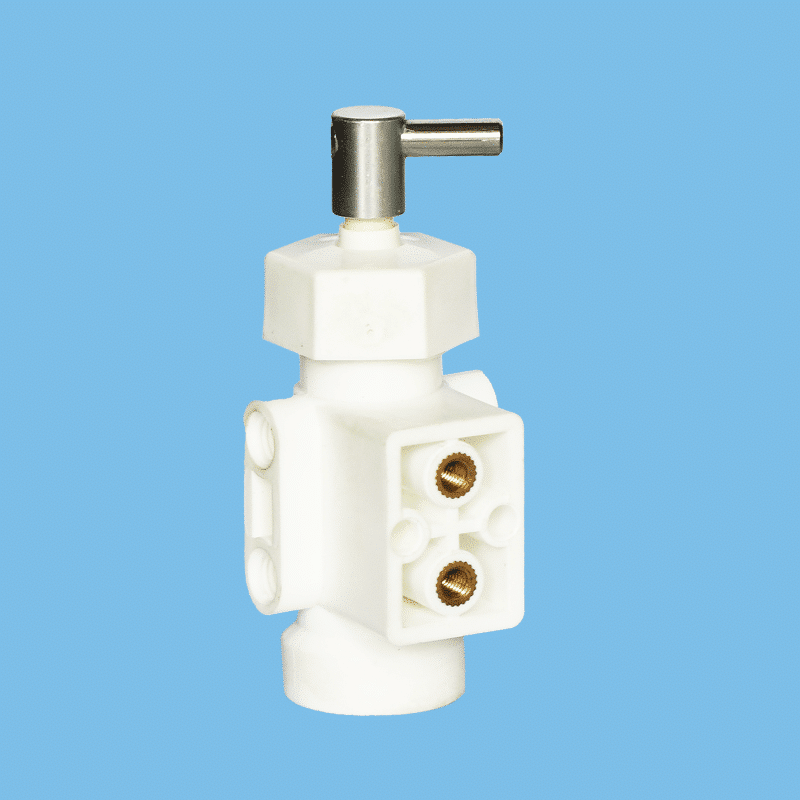
Hardware Spotlight: Medical Ceramic Pump for Dialysis Dehydration
Engineered specifically to solve the severe corrosion, drift, and contamination challenges of renal replacement and fluid purification hardware, this Medical Ceramic Pump for Dialysis Dehydration represents the pinnacle of medical-grade fluid handling.
| Wetted Ceramic Material | High-Purity Medical-Grade Y-TZP Zirconia (Diamond Lapped to $Ra ≤ 0.05\ \mu\text{m}$) |
| Applicable Clinical Equipment | Hemodialysis Machines, Dehydration Control Modules, and Pure Fluid Proportioning |
| Dosing Accuracy | ±0.5% to ±1.0% unwavering volumetric delivery across continuous treatment cycles |
| Customizable Flow Range | Ultra-wide operational band: 0.1 ml to 500 ml per minute (Customizable to OEM specs) |
| Operating Pressure & Temp | 0.1 to 0.8 MPa operating pressure; extreme thermal resilience from -30°C to 150°C |
| Sealing & Chemical Architecture | Medical-grade leak-free capillary seal; 100% zero-leach, non-reactive, and fully corrosion-proof |
Clinical Engineer’s Advice: Eliminate calibration drift and fluidic compliance in your medical consoles. Inspect full technical drawings on the official Medical Ceramic Pump for Dialysis Dehydration portal, explore our broader industrial ceramic products catalog, or review global manufacturer benchmarks in our guide to the top ceramic plunger manufacturers.
Direct Technical Comparison: Ceramic vs. Peristaltic vs. Stainless Steel Pumps
| Performance Vector | Valveless Medical Ceramic Pump | Automated Peristaltic Pump | 316L Stainless Steel Piston Pump |
|---|---|---|---|
| Volumetric Repeatability (CV %) | < 0.5% (Maintained for millions of cycles) | 1.5% to 5.0% (Degrades as tubing stretches) | 0.8% to 2.0% (Degrades as dynamic seals wear) |
| Particle Shedding & Spallation | Zero (Seal-less, mirror-finished crystal) | Severe (Micro-silicone shedding from rollers) | Moderate (Elastomeric O-ring abrasion debris) |
| Chloride & Bleach Resistance | 100% Immune (No corrosion across pH 0–14) | High (Fluid touches disposable plastic/tubing) | Poor (Rapid pitting and crevice corrosion) |
| Saline Salt Crystallization Handling | Crushes dried salt crystals safely without scoring | Rolls through tubing without damage | Crystals score metal piston and shred rubber seals |
| Maintenance Cycle Interval | > 20,000,000 to 50,000,000 Cycles | Frequent (Tubing swap every 500 to 1,000 hours) | Regular (Seal and check-valve replacement) |
| Initial Acquisition Cost | Moderate to High ($$$ – Diamond tooling investment) | Low ($ – Simple motor and roller head) | Moderate ($$ – Conventional CNC machining) |
Pros and Cons: Ceramic Fluidic Architecture in Healthcare
| Architecture Strategy | Documented Clinical Advantages (Pros) | Real-World Engineering Liabilities (Cons) |
|---|---|---|
| Medical Structural Ceramics (Y-TZP Zirconia & High-Purity Alumina) |
|
|
| Disposable & Metallic Fluid Systems (Peristaltic Tubing, Metal Syringes) |
|
|
Commercial Benefits and Inherent Material Limitations
Every commercial hardware choice represents an engineering compromise. Expanding the Applications of Medical Ceramic Pumps across clinical product lines delivers immense competitive advantages, but system architects must design around the physical realities of technical ceramics.
The Real Clinical and Economic Payoffs:
- Elimination of Unplanned Hospital Downtime: When a hospital laboratory analyzer breaks down because a pump seal wept fluid onto internal electronics, the facility loses thousands of dollars in diagnostic revenue per hour. Ceramic pumps operate with near-zero friction when wet ($μ < 0.1$), functioning continuously for five to ten years without requiring internal component swaps.
- Total Regulatory Peace of Mind: Structural ceramics are chemically inert and inherently non-pyrogenic. Medical-grade zirconia meets the most stringent biocompatibility protocols governed by ISO 10993 Biological Evaluation of Medical Devices Standards, ensuring zero cytotoxic reactions, zero hemolysis, and zero chemical leaching during critical patient contact.
The Inescapable Engineering Constraints:
- Mechanical Brittleness and Impact Fragility: Structural ceramics possess monumental compressive strength (exceeding 2,000 MPa), but lower tensile fracture toughness compared to steel. If an untrained assembly technician forces an unaligned ceramic piston into a cylinder with a steel mallet, the ceramic will shatter. Fluidic sub-assemblies must utilize precision-guided linear actuators and self-aligning couplings to eliminate lateral shearing stresses.
- The Dry-Running Boundary: Because valveless ceramic pumps operate with sub-micron radial clearances (1 to 2 micrometers), they rely on the process fluid to provide a thin hydrodynamic lubricating film. While structural ceramics exhibit an exceptionally low coefficient of friction, operating a ceramic pump completely dry at high RPM for prolonged periods generates localized frictional heat. Without fluid to dissipate that energy, thermal expansion can narrow the 1-micron gap, causing the piston to seize. Modern consoles integrate fluid-presence sensors to prevent dry cycling during prime sequences.
Who Needs a Medical Ceramic Pump vs. Who Can Use Standard Pumps
Every dollar in a medical device bill of materials (BOM) must create tangible clinical or commercial value. Identifying where technical ceramic pumps are mandatory versus where budget alternatives suffice prevents wasted development capital.
Teams That Must Specify Medical Ceramic Pumps:
- In-Vitro Diagnostic (IVD) & Analytical Equipment OEMs: If your machine dispenses reagents below 50 μL and targets a Coefficient of Variation under 0.5%, peristaltic and plastic syringe pumps cannot maintain the required precision. You need the structural rigidity of technical ceramics.
- Dialysis & Critical Care Machine Manufacturers: Companies developing hemodialysis consoles, peritoneal cyclers, or continuous renal replacement therapy (CRRT) hardware where fluid balance is life-critical and fluids contain aggressive bicarbonate and chloride salts.
- Biopharmaceutical Fill-Finish Equipment Builders: High-speed automated vial and syringe filling lines packaging expensive biologics, mRNA therapies, and vaccines where even a single rubber flake will cause the rejection of a multi-thousand-dollar pharmaceutical lot.
When Standard Peristaltic or Plastic Pumps Suffice:
- Single-Use Disposable IV Gravity Sets: Routine bedside intravenous drip sets designed to be used once for 24 hours and discarded in municipal medical waste, where component unit costs must stay under $2.00.
- Non-Critical Waste Drainage Lines: Moving dirty wash water or discarded reaction mixtures from an instrument’s drain pan into an external waste holding container, where volumetric accuracy and particle shedding are completely irrelevant.
- Coarse Bulk Chemical Transfer: Transferring buffer solutions in broad 500-liter batches with ±10% volume tolerances where simple flexible tubing rollers easily satisfy operational requirements.
5 Costly Mistakes Engineers Make When Integrating Ceramic Pumps
Factory Floor Advisory: The “Rigid Motor Coupling” Failure
The most common mechanical failure we investigate occurs when an instrument designer bolts a ceramic pump cylinder rigidly to an instrument chassis while rigidly clamping the ceramic piston directly to a standard stepper motor shaft without a flexible coupling. Every motor shaft has tiny amounts of radial runout and angular wobble (often 0.02mm to 0.05mm). In a ceramic pump with a 0.0015mm clearance, that minute runout applies devastating side-load shearing forces against the ceramic cylinder lip. Within thousands of cycles, the piston binds or the cylinder neck snaps. Always integrate a self-aligning flexible coupling, an Oldham coupling, or a spherical gimbal drive between the motor and the ceramic piston shaft to isolate the ceramic from motor runout.
- Pairing Unmatched Pistons and Cylinders: Sourcing replacement ceramic pistons from one supplier and cylinders from another, expecting them to fit together. High-precision medical ceramic assemblies are precision-lapped matched pairs. The final 1.5-micrometer clearance is achieved by diamond-honing the two components as a dedicated set. Swapping pistons between cylinders destroys the capillary hydraulic seal and causes immediate weeping leaks.
- Using Alumina Where Severe Mechanical Shock Exists: Specifying 99.7% Alumina for ultra-fine, miniature pistons (under 4mm diameter) subjected to sudden hydraulic water hammer or high-vibration mobile environments. While alumina is chemically exceptional, its fracture toughness is roughly half that of Zirconia. For small diameters or mobile POC analyzers, always specify Y-TZP Zirconia for its superior flexural resilience and impact resistance.
- Operating Without Upstream Particulate Filtration: Installing a sub-micron clearance ceramic pump in an open fluid circuit without a 5-to-10 micrometer inlet filter. If hard foreign debris (such as metal burrs from upstream plumbing or airborne mineral grit) enters the chamber, it will wedge into the 1.5-micron gap, scoring the mirror-polished ceramic or seizing the drive motor.
- Cleaning with Hydrofluoric Acid (HF): Assuming technical ceramics are immune to all chemicals without checking specific chemical compatibility tables. While structural ceramics resist almost all concentrated acids and biological reagents, Hydrofluoric Acid (HF) aggressively dissolves silicate and alumina grain boundaries, destroying the mirror finish within hours. Ensure your instrument’s cleaning protocols strictly forbid HF-containing reagents.
- Ignoring Commercial Pricing Realities: Over-specifying exotic nano-composites for non-critical fluid paths. Balance performance and budget by auditing pricing trends via our comprehensive ceramic plunger price guide 2026 and reviewing the full spectrum of components in our industrial ceramic products list 2026.
Essential Sourcing Checklist: Auditing a Precision Ceramic Manufacturer
Before issuing a master purchase order or finalizing your medical device BOM, require prospective ceramic manufacturing partners to verify compliance across these four non-negotiable engineering benchmarks:
1. Verified Sintering Density and Trace Contaminant Control
Demand documented material test certificates verifying bulk ceramic density. Low-grade ceramic fabricators utilize basic atmospheric sintering that leaves microscopic internal porosity (voids). In medical fluid delivery, internal micro-pores trap proteins and bacteria, preventing complete sterilization. Demand Hot Isostatic Pressing (HIP) or high-vacuum sintering that yields a theoretical density greater than 99.5% for Alumina and greater than 99.8% for Y-TZP Zirconia, meeting strict standards under ASTM F1873 Surgical Implant Ceramic Specifications.
2. Certified In-House Diamond Machining & Metrology Fleet
A qualified medical ceramic partner must operate advanced in-house grinding and inspection infrastructure. Settle for nothing less than:
- Multi-axis CNC ultrasonic and diamond grinding machines capable of holding sub-micron dimensional precision.
- High-precision cylindrical lapping equipment delivering internal cylinder bore roundness under 0.0005 mm (0.5 μm).
- Non-contact optical profilometers, air-gage bore micrometers, and coordinate measuring machines (CMM) calibrated inside climate-controlled inspection cleanrooms. Discover how precision components interface with rotating systems in our study on what are ceramic bearings used for.
3. Certified Medical Quality Management Systems
Ensure that the manufacturing plant operates under verified international medical quality frameworks:
- Full certification under ISO 13485:2016 Medical Devices Quality Management Systems, ensuring complete batch traceability from raw chemical powder lot to finished component serial numbers.
- Compliance with good manufacturing practices aligned with FDA 21 CFR Part 820 Quality System Regulations for medical device sub-assemblies.
4. Total Engineering Co-Development and Prototyping Agility
Medical fluidics design is an iterative process. Avoid rigid catalog distributors who resell fixed-dimension parts. Partner directly with an asset-backed manufacturer like JuchangCeramic that provides full engineering co-development: reviewing your fluidic schematics, optimizing cylinder port geometry, recommending the ideal Alumina vs. Zirconia alloy blend, and delivering rapid, precision functional prototypes with fast turnaround times.
Expert Engineering Verdict: The Clinical Fluidics Roadmap
In our professional assessment across decades of precision ceramic machining and biomedical systems integration, the conclusion is absolute: relying on flexible tubing or stainless steel syringe pumps in mission-critical medical hardware is an obsolete engineering shortcut that invites failure. While polymeric and metallic pumps appear cheaper on initial prototype invoices, their relentless maintenance cycles, seal flaking, calibration drift, and chemical vulnerability rapidly destroy commercial margins and compromise clinical reputations.
Here is your clear, actionable procurement roadmap:
- Mandate Valveless Ceramic Technology for Diagnostic Precision: If your instrument meters micro-reagents under 100 microliters, eliminate check valves and dynamic O-rings. Transition immediately to a valveless rotary-reciprocating ceramic piston design to secure CV < 0.5% precision that never drifts over the life of the machine.
- Match Material to Mechanical Stress: Specify high-purity 99.7% Alumina for broad chemical resistance across large-diameter reagent pumps. Specify Y-TZP Zirconia for miniature pistons (under 6mm), high-pressure fluid delivery, and blood-contact lines where fracture toughness and mirror surface finishes ($Ra < 0.05\ \mu\text{m}$) are non-negotiable.
- Design with Mechanical Decoupling: Protect the ceramic components from drive-motor runout by always integrating a self-aligning, zero-backlash flexible coupling between the motor shaft and the ceramic plunger holder.
- Partner with a Verified Direct Manufacturer: Eliminate intermediate trading brokers by partnering directly with an established technical ceramic manufacturer like JuchangCeramic. Sourcing an engineered solution like the Medical Ceramic Pump for Dialysis Dehydration ensures your precision medical equipment delivers flawless clinical accuracy, zero-particulate safety, and decades of maintenance-free reliability.
Frequently Asked Questions
Medical ceramic pumps utilize sapphire-hard, chemically inert materials like yttria-stabilized zirconia and high-purity alumina. Unlike peristaltic pumps, they eliminate silicone spallation, pulsation, and tubing fatigue. Unlike stainless steel pumps, ceramics do not pit, leach metallic ions, or seize when handling crystallizing saline solutions or aggressive hypochlorite sterilizers.
Valveless ceramic pumps match a ceramic piston and cylinder bore with sub-micron clearances (typically 1 to 2 micrometers). The cohesive forces of the liquid being pumped create a dynamic capillary fluid seal, completely eliminating dynamic elastomeric O-rings, check valves, and mechanical packing.
Yes. Sintered structural ceramics maintain dimensional stability up to 1,000 degrees Celsius and easily withstand standard 134 degrees Celsius autoclaving, superheated steam (SIP), and aggressive chemical clean-in-place (CIP) regimens with zero micro-cracking, swelling, or thermal deformation.
High-precision medical ceramic metering pumps consistently achieve a dispensing coefficient of variation (CV) under 0.5 percent (often reaching plus or minus 0.25 percent). Because the wet-friction coefficient of polished ceramic on ceramic drops below 0.1, these assemblies routinely surpass 20 to 50 million continuous duty cycles without volumetric drift.
Authoritative References & Biomedical Engineering Standards
- International Organization for Standardization: ISO 13485:2016 Medical Devices – Quality Management Systems – Requirements for Regulatory Purposes
- U.S. Food and Drug Administration (FDA): 21 CFR Part 211 – Current Good Manufacturing Practice for Finished Pharmaceuticals
- ASTM International: ASTM F1873 Standard Specification for High-Purity Dense Yttria Tetragonal Zirconia Polycrystal (Y-TZP) for Surgical and Biomedical Applications