
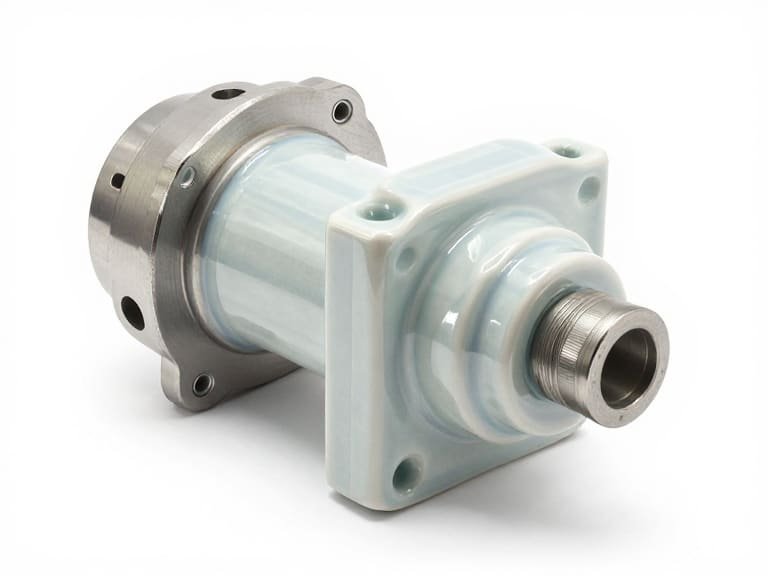
Quick Answer: Primary Considerations for Custom Ceramic Plunger Pump Projects
To successfully engineer a high-reliability fluid displacement assembly, the ten vital considerations for custom ceramic plunger pump design are: (1) Structural Ceramic Grade Selection (choosing between the extreme fracture toughness of Y-TZP Zirconia vs. the cost-effective chemical resistance of 99.5%+ Alumina); (2) Micron-Level Diametrical Clearances (maintaining a 2 to 5 μm gap for seal-less hydrodynamic fluid films); (3) Diamond Superfinishing and Surface Topography (targeting Ra 0.05 to 0.20 μm to protect dynamic packing rings); (4) Rigid Cylindricity, Circularity, and Runout Limits (keeping total indicated runout under 0.003 mm); (5) Mechanical Holder and Crosshead Joint Decoupling (avoiding direct threads; using floating spherical joints); (6) Thermal Shock and Gradient Management (limiting sudden temperature deltas to ΔT < 120°C); (7) Cavitation, Pressure Spikes, and Hydrodynamic Design; (8) Chemical Corrosion and Grain Boundary Leaching Resistance; (9) Generous Lead-In Chamfers and Radiused Edges (preventing micro-chipping during assembly); and (10) Dynamic Seal and Bushing Metallurgy Compatibility (pairing with virgin PEEK, filled PTFE, or matching ceramic sleeves). Partnering with an integrated, high-precision manufacturer like JuchangCeramic ensures these parameters are factored in during raw powder pressing, sintering, and CNC diamond finishing.
Table of Contents
- What It Is: The Mechanics of Ceramic Plungers in Reciprocating Pumps
- Quick Summary Table: Key Engineering Design Parameters
- The 10 Critical Considerations for Custom Ceramic Plunger Pump Design
- Manufacturer Spotlight: JuchangCeramic Custom Precision Solutions
- Direct Technical Comparison: Zirconia vs. Alumina vs. Metallic Alloys
- Pros and Cons: Technical Ceramic Plungers vs. Metallic Counterparts
- Operational Realities: Hardness vs. Fracture Brittleness
- Who Should Use Ceramic Plunger Pumps vs. Who Does Not Need Them
- Common Costly Mistakes in Ceramic Component Design
- Sourcing & Procurement Checklist: Auditing Ceramic Manufacturers
- Expert Sourcing Verdict: The Engineering Roadmap
- Frequently Asked Questions
- Authoritative References & Engineering Standards
What It Is: The Mechanics of Ceramic Plungers in Reciprocating Pumps
A reciprocating plunger pump operates on positive displacement: a smooth cylindrical rod enters and retracts from a sealed fluid chamber. During the suction stroke, the retracting plunger drops chamber pressure, drawing process media past the inlet check valve. During the discharge stroke, the advancing plunger displaces volume, forcing fluid past the discharge check valve under intense pressure. Unlike a piston pump—which utilizes an elastomeric seal attached directly to the reciprocating head that moves against an internal cylinder wall—a plunger pump passes a smooth, static-diameter rod through a stationary packing seal or a high-precision, close-tolerance guide sleeve.
When high operating pressures (10 to 500+ bar) or micro-liter precision dispensing are required, metallic components fail due to micro-weld adhesion, frictional scoring, and corrosive pit formation. A custom Ceramic plunger pump replaces raw metal shafts with dense structural ceramics—primarily Yttria-Stabilized Tetragonal Zirconia Polycrystal (Y-TZP) or High-Purity Aluminum Oxide ($Al_2O_3$). These materials are inorganic, non-metallic solids formed through cold isostatic pressing (CIP) and sintered at temperatures exceeding 1,500°C to achieve near-theoretical densities (>99.5%).
In our testing, technical ceramics provide four distinct mechanical barriers that metals cannot duplicate:
- Vickers Hardness Exceeding 1,200 to 1,800 HV: Harder than tool steels and tungsten carbide, rendering the plunger virtually immune to abrasive scratch damage from crystallized salts, particulate slurries, and hard mineral suspensions.
- Complete Chemical Inertness: Zero ionic leaching, oxidation, or rusting across the entire pH spectrum (0 to 14, depending on the oxide system), critical for a sterile Medical Ceramic Pump or critical pharmaceutical production line.
- Zero Dynamic Cold-Welding: Metals moving against metals under high friction experience atomic boundary micro-welding (galling). Ceramic oxide crystals possess complete covalent and ionic bonding, meaning they cannot gall or bond against dynamic PTFE, UHMW-PE, or metallic glands.
- Near-Zero Thermal Expansion: Linear expansion coefficients are half that of stainless steel, preserving micro-meter hydrodynamic clearances through continuous operating cycles.
However, these extraordinary physical benefits come with an unyielding rule: ceramics have zero yield ductility. They cannot deform plastically to relieve localized mechanical stress. Every mechanical interface must be planned around this reality.
Quick Summary Table: Key Engineering Design Parameters
| Design Parameter | Target Engineering Specification | Primary Material Grade | Critical Failure Prevented | Performance Impact |
|---|---|---|---|---|
| 1. Material Chemistry | Y-TZP Zirconia (≥94.5%) / Alumina (≥99.5%) | Zirconia for toughness; Alumina for acids | Brittle fracture; chemical leaching | Dictates base mechanical and chemical envelope |
| 2. Diametrical Clearance | 2.0 to 5.0 μm (Seal-less) / 0.05–0.1 mm (Packed) | Matched ceramic-to-ceramic sets | Fluid blow-by; mechanical seizure | Governs volumetric dosing accuracy (±0.5%) |
| 3. Surface Roughness ($Ra$) | Ra 0.05 to 0.20 μm (2 to 8 μin); diamond superfinish | Fine-grain diamond wheel + diamond paste | Dynamic lip seal shredding; dry friction | Multiplies packing seal lifespan by 5× to 10× |
| 4. Geometric Tolerances | Circularity < 0.002 mm; Cylindricity < 0.003 mm | Centerless diamond grinding | Localized line pressure; fluid leakage paths | Eliminates asymmetric seal wear and pressure drops |
| 5. Drive Coupling Interface | Floating spherical drive; glued/shrink-fit stud | 316L/17-4PH collar with elastomeric cushion | Tensile bending moment fracture | Isolates ceramic from motor misalignment loads |
| 6. Thermal Gradient (ΔT) | ΔT < 100°C (Alumina) / ΔT < 150°C (Zirconia) | Y-TZP preferred for variable CIP loops | Catastrophic thermal shock cracking | Enables aggressive Clean-In-Place (CIP) sanitation |
| 7. Edge Geometry | 15° to 20° lead-in chamfer; R ≥ 0.5 mm blended radii | CNC contour diamond tool | Edge chipping during seal insertion | Guarantees zero-defect factory assembly |
The 10 Critical Considerations for Custom Ceramic Plunger Pump Design
1. Material Grade Selection: Y-TZP Zirconia vs. High-Purity Alumina
The first and most critical fork in the road when planning considerations for custom ceramic plunger pump components is selecting the base crystal chemistry. In most professional situations, engineers default to specifying “ceramic” as a monolithic category. This is an expensive mistake. Alumina ($Al_2O_3$) and Zirconia ($ZrO_2$) exhibit radically different physical mechanics under load.
High-Purity Alumina (99.5% to 99.9%) is extremely hard (~1,600 to 1,800 HV), electrically insulating, and demonstrates superior chemical inertness in highly concentrated, boiling strong acids (such as sulfuric or nitric acid). However, alumina has a modest fracture toughness ($K_{1c} \approx 3.5\text{ MPa}\cdot\text{m}^{1/2}$). It is sensitive to impact shocks and mechanical flexure. We recommend alumina primarily for stationary cylinder sleeves, chemical dosing pumps, or abrasive slurry handling where mechanical shock loads are low. To explore raw structural differences, review our engineering comparison on zirconia vs alumina ceramic components.
Yttria-Stabilized Tetragonal Zirconia Polycrystal (Y-TZP, typically 3 mol% $Y_2O_3$), by contrast, is the reigning champion for high-pressure reciprocating plungers. Zirconia possesses a unique metallurgical phenomenon called transformation toughening. When a microscopic stress crack initiates in Y-TZP, the high localized tensile stress triggers a crystal phase transformation from the metastable tetragonal phase to the monoclinic phase. This transformation involves a 3% to 5% volumetric expansion, which physically squeezes the advancing crack tip shut, halting crack propagation. With a fracture toughness of $K_{1c} \approx 8\text{ to }10\text{ MPa}\cdot\text{m}^{1/2}$ and flexural strength exceeding 1,000 MPa, a Zirconia Ceramic Structural Part absorbs the reciprocating hydraulic shocks, eccentricities, and pressure spikes of heavy-duty pumping without catastrophic failure. For critical dosing, selecting high precision zirconia ceramic parts is mandatory.
2. Diametrical Clearances and Hydrodynamic Fluid Film Physics
Depending on pump architecture, a ceramic plunger operates in one of two configurations: through an elastomeric/PTFE packing seal assembly, or inside an unsealed, high-precision ceramic cylinder sleeve (clearance-seal design). In precision seal-less pumps—such as a Microliter Ceramic Metering Pump or an automated Dialysis Ceramic Pump—the volumetric efficiency relies entirely on the fluid barrier within the microscopic diametrical gap.
In our testing, the ideal diametrical clearance for seal-less plunger-sleeve pairings sits precisely between 2.0 and 5.0 microns (0.002 to 0.005 mm).
- If the diametrical clearance exceeds 7 microns, low-viscosity fluids (such as water, saline, or solvents) experience laminar slip, resulting in unacceptable internal blow-by and loss of dosing precision.
- If the clearance drops below 1.5 microns, boundary friction spikes. Any trace particulate in the pumped fluid—or minor thermal expansion during continuous running—will wedge into the gap, causing catastrophic hydraulic seizure and scoring the ceramic faces.
Achieving this clearance requires match-grinding and selective assembly pairing: the plunger and cylinder sleeve must be honed, measured on air gauges, and serialized as married pairs.
3. Surface Roughness ($Ra$) and Diamond Lapping Topography
One of the most counterintuitive considerations for custom ceramic plunger pump manufacturing is understanding that a surface can actually be too smooth. In standard machining, engineers assume that a mirror polish is always optimal. In reciprocating tribology, this is a dangerous misconception.
If you specify an extreme mirror finish with $Ra < 0.01\text{ }\mu\text{m}$ ($0.4\text{ }\mu\text{in}$), the ceramic surface becomes completely planar. It wipes the dynamic seal lip 100% dry on the outstroke. Without a microscopic lubricating fluid boundary layer, dry boundary friction generates intense localized thermal spikes, melting or hardening dynamic PTFE or elastomeric V-rings within tens of thousands of cycles. Conversely, a surface rougher than $Ra\text{ }0.30\text{ }\mu\text{m}$ acts like a microscopic diamond abrasive file, shredding soft seals and causing premature fluid weeping.
From our experience, the gold-standard surface topography for a reciprocating ceramic plunger operating against packing seals is $Ra\text{ }0.08\text{ to }0.15\text{ }\mu\text{m}$ (3 to 6 micro-inches), achieved via specialized cross-hatch diamond superfinishing. This controlled surface roughness provides microscopic valley pockets that retain a microscopic monolayer of the process fluid, providing hydrodynamic lubrication that keeps packing seals cool and operating smoothly across millions of strokes.
4. Geometric Dimensioning and Tolerancing (GD&T): Concentricity, Cylindricity, and Runout
Because ceramics cannot yield or bend elastically to absorb geometric errors, strict control over Geometric Dimensioning and Tolerancing (GD&T) is mandatory. If a steel plunger has a slight curve or runout, the flexible metal flexes imperceptibly within the seal gland. If a ceramic plunger has runout, it exerts intense asymmetrical point-loading against the packing gland or sleeve wall, triggering localized stress concentrations and brittle snapping.
When engineering precision precision ceramic components for pumps, your 2D manufacturing drawings must specify three critical geometric constraints:
- Total Indicated Runout (TIR): Keep total radial runout along the entire working length of the plunger below 0.003 to 0.005 mm.
- Cylindricity and Circularity (Roundness): Maintain circularity within 0.0015 mm. If the plunger is ground on a poorly calibrated centerless grinder, it can develop a three-lobed (lobing) profile that measures correct on simple calipers but leaks fluid around its entire perimeter.
- Straightness: Maintain straightness along the active stroke axis within 0.002 mm per 100 mm of length.
Verify that your supplier utilizes specialized sub-micron coordinate measuring machines (CMM) and Taylor Hobson roundness analyzers to validate these features on final inspection reports.
5. Mechanical Interface and Plunger Holder Joint Engineering
How does a brittle ceramic rod connect to a reciprocating metal crosshead or linear motor actuator? This connection interface is where over 70% of premature field failures occur. Inexperienced designers frequently attempt to cut male screw threads directly into the ceramic rod, or bore and tap female threads into its base. Never cut threads directly into structural ceramics for dynamic load applications. Threads create razor-sharp notch roots with theoretical stress concentration factors ($K_t$) exceeding 3.0 to 5.0. Under cyclic tensile pull, the ceramic will fracture cleanly across the thread root.
High-reliability custom pumps utilize three proven mechanical decoupling interfaces:
- The Floating Spherical Joint: The ceramic plunger is engineered with a radiused flange or mushroom head at its base. A metallic retaining collar holds the flange against a hemispherical bronze or stainless steel ball-seat on the crosshead. This design provides 1 to 2 degrees of angular freedom, ensuring that minor crosshead misalignments do not translate into bending moments across the ceramic shaft. Consult our ceramic plunger holder design guide for detailed schematics.
- Interference Shrink-Fit Metal Studs: A metallic adapter stud (typically 17-4PH stainless steel or Invar) is engineered with a precision bore. The metal collar is induction-heated to expand, slipped over the ground ceramic base, and allowed to cool. The controlled hoop stress creates a high-shear mechanical friction lock without localized stress risers.
- Structural Epoxy Bonding with Radiused Shoulders: For low-to-medium pressure medical and chemical pumps, the ceramic rod is bonded into a metallic socket using aerospace-grade structural epoxy (such as Loctite EA 9394). The joint must include a minimum 0.10 to 0.15 mm controlled adhesive gap and generous transition radii.
6. Thermal Shock Resistance and Operating Temperature Gradients ($\Delta T$)
While technical ceramics possess high continuous service temperatures (Alumina can operate at 1,500°C; Zirconia at 900°C), their thermal conductivity ($k$) is significantly lower than copper or aluminum, and their tensile strength under thermal contraction is limited. The primary thermal failure mode in pumping systems is thermal shock.
Consider a pharmaceutical Clean-In-Place (CIP) cycle: the pump operates with ambient buffer fluid at 20°C, and the system suddenly switches to pressurized steam sanitation at 125°C, followed by a rapid cold rinse. The exterior skin of the ceramic plunger expands or contracts rapidly while the core remains stable. This creates intense surface tensile stresses:
$$\sigma_{\text{thermal}} = \frac{E \cdot \alpha \cdot \Delta T}{1 – \nu}$$
Where $E$ is Young’s Modulus, $\alpha$ is the thermal expansion coefficient, $\Delta T$ is the temperature differential, and $\nu$ is Poisson’s ratio.
- Standard 99.5% Alumina can typically withstand a sudden thermal shock delta of only $\Delta T \approx 80\text{ to }100^\circ\text{C}$. Exceeding this triggers fine micro-fracturing (thermal crazing) across the surface.
- Y-TZP Zirconia features higher flexural strength and accommodates thermal deltas up to $\Delta T \approx 150^\circ\text{C}$, but its lower thermal conductivity means internal thermal gradients dissipate slowly.
If your application involves thermal cycling, specify controlled pre-heating cycles, reduce plunger wall mass via internal hollow bores, or choose transformation-toughened composite ceramics.
7. Fluid Cavitation, Micro-Fracture Toughness, and Hydrodynamic Design
In high-speed reciprocating plunger pumps operating at 500 to 1,500 RPM, improper suction line plumbing or restricted inlet check valves induce localized fluid cavitation. As the plunger retracts rapidly, localized fluid pressure drops below the liquid’s vapor pressure, causing micro-vapor bubbles to form. When the discharge stroke begins, pressure spikes instantaneously, causing these vapor bubbles to collapse violently against the plunger face with micro-jet shockwaves exceeding 1,000 MPa (145,000 PSI).
In metallic pumps, cavitation causes pitting, erosion, and orange-peel surface degradation. In low-grade ceramics with poor grain boundary bonding, cavitation micro-jets pluck individual ceramic grains from the matrix, causing accelerated abrasive spalling. When reviewing considerations for custom ceramic plunger pump components under high-velocity regimes, ensure the leading face of the plunger is engineered with a flat or slightly convex profile with blended edge transitions. More importantly, mandate an ultra-fine grain size: high-performance Y-TZP must possess sub-micron grain structures (average grain size < 0.5 μm) to resist micro-jet erosion.
8. Chemical Compatibility and Grain Boundary Leaching
One of the primary drivers for upgrading to custom ceramics is the pursuit of universal chemical compatibility. While it is true that ceramics do not rust or corrode in the manner of galvanic metals, they are not completely impervious to chemical degradation. The vulnerability lies within the grain boundaries and sintering additives.
When high-purity alumina is sintered, secondary fluxing agents (such as silica, $SiO_2$, or calcia, $CaO$) are often added to lower sintering temperatures. If that alumina plunger is exposed to strong hydrofluoric acid, boiling phosphoric acid, or concentrated hot alkaline solutions (pH > 12), the chemical attacks and dissolves the amorphous silica glass phase at the grain boundaries. Over time, the structural grains lose cohesion and slough off into the fluid stream. Similarly, non-stabilized zirconia can suffer from Low-Temperature Degradation (LTD) when exposed to high-pressure steam water vapor between 100°C and 250°C, causing the surface to slowly transform from tetragonal to monoclinic phase and roughening the finish. Always declare your exact chemical wash chemistry, acid concentrations, and operating temperatures to your ceramic manufacturer so they can specify acid-resistant, silica-free, high-purity compositions.
9. Assembly Geometry: Lead-In Chamfers, Edge Radii, and Anti-Chipping Profiles
Technical ceramics are diamond-hard, but sharp 90-degree external edges are brittle and vulnerable to chipping during shipping, handling, and initial installation into the pump head. A microscopic chip measuring only 0.2 mm on the leading edge of a plunger will slice through elastomeric U-cup seals or graphite packing rings on the very first stroke, causing immediate fluid weeping.
Ensure your production drawings eliminate every sharp external corner:
- Lead-In Insertion Angle: The front working face of the plunger must feature a gentle 15° to 20° entry chamfer extending at least 2.0 to 3.0 mm back from the face. This provides a gentle wedge that guides the plunger smoothly through tightly compressed elastomeric packing seals without pinching or cutting the seal lips during factory assembly.
- Fully Blended Corner Radii: Replace sharp chamfer edges with continuous, diamond-ground radii of $R \ge 0.5\text{ to }1.0\text{ mm}$. Every transition must be polished smooth under optical inspection to remove micro-notches.
- End-Face Protection: The non-working rear face must also carry protective edge breaks ($0.5\text{ mm} \times 45^\circ$) to prevent chipping when clamping into ground drive adapters.
10. Dynamic Seal Chemistry and Bushing Metallurgy Compatibility
A ceramic plunger cannot operate in a vacuum; it functions as part of a dynamic tribological system comprising the fluid, the plunger, the dynamic packing seals, and the guide bushings. Designing the ceramic component without defining the mating seal materials is a recipe for system failure.
In our experience testing seal-life durability across industrial pumps, follow these pairing rules:
- Packing Rings for Heavy-Duty Slurry Pumping: Deploy braided carbon-fiber reinforced packing, aramid-fiber rings, or filled PTFE V-rings (such as carbon-graphite or glass-filled PTFE). The extreme hardness of the ceramic plunger resists abrasive slurries while the low friction coefficient of PTFE minimizes motor torque draw.
- Clearance Bushing Selection: If the ceramic plunger reciprocates inside a metallic guide bushing, avoid standard carbon steels or soft 304 stainless steel, which will gall and transfer metallic smearing onto the ceramic surface. Specify hard aluminum-bronze (Ampco 18/21), nitrided stainless steel, or virgin PEEK bushings.
- All-Ceramic Rotary and Plunger Valving: For valveless micro-metering applications, pair the ceramic piston with a matching ceramic sleeve or integrate a complementary Ceramic Rotary Valve. Ceramic-on-ceramic pairings with 2-micron clearances provide zero-wear fluid dosing for millions of continuous maintenance-free cycles.
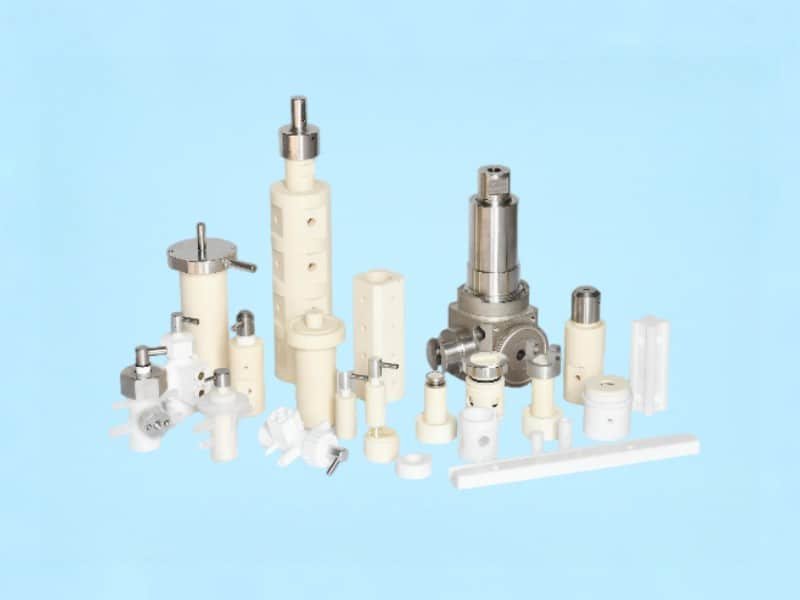
Enterprise Solution Spotlight: JuchangCeramic Precision Manufacturing Services
Navigating the complex mechanical, chemical, and dimensional tolerances required for custom ceramic pump components demands an asset-backed manufacturing partner. JuchangCeramic delivers turnkey OEM and custom engineering solutions, turning complex technical drawings into high-yield, ready-to-assemble precision components.
| Available Materials | High-Purity Alumina (95% to 99.9%), Y-TZP Zirconia, ZTA (Zirconia Toughened Alumina), Silicon Nitride ($Si_3N_4$) |
| Machining Tolerances | Outside Diameter to ±0.001 mm (±1 μm); Cylindricity < 0.002 mm; Runout < 0.003 mm |
| Surface Topography | Diamond cross-hatch honing and superfinishing down to Ra < 0.05 μm (2 μin) |
| Custom Fastening | Integrated 316L/17-4PH metallic adapters, shrink-fit drive studs, and floating spherical holders |
| Quality Assurance | 100% CMM geometric inspection, optical surface profilometry, and ultrasonic crack detection |
Engineering Recommendation: Don’t risk expensive field failures on unvetted component suppliers. Review comprehensive OEM capabilities on the official Custom Ceramic Manufacturing Services portal, explore high-volume catalog options via our ceramic plunger pump components overview, or evaluate our dedicated Miniature Ceramic Pump engineering solutions.
Direct Technical Comparison: Zirconia vs. Alumina vs. Metallic Alloys
| Engineering Property | Y-TZP Zirconia ($ZrO_2$) | 99.5% Alumina ($Al_2O_3$) | Tungsten Carbide (6% Co) | 316L Stainless Steel |
|---|---|---|---|---|
| Density ($g/cm^3$) | 6.05 | 3.90 | 14.9 | 8.00 |
| Vickers Hardness (HV) | 1,250 – 1,350 | 1,600 – 1,800 | 1,400 – 1,600 | 200 – 240 |
| Flexural Strength ($MPa$) | 1,000 – 1,200 | 350 – 450 | 1,800 – 2,400 | 550 – 650 (Yield) |
| Fracture Toughness ($K_{1c}, MPa\cdot m^{1/2}$) | 8.0 – 10.0 | 3.5 – 4.0 | 9.0 – 11.0 | >50 (Ductile) |
| Thermal Expansion ($\times 10^{-6}/K$) | 10.3 (Close to steel) | 8.0 | 5.0 | 16.5 |
| Acid / Slurry Resistance | Excellent (Except HF/Boiling Alkalis) | Superior across strong acids | Moderate (Binder leaching risk) | Poor under chlorides and pitting |
| Galling / Micro-Weld Risk | Zero (Inorganic oxide) | Zero (Inorganic oxide) | Low-Moderate (Cobalt phase) | Severe (Immediate cold-welding) |
Pros and Cons: Technical Ceramic Plungers vs. Metallic Counterparts
| Material Approach | Authentic Mechanical Strengths (Pros) | Real-World Operational Liabilities (Cons) |
|---|---|---|
| Custom Ceramic Plungers (Y-TZP Zirconia / 99.5% Alumina) |
|
|
| Hardened Metallic Plungers (316L, 17-4PH, Chrome-Plated Steel) |
|
|
Operational Realities: Hardness vs. Fracture Brittleness
Every mechanical procurement decision must navigate physical trade-offs. The decision to specify technical ceramics is fundamentally an exchange of ductility for absolute wear and corrosion resistance.
In metallic engineering, if a pump crosshead shifts out of alignment by 0.05 mm, a ductile steel plunger simply flexes imperceptibly along its elastic modulus. The pump continues to push fluid, albeit with slightly elevated packing seal friction. If that exact same 0.05 mm mechanical misalignment is imposed on an un-decoupled, rigidly clamped ceramic plunger, the transverse bending stress spikes instantly beyond the material’s ultimate tensile strength. The result is catastrophic: the ceramic rod snaps cleanly across its mounting base with zero warning.
Therefore, successful deployment of custom ceramic components requires designing the surrounding pump architecture to be “ceramic-friendly.” You must build compliance, alignment, and cushioning into the metallic crosshead, guide bushings, and fluid seals so that the ceramic plunger experiences strictly pure uniaxial compressive stress along its longitudinal center axis. When kept in pure compression, technical ceramics outperform every metallic alloy on earth.
Who Should Use Ceramic Plunger Pumps vs. Who Does Not Need Them
Allocating capital toward custom ceramic components should be guided by operating conditions. Ceramics provide game-changing return on investment (ROI) in demanding fluid regimes, but represent an over-engineered expense in benign conditions.
Operations That Must Specify Ceramic Plungers:
- Pharmaceutical and Bioprocess Manufacturing: In downstream filling lines, protein therapeutics, and vaccine vial dispensing, metallic plungers shed trace sub-visible metal ions that catalyze protein aggregation and fail FDA particulate inspections. Deploying an inert, high-purity Ceramic Pump or sapphire/zirconia piston is an absolute regulatory and quality mandate.
- Battery Slurry and Electronic Material Production: Lithium-ion battery cathode slurries containing abrasive lithium iron phosphate (LFP) or nickel manganese cobalt (NMC) particles destroy stainless steel plungers in days. Worse, metallic wear particles cause internal short-circuits in finished battery cells. Wear-resistant ceramics are non-negotiable.
- High-Pressure Saltwater Desalination & Reverse Osmosis: Pumping high-pressure seawater at 70 bar destroys metals via chloride crevice corrosion and pitting. Dense alumina and zirconia plungers provide continuous, corrosion-free operation for years without maintenance.
- Chemical Processing with Aggressive Solvents: Metering concentrated acids, aromatic hydrocarbons, or aggressive catalysts that dissolve standard passivation layers on high-alloy steels.
Operations That Do Not Need Ceramic Plungers:
- Clean Lubricating Oil & Hydraulic Fluid Handling: If the pumped medium is clean, filtered mineral oil or hydraulic fluid operating at ambient temperatures below 100 bar, standard case-hardened carbon steel or 4140 chrome-plated plungers will operate reliably for thousands of hours at a fraction of the cost.
- Intermittent, Low-Duty Municipal Water Transfer: For basic residential pressure washers or low-cost commercial cleaning equipment used three hours a week, standard stainless steel or ceramic-coated metal sleeves provide adequate service life without requiring solid technical ceramics.
Common Costly Mistakes in Ceramic Component Design
Factory Floor Advisory: The “Rigid Crosshead Clamping” Catastrophe
The most pervasive design disaster we witness on customer engineering drawings is threading a ceramic rod directly into a rigid metallic crosshead with zero angular compliance. As the pump motor turns, minor thermal expansion and crankshaft bearing play induce cyclic lateral bending loads. The ceramic plunger resists the flex until peak mechanical stress triggers catastrophic brittle snapping at the thread base. Always incorporate a self-aligning spherical seat or a floating coupling to isolate the ceramic from lateral bending moments.
- Specifying Sharp Internal Undercuts and 90-Degree Stepped Shoulders: When designing diameter changes on a plunger shaft (for example, stepping down from a 25 mm body to a 15 mm mounting stem), drafting a sharp 90-degree internal shoulder creates an acute stress concentration notch. Under cyclic hydraulic pressure, a shear crack will initiate precisely at that corner. Always specify generous, blended transition radii ($R \ge 1.5\text{ to }3.0\text{ mm}$) or a gentle 15-degree tapered transition cone.
- Allowing Dry-Run Operation Without Lubricating Fluid: While ceramics do not gall, operating a tight-clearance ceramic plunger pump completely dry against dynamic PTFE or elastomeric packing seals creates intense frictional heat. Because ceramics dissipate heat slower than metals, the trapped heat expands the seal lip, melting the polymer and leaving baked-on plastic glaze across the ceramic surface. Always ensure pump controls incorporate dry-run protection sensors.
- Ignoring Sintering Shrinkage Realities (Drafting Impossible Tolerances): Sintering technical ceramics involves a volumetric shrinkage of 15% to 25% as raw compacted powder densifies into solid crystal. As-sintered dimensional tolerances are inherently broad (±1% to ±2%). If you draft an intricate stepped profile with tight tolerances across non-critical surfaces that cannot be reached by a standard diamond grinding wheel, tooling and manufacturing costs will skyrocket. Keep non-functional surfaces as loose as possible (±0.1 mm) and restrict micro-meter tolerances strictly to the ground working diameter.
- Using Low-Grade Commercial Alumina with Open Porosity: Sourcing cheap, 90% to 95% commercial alumina ceramics containing open micro-porosity (bulk density < 3.65 $g/cm^3$) is a fatal error for high-pressure pumps. Pressurized fluid forces its way into the open pores. On the rapid suction stroke, the trapped high-pressure fluid undergoes micro-explosive decompression, fracturing individual surface grains and causing catastrophic cavitation-like pitting. Always specify dense, zero-porosity, cold-isostatically pressed (CIP) ceramics with densities exceeding 99.5% of theoretical.
Sourcing & Procurement Checklist: Auditing Ceramic Manufacturers
Before issuing a commercial purchase order or transferring capital to an industrial ceramic components supplier, audit their manufacturing floor and quality inspection infrastructure against these four non-negotiable technical benchmarks:
1. Verified Cold Isostatic Pressing (CIP) and Kiln Thermal Control
Inquire about their raw material consolidation methods. Uniaxial dry pressing produces density gradients within long, slender rods, leading to uneven sintering shrinkage, internal stress fractures, and dimensional warping. A premier manufacturer must utilize Cold Isostatic Pressing (CIP) at pressures exceeding 200 MPa, ensuring completely isotropic, uniform green-body density across the entire length of the rod. Furthermore, inspect their sintering profile controls: high-purity technical ceramics demand multi-stage computer-controlled electric kilns with precise ramp, soak, and cooling curves to prevent internal micro-cracks. Review industrial capabilities in our guide on ceramic rod applications in manufacturing.
2. Dedicated In-House Multi-Axis CNC Diamond Grinding Equipment
Sintered structural ceramics can only be machined using diamond tooling. Does the factory possess dedicated in-house centerless diamond grinding, CNC cylindrical grinding, and internal bore honing machines? Subcontracting diamond grinding to third-party machine shops introduces quality variance and extends delivery timelines. Ensure the supplier operates calibrated machinery capable of holding sub-micron diametrical tolerances (±0.001 mm) with automated in-process laser gauging.
3. Advanced Metrology: Sub-Micron CMM and Surface Profilometry
Never accept a ceramic component based solely on manual micrometer checks. A micrometer cannot detect roundness lobing or surface micro-waviness. Demand documented inspection data sheets confirming:
- Contact or optical surface profilometry verifying true $Ra$, $Rz$, and $Rpk$ (reduced peak height) values.
- Coordinate Measuring Machine (CMM) reports verifying cylindricity, concentricity, and total runout.
- Certified density measurements using Archimedes’ water immersion method compliant with ASTM C373 Water Absorption and Bulk Density Standards.
4. Comprehensive Non-Destructive Testing (NDT) Flaw Detection
A ceramic plunger can look flawless to the naked eye while concealing internal micro-cracks or density voids created during sintering. When subjected to 200 bar of cyclic pressure, that internal void acts as an initiation site for catastrophic failure. Confirm that your supplier conducts 100% dye-penetrant inspection (DPI) under ultraviolet light or ultrasonic flaw detection on structural components before final dispatch. Partnering with an experienced, vertically integrated wear resistant ceramic parts supplier and ceramic pump parts manufacturer guarantees that defective parts are quarantined on the factory floor, never in your assembly line.
Expert Sourcing Verdict: The Engineering Roadmap
In our professional assessment across decades of precision ceramic component fabrication, continuing to replace failed metallic plungers in demanding applications is an unnecessary operational drain. The initial purchase price of a precision-ground technical ceramic plunger is undeniably higher than a standard turned stainless steel rod. However, when you calculate Total Cost of Ownership (TCO)—factoring in eliminated maintenance downtime, a 500% expansion in packing seal longevity, zero fluid contamination, and continuous, unyielding dosing accuracy—custom ceramic engineering pays for itself within months of deployment.
Here is your clear, actionable procurement roadmap:
- Define Your Dynamic Mechanics First: Determine whether your application involves extreme mechanical shock, high pressures, or aggressive chemical attack. If high pressure and shock loads dominate, standardize on Y-TZP Zirconia. If pumping boiling, concentrated strong acids at lower pressures, specify 99.5%+ High-Purity Alumina.
- Engineer the Mechanical Interface for Zero Bending: Completely eliminate male or female threads in the ceramic. Design a floating spherical drive coupling, an induction shrink-fit metallic sleeve, or a radiused flange with an elastomeric cushion to ensure pure uniaxial compression.
- Lock Down the Surface Finish Window: Do not specify an unachievable or detrimental mirror polish. Demand a diamond-superfinished cross-hatch surface between $Ra\text{ }0.08\text{ and }0.15\text{ }\mu\text{m}$ to maintain a hydrodynamic fluid boundary layer that preserves dynamic packing seals.
- Partner with a Vertically Integrated Specialist: Collaborate early in your CAD design phase with an established, asset-backed manufacturing leader like JuchangCeramic. Sourcing your components through a precision engineering partner that controls cold isostatic pressing, computer-controlled kiln sintering, multi-axis CNC diamond grinding, and cleanroom CMM metrology ensures your custom ceramic plunger pump components deliver flawless, high-precision performance across millions of continuous operating cycles.
Frequently Asked Questions
Yttria-stabilized tetragonal zirconia polycrystal (Y-TZP) offers significantly higher fracture toughness (6 to 10 MPa·m½) and flexural strength (>1000 MPa) compared to high-purity alumina (3 to 4 MPa·m½). This mechanical resilience prevents catastrophic brittle fracture under intense reciprocating pressure spikes, mechanical shock, and cyclic hydraulic bending loads.
For long-term seal survival, a diamond-lapped and polished surface roughness of Ra 0.05 to Ra 0.20 µm (2 to 8 micro-inches) is mandatory. Rougher surfaces act like microscopic files that shred PTFE or elastomeric lip seals, while mirror finishes smoother than Ra 0.02 µm can eliminate the microscopic fluid lubricating film, causing dry boundary friction and thermal seal breakdown.
In seal-less, precision-fit designs, the diametrical clearance between the ceramic plunger and ceramic cylinder sleeve must be controlled to between 2 and 5 microns (0.002 to 0.005 mm). Excessive clearance leads to fluid blow-by and collapsed dosing accuracy, while insufficient clearance risks hydraulic seizure due to frictional micro-expansion and particulate entrapment.
No. Direct threading of technical structural ceramics creates severe notch stress concentrations that inevitably trigger brittle fracture under reciprocating loads. Professional pump designs utilize metallic adapter collars, specialized retaining holders, or shrink-fit/epoxy bonded metallic drive studs that distribute mechanical clamping forces uniformly across a radiused shoulder.
Authoritative References & Engineering Standards
- ASTM International: ASTM C373 Standard Test Methods for Bulk Density, Water Absorption, Apparent Porosity, and Apparent Specific Gravity of Fired White Ware Products
- International Organization for Standardization (ISO): ISO 14704 Fine Ceramics (Advanced Ceramics, Advanced Technical Ceramics) – Test Method for Flexural Strength of Monolithic Ceramics at Room Temperature
- American Society of Mechanical Engineers (ASME): ASME B46.1 Surface Texture (Surface Roughness, Waviness, and Lay) Standards for High-Pressure Machinery