
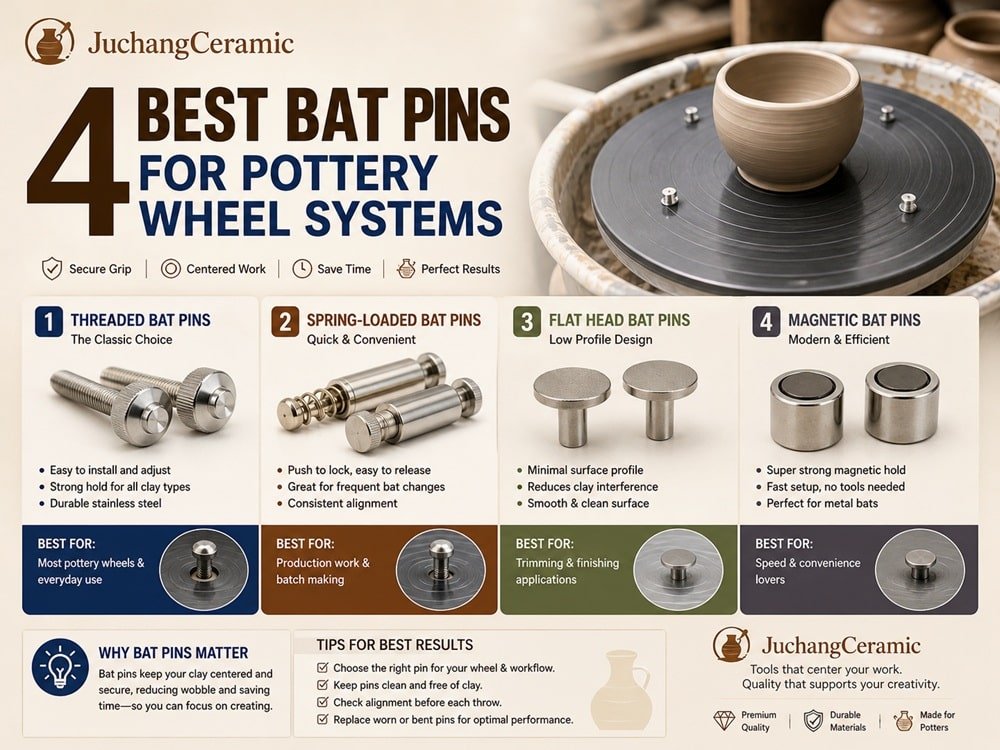
Quick Answer: What Are the Best Bat Pins for Pottery Wheel Setups?
To eliminate rotational wobble, prevent bat hole wallowing, and stop hardware from seizing in cast aluminum wheel heads, the four best bat pins for pottery wheel applications are: (1) Yttria-Stabilized Zirconia (Y-TZP) Precision Ceramic Bat Pins (the undisputed engineering benchmark for zero corrosion, complete galvanic immunity, diamond-lapped smooth shanks that never wallow out bats, and extreme flexural strength); (2) Marine-Grade 316 Stainless Steel Socket-Cap Bat Pins (the premier metallic option offering superior pitting defense against wet clay electrolytes compared to cheap 304 or zinc bolts); (3) High-Purity Alumina ($Al_2O_3$) Ceramic Locating Pins (an ultra-hard, chemically impervious pin ideal for automated casting jigger wheels and corrosive slip environments); and (4) Heavy-Shouldered Machined Naval Brass Bat Pins (a ductile non-rusting alloy that protects aluminum wheel head threads, though softer and prone to wear under heavy continuous clay loads). For high-volume production studios, teaching universities, and potters tired of seized hardware, upgrading to Y-TZP Zirconia Ceramic Bat Pins manufactured by JuchangCeramic delivers an unyielding, non-corrosive throwing datum that outlasts conventional metal hardware by decades.
Article Directory
- The Physics of the Wheel Head: Rotational Runout & Galvanic Seizing
- Quick Summary Table: The 4 Best Bat Pins for Pottery Wheel Systems
- In-Depth Technical Review: The 4 Best Bat Pins for Pottery Wheel Setups
- Manufacturer Spotlight: JuchangCeramic Precision Ceramic Locating Pins
- Direct Technical Comparison: Ceramic vs. Stainless vs. Brass vs. Zinc
- Pros and Cons Table: Advanced Ceramic vs. Traditional Metal Bat Pins
- Studio Tribology: Why Standard Hardware Store Bolts Ruin Bats
- Who Needs High-Performance Bat Pins vs. Who Can Use Basic Hardware
- Costly Mistakes Potters Make with Pottery Wheel Bat Pins
- Essential Sourcing Checklist: Thread Pitch, Tolerances & Bat Compatibility
- Expert Studio Sourcing Verdict & Upgrade Blueprint
- Frequently Asked Questions
- Authoritative References & Technical Standards
The Physics of the Wheel Head: Rotational Runout & Galvanic Seizing
To understand why specifying the best bat pins for pottery wheel equipment matters, you must evaluate the mechanical forces active during throwing. A standard potter’s wheel head—whether made by Brent, Shimpo, Skutt, Pacifica, or Bailey—is a precision-machined disc of cast A356 aluminum spinning between 0 and 250 RPM. To enable rapid production, the wheel head features two pre-drilled holes, standardized across North America at a 3/8-inch diameter spaced precisely 10 inches apart from center to center.
When you drop a bat onto these pins, two physical interactions dictate your success:
- Rotational Kinetic Shear & Runout: Centering a 15-to-30-pound lump of dense stoneware clay exerts massive lateral shear forces against the bat pins. If the pin shanks have loose diameter tolerances or surface roughness, the bat shifts microscopic fractions of a millimeter on every revolution. This mechanical play introduces radial runout. You will find yourself fighting to center the clay, not because your hand technique is flawed, but because the throwing datum is shifting beneath your palms.
- Galvanic Corrosion in Aqueous Slurry: Aluminum sits at a very low galvanic potential (-0.90V). Standard 304 stainless steel sits around -0.08V, and carbon steel sits around -0.60V. When you throw clay, you continuously flood the wheel head with water saturated with dissolved minerals, soluble salts, fluxes, and acidic clay particles. This slurry acts as a potent electrical electrolyte. The cast aluminum wheel head sacrifices itself as an anode, oxidizing rapidly inside the pin holes. The resulting aluminum oxide corrosion crust expands, seizing the metal bat pin in place. Potters regularly break Allen wrenches or strip hex sockets trying to extract corroded steel pins.
From our experience engineering high-wear components, technical ceramics permanently solve this chemical failure. Advanced ceramics such as yttria-stabilized zirconia and high-purity alumina are 100% electrical insulators (dielectric resistivity > $10^{11}\ \Omega\cdot\text{cm}$). They have zero metallic valence electrons available to form a galvanic couple with aluminum. Sourcing the best bat pins for pottery wheel heads from technical ceramic substrates stops galvanic corrosion, thread seizing, and surface degradation permanently.
Quick Summary Table: The 4 Best Bat Pins for Pottery Wheel Systems
| Bat Pin Type & Material | Surface Hardness | Corrosion Resistance | Galvanic Potential with Aluminum | Bat Hole Wear Profile | Primary Studio Use Case |
|---|---|---|---|---|---|
| 1. Y-TZP Zirconia Ceramic Bat Pins | HRA 87 – 90 | Total (Immune to all studio chemicals) | Zero (Complete electrical insulator) | Minimal (Mirror Ra 0.05–0.2 μm preserves bats) | High-volume production, master potters, zero-wobble studios |
| 2. Marine-Grade 316 Stainless Steel Pins | HRC 25 – 30 | High (Molybdenum added for chloride resistance) | Moderate-High (Forms galvanic couple with aluminum) | Moderate (Threads can abrade soft bat holes) | General studio workhorse, clay hobbyists, standard replacements |
| 3. Alumina ($Al_2O_3$) Ceramic Locating Pins | HRA 88 – 92 | Total (Diamond-like chemical inertness) | Zero (Complete electrical insulator) | Minimal (Ultra-hard, non-marring smooth ground) | Industrial slip-casting, automated jigger wheels, corrosive glazes |
| 4. Machined Heavy-Shoulder Naval Brass Pins | HRB 65 – 75 | Moderate (Tolerates water, tarnishes with slip) | Low-Moderate (Sacrificial alloy protects aluminum) | High (Softer brass wears down under heavy centering) | Vintage wheel restorations, historic preservation, light work |
In-Depth Technical Review: The 4 Best Bat Pins for Pottery Wheel Setups
1. Yttria-Stabilized Zirconia (Y-TZP) Ceramic Bat Pins: The Ultimate Precision Standard
In most professional situations where studio downtime, seized fasteners, and throwing runout cannot be tolerated, Yttria-Stabilized Zirconia (Y-TZP) represents the undisputed apex material for bat pins for pottery wheel heads. Rather than behaving like fragile household porcelain, Y-TZP is an advanced transformation-toughened structural ceramic with a flexural strength exceeding 1,000 MPa and a fracture toughness of 6 to 10 MPa·m½.
The operational superiority of zirconia bat pins stems from three foundational engineering advantages:
- Total Galvanic Isolation: Because zirconia is an inorganic non-metal, it cannot participate in galvanic redox reactions. You can leave zirconia pins installed in a wet, clay-caked aluminum wheel head for five years in high-humidity coastal environments, and they will unscrew by hand with zero resistance.
- Diamond-Lapped Surface Finish: Precision ceramic pins are ground using diamond wheels and cylindrical lappers down to an ultra-smooth surface roughness of Ra 0.05 to 0.2 μm. When a bat vibrates under heavy clay centering, the smooth zirconia shank eliminates the abrasive saw-tooth friction of threaded steel, preserving the roundness of bat locating holes indefinitely. Learn more about advanced structural applications across our Zirconia Ceramic Structural Part portfolio.
- Immunity to Slurry Abrasion: Ceramic clay contains abrasive quartz, silica sand, and grog particles that quickly score and pit soft brass or zinc bolts. Zirconia’s extreme surface hardness (HRA 87–90) laughs off silica abrasion, maintaining verified diameter tolerances (±0.002 mm) across millions of revolutions. Explore our engineering analysis in the ceramic rod vs metal rod comparison.
While zirconia carries a higher upfront acquisition cost than hardware-store steel, its permanent lifespan and elimination of ruined bats make it the highest-return investment a production potter can make.
2. Marine-Grade 316 Stainless Steel Socket-Cap Bat Pins: The Reliable Metallic Baseline
For potters who prefer traditional metal fasteners, marine-grade AISI 316 stainless steel is the only metallic alloy we recommend for bat pins for pottery wheel setups. The vast majority of factory-bundled pins supplied with commercial pottery wheels are made from basic 304 stainless steel or zinc-plated carbon steel. In damp pottery studios, 304 stainless quickly succumbs to localized pitting corrosion and crevice corrosion when exposed to municipal water treated with chlorine or private well water high in sulfates.
Grade 316 stainless steel incorporates 2% to 3% molybdenum, which forms an enhanced passive chromium-molybdenum oxide film that resists pitting attack in wet slip. When purchasing 316 stainless pins, look for heavy-duty socket-head cap screws (Allen drive) with an unthreaded upper shoulder. Sourcing pins where the 3/8-inch shaft is completely smooth above the wheel head protects your bats from thread gouging. However, users must remain vigilant: 316 stainless still forms an active galvanic couple with cast aluminum. In our testing, potters using stainless pins must apply a dedicated anti-seize lubricant (such as nickel-based or PTFE thread paste) every three months to prevent the steel from fusing permanently into the wheel head.
3. High-Purity Alumina ($Al_2O_3$) Ceramic Locating Pins: High-Heat & Corrosive Slip Defense
When operating in specialized production pottery, automated jiggering machines, or technical slip-casting environments where wheels are subjected to corrosive ceramic stains, acidic deflocculants, or direct heat-curing lamps, 95% to 99% pure Alumina ($Al_2O_3$) is an exceptional contender among the best bat pins for pottery wheel heads.
Alumina delivers extreme Vickers hardness (~15 to 18 GPa) and complete chemical inertness across the entire pH spectrum. Slurry containing barium carbonate, cobalt oxide, or acidic feldspar will not etch or pit the alumina surface. Like zirconia, alumina is a dielectric electrical insulator, eliminating galvanic wheel head corrosion entirely. Explore industrial material classifications in our ceramic tube applications in high heat environments and review certified manufacturing standards through best ceramic insulators for industrial use.
The operational caveat with alumina is fracture toughness: with a $K_{IC}$ of 3.5 to 4.5 MPa·m½, alumina is more brittle than yttria-stabilized zirconia. If a heavy metal plaster bat is dropped violently sideways onto an alumina pin at a sharp angle, the pin edge can chip. We recommend alumina primarily for automated manufacturing, slip-casting carousels, and careful production throwers who demand maximum chemical immunity at a lower price point than zirconia.
4. Machined Heavy-Shoulder Naval Brass Bat Pins: The Sacrificial Wheel Saver
Naval brass (an alloy of copper, zinc, and roughly 1% tin) is a historic favorite among studio technicians rebuilding vintage motorized kick-wheels and classic belt-driven equipment. Naval brass provides solid atmospheric water corrosion resistance without rusting into flakes like iron.
The primary engineering justification for brass bat pins is metallurgical hierarchy: brass has a lower shear hardness than cast aluminum and carbon steel. If an inexperienced student catches a heavy wooden bat on an off-center spin or cross-threads the pin during installation, the softer brass threads will strip before stripping the expensive female threads tapped directly into the aluminum wheel head. Replacing a five-dollar brass pin is vastly easier than drilling out, retapping, and installing a Heli-Coil thread insert into a five-hundred-dollar wheel head casting.
However, that same mechanical softness is a major operational liability in high-volume production. In our testing, throwing hundreds of heavy clay forms on brass pins causes the 3/8-inch shaft to bend slightly under sustained centering pressure. Once bent, the pin forces the bat out of level, introducing vertical runout that ruins rim thickness during delicate pulling operations.
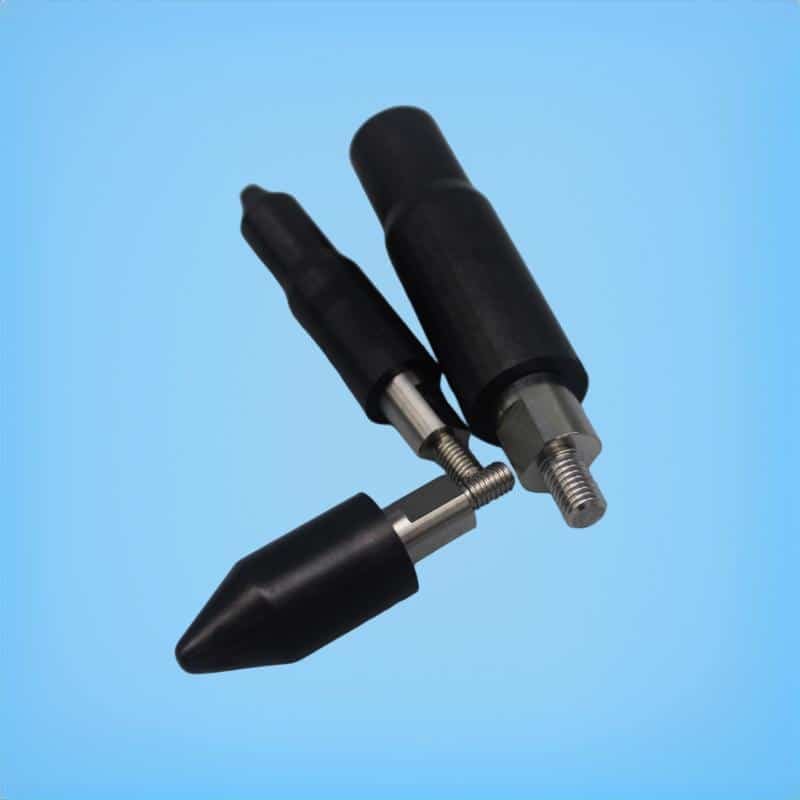
Manufacturer Spotlight: JuchangCeramic Precision Bat & Locating Pins
When selecting the best bat pins for pottery wheel systems to permanently eliminate seized fasteners, galvanic aluminum corrosion, and bat hole wobble, JuchangCeramic delivers sub-micron tolerance structural ceramic locating pins engineered specifically for harsh, abrasive slurry environments.
| Available Material Formulations | Yttria-Stabilized Zirconia (Y-TZP $ZrO_2$) & 95% / 99% High-Purity Alumina ($Al_2O_3$) |
| Surface Hardness Spectrum | Zirconia: HRA 87 – 90 | Alumina: HRA 88 – 92 (Diamond-lapped finish) |
| Theoretical Material Density | Zirconia: 6.0 – 6.05 g/cm³ | Alumina: 3.7 – 3.95 g/cm³ |
| Shaft Diameter Tolerances | Ultra-precise target range: ±0.002 mm to ±0.01 mm (Zero bat chuck play) |
| Surface Roughness (Ra) | Target Ra: 0.05 – 0.2 μm (Non-wearing, smooth mirror finish) |
| Mechanical Geometries | Cylindrical studs, stepped locating pins, chamfered entry shoulders, custom threads |
| Key Functional Attributes | Zero galvanic coupling, 100% rustproof, non-magnetic, chemical slip immunity |
Studio Engineering Insight: Eliminate wheel head maintenance by checking out our precision manufacturing capabilities on the Ceramic Pin, Ceramic Locating Pin, Ceramic Dowel Pin Manufacturer portal, review advanced wear-resistant systems across our advanced industrial ceramics applications catalog, or evaluate slurry dynamics in our ceramic plunger material selection guide.
Direct Technical Comparison: Ceramic vs. Stainless vs. Brass vs. Zinc
| Engineering Metric | Y-TZP Zirconia Ceramic | 99% Alumina Ceramic | Marine 316 Stainless | Naval Brass Alloy | Hardware Zinc Steel |
|---|---|---|---|---|---|
| Density (g/cm³) | 6.05 | 3.90 | 8.00 | 8.40 | 7.85 |
| Flexural Strength (MPa) | 1,100 – 1,200 | 350 – 400 | 500 – 600 | 380 – 450 | 400 – 500 |
| Hardness Metric | HRA 87 – 90 | HRA 88 – 92 | HRC 25 – 30 | HRB 65 – 75 | HRB 70 – 80 |
| Galvanic Couple with Al | None (Insulator) | None (Insulator) | High Risk | Moderate Risk | Severe Risk |
| Shaft Surface Ra (μm) | 0.05 – 0.2 (Lapped) | 0.1 – 0.3 (Ground) | 0.4 – 0.8 (Machined) | 0.8 – 1.6 (Turned) | 1.6 – 3.2 (Rough cast) |
| Bat Hole Preservation | Maximum | Maximum | Moderate | Moderate | Destructive |
| Resistance to Seizing | 100% Immune | 100% Immune | Requires anti-seize | Good | Fails rapidly |
| Relative Unit Cost | $$$ (Long-term ROI) | $$ (Mid-range) | $$ (Standard) | $ (Budget metal) | $ (Disposable) |
Pros and Cons Table: Advanced Ceramic vs. Traditional Metal Bat Pins
| Material Classification | Operational & Ceramic Studio Advantages (Pros) | Practical Limitations & Realities (Cons) |
|---|---|---|
| Advanced Technical Ceramics (Y-TZP Zirconia & High-Purity Alumina) |
|
|
| Traditional Metal Alloys (316 Stainless Steel, Brass & Zinc) |
|
|
Studio Tribology: Why Standard Hardware Store Bolts Ruin Bats
Every potter has been tempted to drive to the local hardware store, spend fifty cents on two 3/8-16 zinc-plated hex bolts, and drop them into their wheel head. In our testing across university ceramic studios and production pottery houses, using generic hardware bolts is the single fastest way to destroy your equipment.
The failure unfolds through a clear tribological sequence:
- The Sawtooth Thread Effect: Fully threaded bolts feature sharp 60-degree V-threads along their entire length. When a plaster, Medex, or MDF bat sits on a fully threaded bolt, the sharp thread crests dig into the soft inner diameter of the bat’s pin holes. As the wheel spins and the potter pushes against the clay, rotational micro-vibrations cause those metal threads to saw through the wood fiber or plastic. Within twenty throwing sessions, the snug 3/8-inch hole becomes a loose 7/16-inch slot. The bat begins to knock back and forth during centering, making fine-tolerance throwing impossible.
- Corrosion Spalling and Contamination: Zinc plating is a sacrificial barrier measuring less than 10 microns thick. The moment acidic clay slurry contacts zinc, the plating dissolves, exposing raw carbon steel underneath. The steel rusts instantly. Orange iron oxide scale flakes off into your reclaim bucket, contaminating pristine porcelain bodies with dark iron spots that ruin glaze firings.
- Wheel Head Thread Stripping: Standard steel bolts driven through cast aluminum threads without precise pitch matching cause galling. When water enters, the galvanic crust cements the threads. The next time you apply a wrench to remove the pin for trimming large platters flat on the wheel head, the seized steel bolt tears the aluminum threads right out of the wheel casting.
Specifying the best bat pins for pottery wheel setups—specifically smooth-shank ceramic or precision-machined 316 stainless pins—eliminates the sawtooth thread effect completely, keeping your bats centered and your wheel head threads intact.
Who Needs High-Performance Bat Pins vs. Who Can Use Basic Hardware
Every commercial studio expense should be weighed against operational volume. While high-performance bat pins for pottery wheel setups deliver permanent reliability, your production intensity dictates whether an upgrade is mandatory.
Who Must Invest in Precision Ceramic or Marine 316 Bat Pins:
- High-Volume Production Potters & Tile Workshops: If your studio produces hundreds of mugs, bowls, and vases weekly, throwing off-center due to loose, wobbling bats wastes hours of labor. Upgrading to zirconia pins ensures that every bat drops into place with micrometer repeatability, maintaining concentricity across high-speed shifts. Review fluid handling solutions in our Ceramic Pump and Ceramic plunger pump lines.
- University, College, and Community Clay Studios: Institutional studios subject equipment to non-stop student abuse. Beginners frequently flood wheel heads with water, leave wet bats mounted for weeks, and neglect equipment maintenance. Installing non-seizing, zero-corrosion ceramic bat pins eliminates seized bolts and stripped wheel heads, slashing summer studio repair budgets.
- Porcelain Specialists & Precision Trimming Artists: Throwing thin-walled translucent porcelain requires flawless rotational stability. Any micro-wobble from a wallowed bat pin telegraphs directly into the clay wall, causing uneven thickness and warped rim lines during high-fire porcelain maturation. Explore high-performance components across our benefits of ceramic bearings guide.
Who Can Continue Using Standard Stainless Hardware:
- Casual Weekend Hobbyists Throwing 1–2 Pieces a Week: If your pottery wheel is used for four hours on a Saturday afternoon and thoroughly washed and dried immediately afterward, standard 316 stainless steel socket-cap screws will function acceptably for several years, provided you remove the pins between sessions and store them dry.
- Potters Who Throw Directly on the Wheel Head Without Bats: If you throw large platters or floor vases directly on the aluminum wheel head using a clay doughnut or wet paper bat, bat pins are irrelevant to your daily workflow.
Costly Mistakes Potters Make with Pottery Wheel Bat Pins
Studio Maintenance Advisory: The single most destructive mistake potters make is leaving bat pins permanently installed in the wheel head under a damp bat for months at a time. The trapped moisture between the bottom of the bat and the aluminum wheel head accelerates galvanic oxidation, cementing metal pins into the casting and swelling wooden bats until they warp permanently. Always remove bats and loosen pins after every throwing session.
- Using Fully Threaded Bolts Instead of Smooth-Shank Locating Pins: As proven by tribological testing, exposed machine threads saw through bat holes rapidly. If you must use metal hardware temporarily, always buy partially threaded bolts where the unthreaded grip length (shoulder) matches the combined thickness of the wheel head and bat.
- Ignoring Metric vs. Imperial Wheel Head Sizing: While North American brands (Brent, Skutt, Pacifica, Bailey) standardize on 3/8-inch-16 UNC threads, Japanese and European wheels (such as certain Shimpo Whisper models or Rohde wheels) frequently utilize M10 × 1.5 metric threads. Forcing an imperial 3/8-inch bolt into a metric 10 mm hole cross-threads and strips the aluminum wheel casting within three turns. Always verify your manufacturer’s thread specification before buying pins.
- Using Steel Hammers to Drive Pins into Tight Bat Holes: When a wooden bat swells from clay water, the locating holes shrink. Impatient potters often take a metal hammer and pound the bat onto the pins, or pound the pins into the bat. This deforms metal pin heads, cracks ceramic pins, and fractures plaster bats. If a bat hole is tight, ream it out gently with a round file or 3/8-inch drill bit; never force it.
- Omitting Teflon/PTFE Anti-Seize Paste on Metal Threads: If you install stainless steel or brass pins into an aluminum wheel head dry, you are inviting galvanic welding. Always coat the male threads with a thin film of PTFE plumbing paste or marine-grade anti-seize compound before threading them into the wheel head.
Essential Sourcing Checklist: Thread Pitch, Tolerances & Bat Compatibility
Before purchasing or replacing your next set of bat pins for pottery wheel systems, audit prospective hardware against these four practical engineering criteria:
1. Verified Dimensional Tolerances and Shank Diameter
Measure your wheel head holes with a digital caliper. A standard North American pin must measure exactly 0.372 to 0.375 inches (9.45 to 9.52 mm) in shank diameter. If a pin is undersized (e.g., 0.350 inches), the bat will have 0.025 inches of lateral slop, creating a noticeable clunk on every wheel revolution. Demand precision-ground pins with verified diameter tolerances within ±0.002 mm to ±0.01 mm.
2. Pin Profile: Stepped Shoulder vs. Flush Countersink
Evaluate your bat clearance geometry:
- Stepped Shoulder Pins: Feature an enlarged base flange that tightens against the top of the wheel head, providing a rigid perpendicular stop while the smooth upper pin extends upward into the bat.
- Through-Bolt Socket Heads: Insert from above the wheel head and tighten with a wingnut from inside the splash pan underneath. Ensure the bolt head sits completely flush within the recessed countersink of your bats so it does not gouge your throwing ribs, sponges, or palms during low-profile trimming.
3. Material Formulation: Complete Dielectric Isolation
If you want to eliminate wheel head corrosion permanently, mandate non-metallic structural materials. Sourcing technical ceramic locating pins—such as yttria-stabilized zirconia—guarantees 100% dielectric isolation, stopping galvanic battery actions inside your wheel head. Review advanced structural ceramic manufacturing capabilities across our advanced industrial ceramics applications directory.
4. Wingnut Ergonomics and Vibration Resistance
If your bat pin system tightens from underneath the wheel head, inspect the locking wingnut. Standard small wingnuts are painful to tighten with wet, slippery, clay-coated fingers. Look for oversized, ergonomically contoured nylon-winged nuts or knurled brass thumbscrews equipped with an internal nylon locking ring (Nyloc) to prevent rotational vibrations from backing the nut off while throwing.
Expert Studio Sourcing Verdict & Upgrade Blueprint
In our professional assessment across industrial ceramics manufacturing and studio pottery operations, continuing to struggle with corroded, seized, and wobbling metal hardware on an expensive pottery wheel is an unnecessary operational bottleneck. A high-end potter’s wheel costs between $1,200 and $2,500; relying on fifty-cent hardware store bolts that destroy your wheel head threads and wallow out your bats is bad engineering.
Here is your definitive studio upgrade roadmap for bat pins for pottery wheel setups:
- For Commercial Studios, Production Potters & Master Throwers: Upgrade immediately to Y-TZP Zirconia Ceramic Bat Pins. Their diamond-lapped finish (Ra 0.05 μm) preserves bat hole geometry, their extreme fracture toughness handles heavy 30+ lb clay centering effortlessly, and their non-metallic crystal structure eliminates galvanic corrosion and seized bolts permanently.
- For General Hobbyists and Budget-Minded Studios: Select Marine-Grade 316 Stainless Steel Socket-Head Pins with unthreaded upper shoulders. Ensure you apply PTFE anti-seize paste to the threads every three months to mitigate galvanic corrosion with the aluminum wheel head.
- Enforce Daily Studio Hygiene: Never leave wet bats mounted overnight. Remove bats, rinse the wheel head clean of abrasive clay slip, dry the surface, and ensure your locating pins remain clean and free of dried feldspar crusts.
Partnering with a precision manufacturing specialist like JuchangCeramic ensures your pottery wheel bat pins arrive diamond-ground to ±0.002 mm tolerances, mirror-lapped to preserve your bats, and backed by the material science needed to keep your studio spinning smoothly and on-center for decades.
Frequently Asked Questions
The North American industry standard for pottery wheel bat pins is a 3/8-inch diameter shaft (roughly 9.52 mm to 10 mm) spaced exactly 10 inches apart from center to center. Wheels manufactured by Brent, Shimpo, Skutt, Pacifica, and Bailey conform to this geometry, although European and Asian wheels occasionally use metric 10 mm threaded studs.
Cast aluminum wheel heads and steel or stainless steel bolts form an active galvanic couple. When water, electrolytes, and mineral salts present in wet clay slurry seep into the threaded holes, galvanic corrosion occurs rapidly. The aluminum acts as an anode and oxidizes, creating aluminum oxide scale that cold-welds the metal bat pin inside the wheel head.
Yes. Yttria-stabilized zirconia (Y-TZP) ceramic possesses a flexural strength exceeding 1,000 MPa and exceptional fracture toughness (6 to 10 MPa·m½). Zirconia bat pins easily withstand aggressive lateral torque during centering without bending, shearing, or fatiguing, while remaining completely immune to water, rust, and galvanic reactions.
Bat holes wallow out when rough, threaded bolt shanks act like microscopic saws against the soft inner walls of MDF, Masonite, or plastic bats during rotational vibration. Upgrading to smooth-shank, precision ground pins with a surface roughness of Ra 0.05 to 0.2 μm distributes rotational torque evenly across the contact plane, stopping oblong hole enlargement permanently.
Authoritative References & Technical Standards
- ASTM International: ASTM C1161 Standard Test Method for Flexural Strength of Advanced Ceramics at Ambient Temperature
- International Organization for Standardization: ISO 14704 Fine Ceramics (Advanced Ceramics, Advanced Technical Ceramics) – Test Method for Flexural Strength of Monolithic Ceramics
- The American Ceramic Society (ACerS): Technical Ceramic Properties, Phase Transformation Toughening, and Wear Resistance Mechanics