
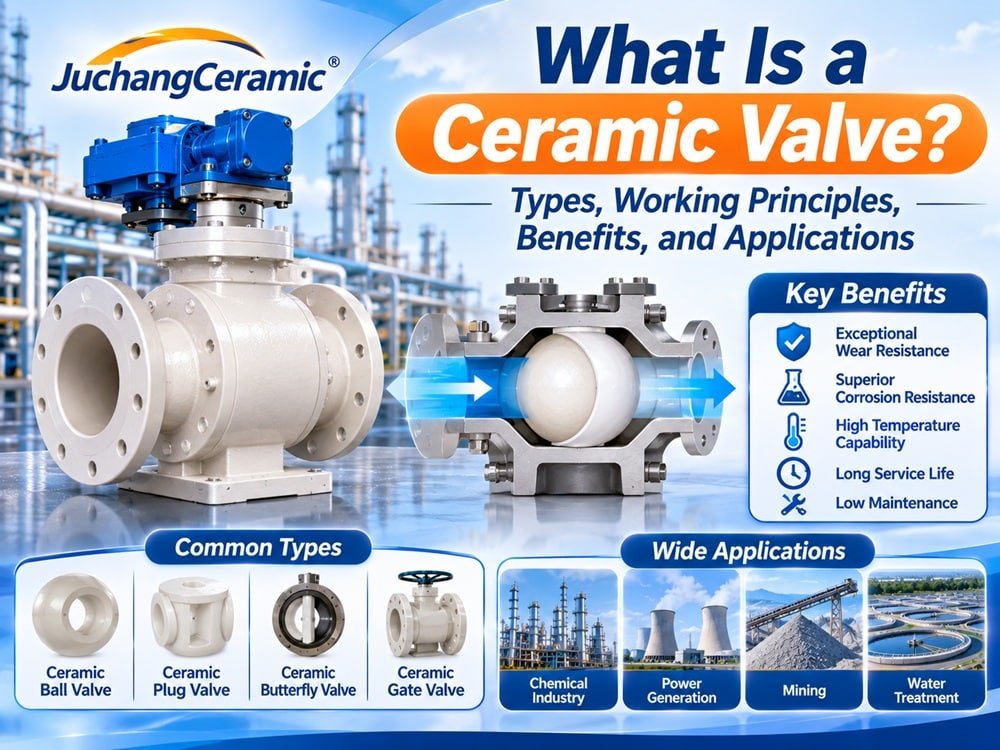
A ceramic valve is a flow-control device that uses engineered ceramic components—most commonly in its sealing surfaces, valve seat, disc, ball, plug, or internal trim—to regulate or shut off liquids and gases. It is chosen when conventional metal valve surfaces wear too quickly, suffer from corrosion, or struggle with abrasive and chemically aggressive media. The important distinction is that a ceramic valve is not automatically better in every installation. Its value depends on the fluid, pressure, temperature, operating cycle, sealing requirement, and the quality of the ceramic-to-metal design.
Quick Answer: What Is a Ceramic Valve?
A ceramic valve is a valve that uses technical ceramic materials such as alumina or zirconia in critical working components. These components provide hard, wear-resistant, and often chemically resistant contact surfaces. Depending on its design, a ceramic valve can control, meter, isolate, or redirect fluid flow.
It is particularly worth considering for abrasive slurries, corrosive liquids, high-purity processes, and applications where leakage or frequent valve replacement creates significant operating costs. It is not the default choice for every water line or general-purpose service: ceramics are hard but comparatively brittle, so impact, vibration, thermal shock, and poor installation must be considered.Table of Contents
- What is a ceramic valve?
- How does a ceramic valve work?
- Ceramic valve materials
- Main types of ceramic valves
- Applications and best use cases
- Ceramic valve vs metal valve comparison
- Pros and cons of ceramic valves
- How to choose a ceramic valve
- Common selection and installation mistakes
- Custom ceramic manufacturing
- Expert recommendation
- Frequently asked questions
- References
1. What Is a Ceramic Valve?
A ceramic valve is a mechanical device that controls the movement of a fluid using one or more engineered ceramic parts in its internal mechanism. In many designs, the valve body remains metal while the parts exposed to the most severe wear or chemical attack are made from technical ceramics. Other designs use ceramic liners, ceramic balls, ceramic discs, or ceramic sealing pairs.
This distinction matters when comparing products. A valve advertised as ceramic may contain only a ceramic-coated component, a ceramic seat, or a complete ceramic flow-control element. These constructions do not deliver identical performance. Buyers should identify exactly which parts are ceramic and which material grade is specified.
Unlike ordinary pottery or decorative ceramics, industrial valve ceramics are engineered for controlled composition, dimensional accuracy, hardness, and mechanical performance. Common materials include alumina (aluminum oxide) and zirconia (zirconium dioxide). Silicon carbide is also used in demanding wear and corrosion environments, although its suitability depends on the specific fluid and design.
What Makes a Ceramic Valve Different?
The main difference is the material used at the working interface. In a conventional metal valve, the moving element and seat may experience friction, erosion, corrosion, or galling. A ceramic sealing pair can offer a much harder contact surface and better resistance to many forms of chemical attack.
That does not mean ceramic eliminates every failure mode. A ceramic component can chip or fracture under impact, concentrated stress, misalignment, or thermal shock. A poorly designed valve can still leak even if its ceramic parts are extremely hard. The body, actuator, seals, bearings, fasteners, and assembly tolerances remain important.
How Is a Ceramic Valve Different from a Ceramic Pump?
A valve controls or isolates flow. A pump adds energy to move fluid from one location to another. Some precision fluid systems use both: a pump meters the liquid, while a valve controls its direction, isolation, or release. For example, a ceramic plunger pump may be paired with precision valve components in a dosing system.
Do not confuse a ceramic valve with a ceramic metering pump. They may share material advantages, but their functions, internal structures, performance specifications, and selection criteria are different.
2. How Does a Ceramic Valve Work?
A ceramic valve works by moving or positioning a ceramic element relative to a matching seat, port, or sealing surface. The movement changes the available flow passage. Depending on the valve architecture, the element may rotate, slide, lift, or move linearly.
The operating principle is similar to that of a conventional valve. What changes is the material at the critical interface and, often, the way the valve is engineered to manage friction, sealing pressure, and mechanical stress.
Typical Operating Sequence
- Fluid enters the valve: The inlet directs liquid or gas toward the internal flow passage.
- The actuator or operating mechanism moves: A handle, motor, pneumatic actuator, or other mechanism positions the valve element.
- The ceramic element changes the flow opening: A disc, ball, plug, or other ceramic component aligns with or moves away from the seat or port.
- Flow is regulated or stopped: The geometry and sealing contact determine whether the valve is open, partially open, or closed.
- The sealing interface withstands service conditions: Material hardness, surface finish, dimensional accuracy, and contact loading influence wear and leakage performance.
In a ceramic ball valve, for example, a rotating ball with a port controls the flow path. In a ceramic rotary valve, rotating passages or openings align to direct or interrupt flow. In a precision dosing system, small ceramic valve components may help manage repeatable fluid movement and shutoff.
Why Surface Finish and Tolerance Matter
Hardness alone does not create a reliable seal. The mating surfaces must have suitable geometry, flatness or roundness, surface finish, and alignment. If the sealing surfaces are poorly matched, the valve may leak, require excessive operating force, or experience localized stress that increases the risk of chipping.
From our experience with precision ceramic components, buyers should evaluate the complete working pair rather than asking only for the ceramic material name. The seat and moving element must be designed to work together under the actual pressure, temperature, and fluid conditions.
3. Which Materials Are Used in Ceramic Valves?
There is no universal ceramic grade for every valve. The correct material depends on chemical compatibility, wear mechanism, mechanical loading, operating temperature, and the required dimensional stability. A supplier should be able to identify the ceramic grade and explain why it is suitable for the service.
Alumina Ceramic
Alumina is one of the most widely used technical ceramics. It offers high hardness, good wear resistance, electrical insulation, and resistance to many chemicals. It is often considered for valve seats, sealing parts, liners, and precision components where cost and performance need to be balanced.
Different alumina purities and formulations have different properties. A buyer should not assume that every alumina part performs identically. If you are evaluating this material, our guide to what alumina ceramics are provides additional material context.
Zirconia Ceramic
Zirconia is valued for its comparatively high fracture toughness among engineering ceramics, good wear resistance, and suitability for precision components. It can be useful where a design needs a combination of hardness and improved resistance to crack propagation compared with many conventional ceramics.
Zirconia is not automatically the best material for every chemical or thermal environment. Its formulation, stabilizer system, temperature range, and compatibility with the process fluid must be checked. It is often selected for demanding precision parts where mechanical reliability is a priority.
Silicon Carbide Ceramic
Silicon carbide is known for high hardness, thermal conductivity, and resistance to wear and many corrosive environments. It can be considered for severe abrasion or demanding process conditions. However, its suitability must be assessed against the actual chemical environment, temperature, pressure, and design loads.
| Ceramic Material | Typical Strengths | Selection Considerations | Potential Valve Uses |
|---|---|---|---|
| Alumina | Hardness, wear resistance, electrical insulation, broad industrial use | Grade and purity matter; brittle fracture remains a design consideration | Seats, sealing faces, liners, flow-control components |
| Zirconia | High hardness and comparatively high fracture toughness for a technical ceramic | Stabilizer composition, temperature, and chemical compatibility require review | Precision valve elements, plungers, mating components |
| Silicon carbide | High hardness, thermal conductivity, wear and corrosion resistance in suitable media | Material compatibility and mechanical design must be validated for the process | Severe-wear components, seats, liners, selected flow-control parts |
For buyers, the practical rule is simple: specify the operating conditions first, then select the ceramic. Choosing a material because it has the highest hardness figure is not a reliable engineering method.
4. What Are the Main Types of Ceramic Valves?
The term ceramic valve covers several designs. They are not interchangeable. Each type controls flow in a different way and suits a different operating requirement.
Ceramic Ball Valve
A ceramic ball valve uses a spherical element with a passage through its center. Turning the ball aligns or blocks the passage. Ceramic balls and seats can provide hard sealing surfaces for applications where wear and corrosion are concerns.
Consider this design when the process needs straightforward on-off control and the valve’s pressure, temperature, and sealing requirements match the product specification. Do not assume a ceramic ball valve is suitable for throttling unless the manufacturer specifically rates it for that duty.
Ceramic Disc Valve
A ceramic disc valve uses one or more shaped or flat ceramic discs to control flow. In some designs, openings in the discs align to permit flow; changing their relative position restricts or stops it. Ceramic disc technology is used in certain compact control and mixing applications.
The key buying questions are the disc material, surface finish, operating pressure, flow characteristics, and resistance to particles in the fluid. Fine particles can affect sealing even when the ceramic surfaces themselves are highly wear-resistant.
Ceramic Rotary Valve
A ceramic rotary valve uses rotation to align flow passages or control the movement of fluid. It may be used in metering, dosing, switching, or fluid distribution systems, depending on its design. Precision is particularly important when small quantities must be controlled repeatedly.
For specialized flow-routing and precision applications, explore the available ceramic rotary valve category. Confirm the number of ports, operating sequence, leakage requirements, and fluid compatibility before selecting a model.
Ceramic Plug and Specialty Valves
Ceramic plug valves and other specialty configurations use ceramic elements to control flow through shaped ports or sealing interfaces. These designs may be customized for a particular fluid path, compact assembly, or wear condition. Their suitability depends heavily on geometry and the way the ceramic component is supported inside the valve body.
Precision Ceramic Check-Valve Components
Some fluid systems use ceramic balls, seats, or other precision elements in check-valve arrangements. These components help control one-way flow, but the complete check-valve performance also depends on spring force, seat geometry, fluid viscosity, particle content, and operating pressure.
5. Where Are Ceramic Valves Used?
Ceramic valves are most valuable where the material properties solve a real process problem. They should not be purchased simply because ceramic sounds more advanced than metal. The application must justify the additional material and manufacturing requirements.
Chemical Processing
Chemical plants may handle corrosive liquids, solvents, acids, alkalis, and process mixtures that attack conventional valve materials. A ceramic sealing component can be useful when its specific grade is compatible with the chemical and operating temperature.
However, “chemical resistant” is not a universal specification. Buyers must identify the exact fluid concentration, impurities, temperature, pressure, and exposure conditions. Seals, body materials, and connection hardware also need compatibility checks.
Abrasive Slurry and Particle-Laden Fluids
Slurries can cause erosion and abrasion as solid particles move through a valve. In these conditions, ceramic components may help extend service life because of their hardness and wear resistance. This is one of the strongest reasons to investigate a ceramic valve.
But particle size, shape, concentration, velocity, and impact angle all affect performance. A ceramic part that resists sliding abrasion may still be vulnerable to impact damage from large or hard particles. For heavy-duty applications, ask the manufacturer for application-specific evidence rather than relying on a generic wear-resistance claim.
Water Treatment and High-Purity Fluid Systems
Selected water treatment and high-purity systems use ceramic components where corrosion resistance, low wear, or material stability is important. The exact grade and surface condition matter, especially when contamination control is critical.
For medical and precision fluid systems, the complete assembly must meet the relevant cleanliness, biocompatibility, and validation requirements. A ceramic component alone does not make a valve or pump suitable for medical use.
Medical and Laboratory Equipment
Compact fluid-control assemblies may use precision ceramic elements where dimensional stability, wear resistance, and repeatable operation are important. Examples include selected analytical instruments, dosing equipment, and medical fluid-handling systems.
In dialysis-related equipment, for example, buyers must assess the complete fluid path, materials, validation, and applicable regulatory requirements. A dialysis ceramic pump is a specialized pumping product, not simply a ceramic valve, but it illustrates how precision ceramic components can be used in demanding fluid-handling equipment.
Precision Metering and Dosing
When a process must deliver small quantities of fluid repeatedly, dimensional consistency and controlled sealing are essential. Ceramic valve elements may be integrated into precision dosing or metering systems to manage flow paths and reduce wear at critical interfaces.
For applications involving very small fluid volumes, evaluate the complete microliter ceramic metering pump system rather than specifying a valve in isolation. The pump, valve, tubing, control logic, and fluid properties all influence dosing accuracy.
6. Ceramic Valve vs Metal Valve: Which Should You Choose?
A ceramic valve is not a universal replacement for a metal valve. Metal valves remain a strong choice for many standard industrial services, especially where impact resistance, ductility, broad pressure ratings, and established maintenance practices matter. Ceramic valve components become attractive when wear or corrosion at the working interface drives frequent maintenance or process instability.
| Selection Factor | Ceramic Valve | Conventional Metal Valve | Practical Buying Advice |
|---|---|---|---|
| Hardness and abrasion | Typically offers very high hardness and strong wear resistance | Depends on alloy, coating, and surface treatment | Consider ceramic for severe wear, but validate particle impact conditions |
| Corrosion resistance | Can resist many chemicals, depending on ceramic grade and fluid | Varies widely with alloy and process chemistry | Check compatibility charts and all wetted materials |
| Impact tolerance | Lower tolerance to impact and tensile stress because ceramics are brittle | Metals generally tolerate impact and deformation better | Prefer metal where shock loading or mechanical abuse is likely |
| Thermal shock | Depends on material, geometry, and temperature change rate | Often more tolerant of rapid temperature changes, depending on alloy | Check start-up, shutdown, and cleaning cycles |
| Precision sealing | Can provide highly stable, hard sealing interfaces when accurately manufactured | Can also provide reliable sealing with suitable design and materials | Compare actual leakage specification and test data |
| Initial purchase cost | Can be higher for precision grades and custom geometries | Often has more standard low-cost options | Compare lifecycle cost, not only purchase price |
| Maintenance | May reduce wear-related replacement in suitable applications | May require more frequent trim replacement in abrasive or corrosive service | Use operating history to estimate maintenance savings |
| Customization | Complex ceramic geometry can require specialized tooling and finishing | Many standard metal valve configurations are widely available | Confirm manufacturing capability and achievable tolerances early |
Is a Ceramic Valve Worth the Extra Cost?
It is worth paying more when the ceramic component addresses a measurable failure mode. If a metal valve seat wears out repeatedly because of abrasive particles, and the ceramic design has been validated for that slurry, a higher initial purchase price may be recovered through fewer shutdowns and replacements.
It is usually not worth upgrading when a standard metal valve already provides acceptable service life, the process is not abrasive or corrosive, and the installation is exposed to impact or vibration that makes brittle components difficult to protect.
We recommend comparing total cost over the expected service period: purchase price, installation, inspection, replacement parts, labor, downtime, and production losses. That is the only useful way to judge whether a ceramic valve is a commercial improvement.
7. Pros and Cons of Ceramic Valves
| Pros | Cons |
|---|---|
| High hardness can provide strong resistance to sliding wear and abrasion. | Ceramics are brittle and can fracture under impact or concentrated mechanical stress. |
| Many technical ceramics resist a broad range of corrosive chemicals. | Chemical compatibility is grade-specific; no ceramic is universally resistant. |
| Precision-finished ceramic surfaces can support stable sealing interfaces. | Reliable sealing depends on geometry, surface finish, alignment, and assembly quality. |
| Can reduce wear-related maintenance in correctly selected applications. | Initial costs and custom manufacturing lead times may be higher. |
| Useful in compact precision fluid-control and metering assemblies. | Thermal shock, vibration, and installation loads require careful engineering. |
| Can extend service life where metal trim suffers severe erosion or corrosion. | Replacement components may require specialized sourcing and dimensional control. |
The biggest benefit is not simply that ceramic is hard. It is that the right ceramic material, correctly engineered into a valve, can reduce the specific wear or corrosion mechanism causing repeated maintenance. The biggest limitation is brittleness. A good design must protect the ceramic from loads it is not suited to withstand.
8. How to Choose the Right Ceramic Valve
For commercial users, valve selection should begin with process data, not a catalogue photograph. A supplier cannot recommend the right construction reliably if the buyer only says “we need a corrosion-resistant ceramic valve.”
1. Identify the Fluid
Provide the chemical name, concentration, temperature, impurities, solids content, viscosity, and whether the fluid changes during cleaning or production. If the fluid contains abrasive particles, specify particle size, hardness, and concentration.
2. Define Pressure and Temperature
State normal operating pressure, maximum pressure, pressure surges, operating temperature, and temperature cycling. The valve’s rated limits must apply to the complete assembly, not just the ceramic component.
3. Specify the Required Valve Function
Decide whether the valve is used for isolation, on-off control, throttling, switching, metering, or non-return service. A valve suitable for shutoff may not provide stable control at partial opening. For precision dosing, consider the repeatability and response of the whole fluid system.
4. Confirm the Ceramic Grade and Component Location
Ask whether the ceramic is used in the ball, disc, plug, seat, liner, plunger, or another component. Request the material grade and relevant properties. If the manufacturer only states “industrial ceramic” without identifying the material, request clarification before approving the design.
5. Review Sealing and Leakage Requirements
Define the acceptable leakage rate and the conditions under which it must be achieved. Ask how the valve is tested and whether the test method and acceptance criteria match your process requirements.
6. Check Connections, Actuation, and Installation
Confirm end connections, dimensions, actuator type, operating torque, mounting orientation, and space limitations. Review pipe alignment and support requirements. Ceramic parts should not be forced into position by poorly aligned piping or excessive tightening.
7. Evaluate the Manufacturer’s Quality Controls
Ask how ceramic materials are identified, how dimensional tolerances are controlled, how surfaces are finished, and how components are inspected. For critical applications, request inspection records, material traceability, and evidence of testing appropriate to the design.
| Information to Provide | Why It Matters |
|---|---|
| Fluid composition and concentration | Determines chemical compatibility of ceramic, metal, and seal materials |
| Operating and peak pressure | Defines mechanical loading and valve pressure rating requirements |
| Normal and transient temperature | Helps assess thermal expansion, thermal shock, and material limits |
| Solids content and particle size | Helps predict abrasion, erosion, and impact damage |
| Flow rate and control function | Determines valve size, port geometry, and whether throttling is required |
| Leakage and service-life targets | Sets measurable acceptance and maintenance criteria |
| Installation and actuation details | Prevents misalignment, overload, and actuator mismatch |
9. Common Ceramic Valve Selection and Installation Mistakes
Even a high-quality ceramic component can fail early if the valve is incorrectly specified or installed. These are the mistakes we recommend addressing before purchase.
- Assuming all ceramics are the same: Alumina, zirconia, and silicon carbide have different properties. Specify the grade, not just the word ceramic.
- Choosing by hardness alone: Hardness does not measure impact resistance, thermal shock tolerance, or sealing performance. Consider the full mechanical and chemical environment.
- Ignoring the valve body and seals: The ceramic may resist the fluid while the metal body, elastomer, or other wetted parts do not.
- Using a shutoff valve for throttling without approval: Partial-opening service can create flow conditions that cause localized erosion or unstable control. Confirm the intended duty with the manufacturer.
- Overlooking thermal cycling: Rapid temperature changes can create stresses that damage ceramic components. Include cleaning and sterilization cycles in the specification where relevant.
- Forcing misaligned connections: Pipe strain and uneven tightening can transfer stress into brittle components. Follow the installation instructions and support the pipework correctly.
- Failing to define acceptance tests: A vague requirement such as “no leakage” is not a complete specification. Define the test conditions and acceptable leakage level.
- Buying a custom valve without confirming replacement support: Ask about spare parts, drawings, revision control, and future production availability before approving a specialized design.
Practical advice: If a ceramic valve is intended for a critical process, ask the manufacturer to review the operating conditions in writing. A short engineering review before purchase is usually less expensive than troubleshooting a valve that was selected from incomplete information.
10. When Do You Need Custom Ceramic Valve Components?
Standard valves are usually the sensible first choice when their size, pressure rating, material, and connection options match the application. Custom ceramic components become worthwhile when standard products cannot meet the required geometry, dimensions, sealing behavior, chemical compatibility, or integration constraints.
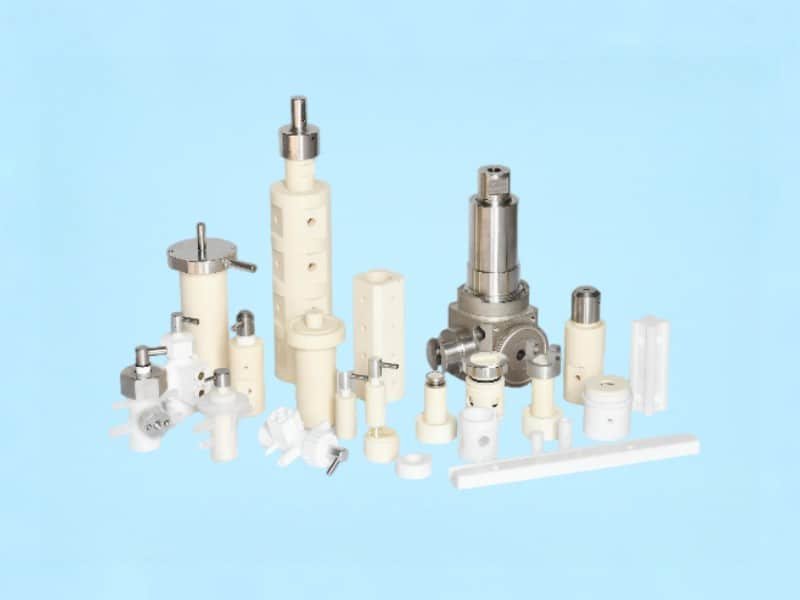
Custom manufacturing may be appropriate for compact equipment, specialized fluid paths, precision metering systems, unusual port arrangements, or replacement parts for legacy assemblies. It can also be useful when the ceramic component is only one part of a larger OEM design and must fit precisely with metal housings, seals, springs, or actuators.
Custom Ceramic Manufacturing Services
JuchangCeramic provides OEM and custom manufacturing solutions for precision ceramic parts, pumps, and components. Whether you have complete engineering drawings or an early-stage concept, the first step is to clarify the functional requirements and determine whether the geometry and material can be manufactured reliably.
- Custom ceramic components based on drawings or defined requirements
- Precision parts for pumps and industrial assemblies
- Material and design discussions for application-specific components
- Quotation and production planning based on technical requirements
What to Send for a Custom Ceramic Quotation
To receive a useful quotation, provide a 2D drawing or 3D model, ceramic material preference if known, required tolerances, surface finish, quantity, operating environment, and the function of the component. If you do not have a complete drawing, provide a sketch, photographs, mating-part dimensions, and a description of the operating problem.
For pump-related assemblies, ceramic plungers and precision sealing components may be more relevant than a complete ceramic valve. Review the alumina and zirconia ceramic parts for metering pumps when the project involves precision fluid delivery.
For smaller fluid systems, a miniature ceramic pump may be a better solution than developing a separate custom valve. The correct architecture depends on whether the main requirement is flow isolation, flow switching, or accurate fluid displacement.
11. Expert Recommendation: When Should You Choose a Ceramic Valve?
Our recommendation is to choose a ceramic valve when you can identify a specific material-related problem that the ceramic design is intended to solve. The strongest cases usually involve wear at the sealing interface, corrosion of conventional trim, or precision fluid control where stable ceramic surfaces offer a practical advantage.
For beginners, do not start by choosing between alumina and zirconia based on a general material comparison. Start with the fluid, pressure, temperature, flow function, and expected service life. Then ask a manufacturer to recommend a material and valve configuration that fits those conditions.
For commercial users, compare the total lifecycle cost. Include purchase price, installation, replacement frequency, downtime, inspection, and spare-part availability. If the current metal valve is performing reliably and maintenance costs are low, upgrading may not deliver a meaningful return.
For heavy-duty applications, pay particular attention to particle impact, pressure surges, vibration, and thermal cycling. Ceramic wear resistance is valuable, but it does not make the component immune to fracture. A properly supported ceramic element in a well-designed assembly is a better investment than a high-hardness component exposed to unsuitable mechanical loads.
JuchangCeramic’s practical position is that precision ceramic engineering should be specified around the real operating conditions, not selected as a generic upgrade. If a standard valve meets the duty, use it. If repeated wear, corrosion, or dimensional instability is creating measurable costs, investigate a ceramic solution and validate it against the actual process.
12. Frequently Asked Questions About Ceramic Valves
1. What is a ceramic valve used for?
A ceramic valve is used to control, isolate, meter, or redirect fluid flow. It is particularly useful in selected abrasive, corrosive, high-purity, and precision fluid-handling applications where ceramic sealing or flow-control components can improve wear resistance or material compatibility.
2. What materials are used to make ceramic valves?
Common technical ceramic materials include alumina, zirconia, and silicon carbide. Each has different mechanical, thermal, and chemical properties. The correct grade depends on the fluid, temperature, pressure, wear mechanism, and valve design.
3. Are ceramic valves better than metal valves?
Not in every application. Ceramic valves can offer excellent hardness, wear resistance, and chemical resistance in suitable conditions. Metal valves generally offer better tolerance to impact and deformation and may be more economical for standard services. Select according to the process rather than assuming one material is always superior.
4. Are ceramic valves suitable for corrosive liquids?
Some ceramic materials resist many corrosive chemicals, but compatibility depends on the exact ceramic grade, concentration, temperature, and exposure conditions. The valve body, seals, and other wetted parts must also be compatible with the fluid.
5. Can ceramic valves handle abrasive slurry?
They can be suitable for some abrasive slurry applications because technical ceramics are hard and wear-resistant. However, particle size, hardness, concentration, velocity, and impact loading affect performance. The manufacturer should review the actual slurry conditions before recommending a design.
6. Why are ceramic valves sometimes more expensive?
Technical ceramics require controlled material processing, forming, sintering, precision grinding, and careful inspection. Complex geometries and tight tolerances can increase manufacturing cost. The higher initial price may be justified if the valve reduces wear-related replacement and downtime.
7. Can a ceramic valve break?
Yes. Technical ceramics are hard but brittle compared with most metals. Impact, tensile stress, misalignment, excessive tightening, vibration, and thermal shock can cause chipping or fracture. Correct support, assembly, and operating conditions are essential.
8. What is the difference between a ceramic rotary valve and a ceramic ball valve?
A ceramic ball valve uses a rotating ball with a passage to open or close the flow path. A ceramic rotary valve uses rotation to align or switch flow passages according to its specific internal design. The appropriate choice depends on the required flow function, port arrangement, sealing needs, and operating conditions.
9. How do I select the right ceramic valve material?
Identify the fluid composition, concentration, temperature, pressure, solids content, and required service life. Then compare alumina, zirconia, silicon carbide, or other suitable materials against those conditions. Request the exact grade and supporting technical information from the manufacturer.
10. Can JuchangCeramic manufacture custom ceramic valve components?
JuchangCeramic provides custom manufacturing for precision ceramic parts, pumps, and components. For a valve-related project, provide drawings or a sketch, dimensions, material requirements if known, operating conditions, tolerances, and the intended function so the feasibility and quotation can be evaluated.
13. References and Technical Resources
Use recognized engineering standards and technical documentation to define valve testing, material requirements, and the acceptance criteria for the complete assembly. The following resources provide useful starting points:
- ISO 5208 – Industrial valves: Pressure testing of metallic valves. A reference for pressure testing principles and acceptance criteria for metallic valves. Confirm the applicable edition and scope for the valve being specified.
- ASME B16.34 – Valves: Flanged, Threaded, and Welding End. A recognized valve standard addressing design, materials, dimensions, pressure-temperature ratings, and examination requirements within its scope.
- The American Ceramic Society. A technical resource for engineering ceramics, ceramic materials, processing, and industry knowledge.
Standards have specific scopes and may not apply to every ceramic valve construction. Confirm the relevant product standard, test method, and regulatory requirements with the valve manufacturer and project engineer before purchase.
Need a Ceramic Component Designed for Your Application?
A ceramic valve is worth considering when its material properties solve a defined problem in your process. The right choice requires more than selecting a hard ceramic: it requires matching the material, geometry, sealing interface, and complete valve construction to the operating environment.
If your project requires a non-standard ceramic seat, sealing element, plunger, or other precision part, review JuchangCeramic’s custom precision ceramic manufacturing services. Share the drawing or application details so the component can be evaluated against the actual engineering requirements.