
When a ceramic component operates inside a metering pump, precision valve, industrial actuator or high-wear assembly, a small dimensional error can become a production problem. Leakage, premature wear, unstable flow and repeated maintenance are rarely caused by one factor alone. Material selection, forming, sintering, grinding, inspection and application knowledge all influence the final result.
Shenzhen is an important manufacturing and engineering center for buyers sourcing precision components in China. However, location alone does not establish manufacturing capability. Buyers should evaluate the manufacturer’s engineering process, material control, machining equipment, inspection methods and ability to support repeat orders.
For industrial buyers, the strongest reason to choose an experienced supplier is not simply access to ceramic parts. It is the ability to turn application requirements into repeatable components with measurable performance. We recommend evaluating engineering capability and quality control before comparing unit prices.
- What is a precision ceramic manufacturer?
- 10 reasons to choose an experienced manufacturer
- How material selection affects performance
- Experienced manufacturer vs. general supplier
- Benefits and limitations of precision ceramics
- Industrial applications and best use cases
- How to evaluate a Shenzhen ceramic manufacturer
- Cost-benefit analysis and sourcing strategy
- Common sourcing mistakes
- Custom precision ceramic manufacturing by JuchangCeramic
- Frequently asked questions
- References
What Is a Precision Ceramic Manufacturer?
A precision ceramic manufacturer produces engineered ceramic components for applications where dimensional accuracy, hardness, wear resistance, thermal stability, electrical insulation or chemical resistance are important. Unlike ordinary pottery or decorative ceramics, industrial technical ceramics are designed around engineering requirements and controlled production processes.
Common materials include alumina (Al₂O₃), zirconia (ZrO₂), silicon carbide (SiC), silicon nitride (Si₃N₄) and other specialized ceramic compositions. Each has different mechanical, thermal, electrical and chemical properties. The correct choice depends on the operating environment rather than on a generic claim that one ceramic is always better than another.
A precision ceramic manufacturer may produce components such as:
- Ceramic plungers and pump pistons
- Ceramic sleeves, tubes and rods
- Ceramic bearings and bearing elements
- Insulating tubes and electrical components
- Wear-resistant valve parts and sealing components
- Custom ceramic inserts, bushings and structural parts
- Alumina and zirconia components manufactured to customer drawings
The manufacturing process can involve powder preparation, forming, pressing, injection molding or other shaping methods, controlled sintering, diamond grinding, lapping, polishing and dimensional inspection. Not every manufacturer offers every process. Buyers should confirm which operations are performed in-house and which are outsourced.
For a broader view of available component types, see our industrial ceramic products catalog.
10 Reasons to Choose an Experienced Precision Ceramic Manufacturer in Shenzhen
1. More Accurate Material Selection for Your Application
Material selection is one of the earliest decisions in precision ceramic manufacturing, and it is one of the easiest places to make an expensive mistake. Alumina, zirconia, silicon carbide and silicon nitride are not interchangeable. Their hardness, fracture toughness, thermal conductivity, chemical compatibility and cost differ significantly.
For example, alumina is widely used where electrical insulation, hardness and general wear resistance are important. Zirconia offers higher fracture toughness than many conventional ceramic materials and can be useful for components exposed to impact or concentrated mechanical stress. Silicon carbide is often considered for demanding wear, corrosion and high-temperature environments.
An experienced manufacturer should ask about the fluid, temperature, pressure, load, operating speed, lubrication conditions and expected service life before recommending a material. If a supplier recommends a ceramic grade without asking about the application, treat that as a warning sign.
For technical background, read our guide on what alumina ceramics are and how they are used.
2. Better Control of Tight Dimensional Tolerances
Precision ceramic parts often need to fit into assemblies with metal, polymer or other ceramic components. A plunger that is slightly oversized may create excessive friction. A sleeve with an incorrect bore may cause leakage or inconsistent movement. A sealing surface that is not sufficiently flat or smooth can compromise the complete assembly.
Experienced manufacturers understand that ceramic dimensions change during sintering. The forming process must account for shrinkage, material behavior and the final machining allowance. Critical surfaces may then require diamond grinding or lapping to achieve the specified dimensions and surface finish.
From our experience, buyers should not rely on a general statement such as “high precision available.” Ask for measurable tolerances on the features that matter to your assembly. Specify bore diameter, outside diameter, roundness, cylindricity, concentricity, flatness and surface roughness where relevant.
A good manufacturer will also identify dimensions that are difficult or uneconomical to achieve and explain the implications before production begins.
3. More Reliable Wear Resistance for Long-Service Applications
Wear resistance is a major reason industrial buyers select technical ceramics. In pumps, valves, metering equipment and material-handling systems, moving surfaces may be exposed to abrasive particles, repeated contact or high-frequency movement.
Suitable ceramic materials can offer high hardness and strong resistance to abrasive wear. This can reduce the rate at which critical dimensions change during operation. However, ceramic hardness alone does not guarantee long service life. Surface finish, counterface material, alignment, lubrication, particle size and operating load also matter.
For heavy-duty applications, the manufacturer should understand the wear mechanism rather than simply recommend the hardest available material. A ceramic component that is too brittle for the impact conditions may fail even if its abrasion resistance is excellent.
Buyers looking for a wear-resistant ceramic parts supplier should request material data and, where possible, application-specific wear-test information.
4. Stronger Engineering Support Before Production
Not every buyer has a complete engineering drawing. Some have an existing metal component that needs to be converted into ceramic. Others have a failed part, a sample, a concept sketch or a performance problem that requires a different material or geometry.
An experienced precision ceramic manufacturer can help review the design before production. This may include checking wall thickness, internal corners, machining access, shrinkage allowances, assembly clearances and the feasibility of achieving the requested tolerance.
This engineering review is particularly valuable because technical ceramics are hard and relatively brittle compared with many metals. Designs that work well in steel or aluminum may create stress concentrations or manufacturing difficulties when converted directly into ceramic.
We recommend involving the manufacturer early, especially for custom parts, rather than sending a drawing for quotation only after the design is finalized.
5. More Consistent Production Through Process Knowledge
Precision ceramic manufacturing is not a single machining operation. It is a connected process in which powder characteristics, forming density, sintering conditions and finishing operations influence the final product.
Inconsistent green-body density, uncontrolled shrinkage or unsuitable grinding parameters can cause dimensional variation, cracks, chipping or unstable surface quality. A supplier with experience in the relevant material and component geometry is better positioned to identify these risks.
For repeat orders, process consistency matters as much as the first sample. Buyers should ask how the manufacturer controls raw-material batches, process parameters, inspection frequency and production records. If a component is critical to a pump or precision assembly, request a documented first-article approval process before releasing a large order.
6. Access to More Suitable Custom Shapes and Components
Standard ceramic rods, tubes and plates are useful for straightforward applications. But industrial equipment often requires custom dimensions, stepped profiles, grooves, internal bores, sealing surfaces or special mounting features.
An experienced manufacturer can assess whether the part should be formed close to its final shape and then finish-machined, or produced from a standard ceramic blank. The best method depends on geometry, material, tolerances, production volume and cost.
This is important for OEM buyers. A custom component should not be designed around what a supplier happens to stock if that compromises performance. Instead, the design should be optimized for the application’s functional requirements and the manufacturer’s actual process capabilities.
Explore our custom precision ceramic parts manufacturing service for components developed from customer drawings, samples or project requirements.
7. Better Quality Inspection and Traceability
A precision component should be accepted against defined criteria, not visual judgment alone. Depending on the part, inspection may include dimensional measurement, surface roughness testing, visual examination, density checks, material verification and non-destructive inspection where appropriate.
For cylindrical pump components, buyers may need to check diameter, roundness, cylindricity, straightness and surface finish. For sealing components, flatness and contact-surface quality may be critical. For insulating components, electrical properties and dielectric performance may also need to be specified.
Ask the manufacturer which instruments are used and whether the inspection method is suitable for the tolerance range. A supplier should be able to explain how measurements are taken, how instruments are calibrated and how nonconforming parts are handled.
For larger OEM programs, we recommend agreeing on a control plan and inspection report format before mass production. This makes supplier performance easier to review across batches.
8. More Practical Communication and Supply-Chain Coordination
Shenzhen’s manufacturing ecosystem can be useful for buyers who need coordinated sourcing, engineering communication and export logistics. A manufacturer with experience serving overseas customers may be familiar with drawing reviews, sample approval, packaging requirements, export documentation and production scheduling.
However, being located in Shenzhen does not automatically mean a company has an integrated ceramic production facility. Some trading companies outsource all manufacturing. Others may perform machining or inspection in-house while purchasing ceramic blanks from specialist factories.
There is nothing inherently wrong with a managed supply chain, but buyers should understand who controls each production stage. Ask where forming, sintering, grinding and final inspection take place. Confirm who is responsible when a part fails dimensional or performance inspection.
In most professional situations, clear ownership of quality responsibilities is more valuable than a supplier’s location or sales presentation.
9. Lower Total Cost of Ownership, Not Just a Lower Unit Price
Precision ceramic components can cost more upfront than simple metal or polymer alternatives. But the purchase price does not tell the whole story. Buyers should consider component life, maintenance frequency, downtime, replacement labor, rejected products and the cost of production interruptions.
For example, a ceramic plunger used in a metering pump may have a higher initial price than a conventional alternative. If the selected ceramic grade and surface finish improve wear performance in the actual fluid and operating conditions, the longer service interval may justify the initial investment.
That outcome should be demonstrated, not assumed. Ceramic is not automatically the best solution for every application. Impact loading, thermal shock, tensile stress, poor alignment or incompatible operating conditions can lead to premature failure.
For a practical purchasing comparison, see our ceramic plunger price guide.
10. Better Support for Long-Term OEM Development
Industrial buyers rarely need only one component forever. Equipment revisions, new models, replacement programs and production-volume changes can create ongoing requirements. A manufacturer that understands the original application can make future changes more efficiently.
That support may include adjusting dimensions, improving surface finish, changing material grade, developing a new component family or maintaining approved specifications across repeat orders.
For OEM programs, we recommend treating the ceramic manufacturer as an engineering supply partner rather than a one-time parts vendor. Keep approved drawings, material specifications, inspection records and revision history under control. This reduces the risk of receiving a technically different replacement part several months after the original order.
How Ceramic Material Selection Affects Component Performance
The best material depends on the operating conditions. A manufacturer should explain the trade-offs rather than promote one ceramic grade as a universal solution.
| Material | Typical strengths | Common industrial uses | Important considerations |
|---|---|---|---|
| Alumina (Al₂O₃) | Hardness, electrical insulation, wear resistance and broad industrial availability | Insulators, pump parts, tubes, rods and wear components | Grade and purity affect properties; brittle behavior must be considered |
| Zirconia (ZrO₂) | Higher fracture toughness than many conventional ceramics and good wear performance | Plungers, precision shafts, valve components and structural parts | Stabilizer composition and grade influence performance and cost |
| Silicon carbide (SiC) | High hardness, thermal conductivity and strong wear/corrosion performance in suitable environments | Mechanical seals, wear plates and demanding fluid-handling components | Machining and joining can be challenging; chemical compatibility still needs checking |
| Silicon nitride (Si₃N₄) | Good strength, thermal-shock resistance and fracture toughness for selected applications | Bearings, high-performance mechanical and thermal components | Higher material and manufacturing costs may apply |
These are general engineering tendencies, not substitutes for a grade-specific technical datasheet. Composition, manufacturing route, porosity, microstructure and finishing quality can change the properties of the finished component.
Alumina or zirconia: which should you choose?
Alumina is often a cost-effective option for applications requiring hardness, electrical insulation and general wear resistance. Zirconia may be more suitable where fracture toughness and resistance to crack propagation are important. But zirconia is not automatically superior: it can cost more, and its properties depend on the specific stabilized composition and processing conditions.
For pump components, the decision should account for the fluid, pressure, operating temperature, contact conditions and required dimensional stability. Our guide to alumina and zirconia ceramic components for metering pumps provides a useful starting point.
Experienced Precision Ceramic Manufacturer vs. General Ceramic Supplier
Not every ceramic supplier is equipped to produce high-precision industrial components. A general supplier may be suitable for standard shapes or noncritical applications, but custom engineering parts require more control over material, geometry and inspection.
| Evaluation factor | Experienced precision ceramic manufacturer | General ceramic supplier |
|---|---|---|
| Material selection | Reviews operating conditions and recommends suitable grades | May offer a limited standard material range |
| Drawing review | Checks geometry, tolerances and manufacturability | May quote directly from the supplied drawing |
| Process knowledge | Understands forming, sintering, grinding and finishing interactions | May rely on external production partners |
| Dimensional inspection | Uses defined measurement methods for critical features | Inspection may focus on basic dimensions |
| Custom components | Can support complex shapes and OEM development | May concentrate on standard products |
| Repeat-order control | Can maintain approved specifications and process records | Consistency may depend on sourcing arrangements |
| Technical communication | Discusses performance, failure risks and design changes | May focus mainly on price and delivery |
| Best fit | Critical industrial components and long-term OEM supply | Standard parts and less demanding requirements |
The distinction is not that every general supplier produces poor products. The question is whether the supplier has the specific capabilities your component requires. A standard ceramic tube may not need extensive engineering support. A precision plunger operating in a demanding metering pump almost certainly needs a more controlled process.
Benefits and Limitations of Precision Ceramic Components
| Benefits | Limitations |
|---|---|
| High hardness and strong wear resistance in suitable applications | Many technical ceramics are brittle and sensitive to impact or tensile stress |
| Good chemical resistance for compatible material and fluid combinations | Chemical compatibility must be checked for the exact grade and operating conditions |
| Electrical insulation for suitable alumina and other insulating grades | Electrical properties vary by composition, purity and temperature |
| Dimensional stability in many demanding operating environments | Thermal expansion and thermal shock behavior differ by material |
| Potentially longer service intervals in abrasive or corrosive applications | Higher initial cost and specialized machining may increase purchase price |
| Can be manufactured into complex custom components | Design changes after tooling or production release can be expensive |
Precision ceramics are worth using when their properties solve a real engineering problem. They are not a universal upgrade for every metal or polymer part. If a component experiences repeated impact, large bending loads or severe thermal shock, a ceramic solution may need a different design—or may not be suitable at all.
Industrial Applications: Where an Experienced Manufacturer Adds the Most Value
Precision pumps and fluid metering systems
Ceramic plungers, sleeves, liners and valve components can be used in metering and dosing equipment where wear resistance, dimensional consistency and chemical compatibility are important. The manufacturer must understand the fluid, operating pressure, stroke frequency, sealing arrangement and clearance requirements.
Explore our overview of precision ceramic components for pumps and ceramic pump parts and component categories.
Electrical insulation and high-temperature equipment
Alumina tubes, rods and insulating components are used in electrical and thermal systems where a combination of insulation, temperature resistance and mechanical stability is required. Buyers should specify operating temperature, voltage, dielectric requirements, atmosphere and mechanical mounting conditions.
For projects involving tubular components, our guide to ceramic tube insulator manufacturers can help clarify the supplier capabilities worth checking.
Industrial machinery and precision motion systems
Ceramic rods, bearings, bushings and wear components can support machinery that operates under demanding friction, contamination or temperature conditions. The suitability of a ceramic bearing, for example, depends on load, speed, lubrication, fit and the bearing’s complete construction—not merely the material of the rolling elements.
Read our guide on what ceramic bearings are used for before specifying them for a motion-control application.
Chemical processing and abrasive fluid handling
In chemical processing, slurry transfer and dosing systems, ceramic parts may provide useful resistance to abrasion and selected corrosive environments. The material must be checked against the actual chemical concentration, temperature and cleaning process. Generic chemical-resistance charts are a starting point, not a substitute for application review.
How to Evaluate an Experienced Precision Ceramic Manufacturer in Shenzhen
A supplier audit should focus on evidence. A professional website, attractive sample photos and a low quotation are not enough to establish manufacturing capability. Use the following checks before approving a supplier.
1. Confirm the actual manufacturing scope
Ask which operations are performed in-house: powder preparation, forming, sintering, grinding, lapping, polishing and final inspection. If operations are outsourced, identify the responsible subcontractors and how quality is controlled between stages.
2. Review relevant material and process experience
Ask for examples of components made from the material you need. Experience producing alumina tubes does not automatically prove capability in precision zirconia plungers. Look for evidence related to similar geometries, tolerances and operating conditions.
3. Request sample inspection data
For critical dimensions, ask for a sample inspection report. The report should identify the measured feature, nominal dimension, tolerance, actual result and measurement method. If surface roughness is important, specify the required parameter and measurement standard.
4. Check quality management and traceability
Ask whether the manufacturer operates a documented quality management system and whether relevant certifications are current and within scope. ISO 9001 certification can indicate a structured quality management framework, but it does not by itself guarantee that a particular ceramic component will meet your drawing.
5. Evaluate communication and engineering response
Send a drawing and ask the supplier to identify potential manufacturing risks. A useful technical response should address tolerances, material options, critical dimensions, finishing requirements and any information still needed to quote accurately.
6. Clarify tooling, MOQ and lead time
Custom ceramic parts may require dedicated tooling, forming development or process qualification. Ask whether tooling charges are separate, who owns the tooling, what the minimum order quantity is and how lead time changes between prototype and repeat production.
7. Confirm after-sales support and corrective action
Before ordering, agree on how nonconforming parts are handled. Ask whether the supplier provides replacement parts, root-cause analysis and corrective-action reports. For long-term OEM programs, these procedures should be documented.
Cost-Benefit Analysis: Is an Experienced Manufacturer Worth the Higher Price?
In precision ceramic sourcing, a low quotation can hide costs that appear later. A supplier may quote a standard material without confirming the grade, exclude critical grinding operations or use a tolerance that does not meet the assembly requirement. The part may look acceptable but fail during installation or operation.
We recommend comparing the total cost of ownership rather than the unit price alone.
| Cost factor | Questions to ask | Commercial impact |
|---|---|---|
| Unit price | Does the quotation include the specified material, finishing and inspection? | Prevents hidden specification gaps |
| Tooling and development | Are molds, fixtures or engineering fees charged separately? | Clarifies the true initial investment |
| Yield and rejection | What inspection criteria and acceptance limits apply? | Reduces scrap and incoming quality disputes |
| Service life | Is there application evidence for wear and chemical performance? | Helps estimate replacement frequency |
| Delivery reliability | Can the supplier maintain the required production schedule? | Reduces production interruption risk |
| Replacement supply | Can the same approved specification be repeated? | Supports long-term equipment maintenance |
| Engineering changes | Can the supplier review and implement drawing revisions? | Reduces redesign and qualification costs |
When paying more is justified
Paying a higher price is often justified when the component is critical to equipment uptime, when tolerances are demanding, when the material is difficult to machine or when failure creates expensive downtime. In these situations, engineering support and process control are part of the product—not optional extras.
When a lower-cost supplier may be sufficient
For noncritical standard components with broad tolerances and predictable operating conditions, a general supplier may be perfectly adequate. There is no commercial reason to pay for extensive engineering support if the part does not require it. The key is to define the specification accurately and verify that the supplier can meet it consistently.
Common Mistakes When Sourcing Precision Ceramic Parts
Mistake 1: Choosing material by name rather than operating conditions
Specifying “alumina” or “zirconia” without a grade, purity or property requirement leaves room for variation. Identify the relevant material characteristics and require the supplier to confirm the exact grade.
Mistake 2: Applying metal tolerances without reviewing ceramic manufacturability
Ceramics behave differently from metals during forming, sintering and machining. A drawing should be reviewed for realistic tolerances, stress concentrations and finishing access before production starts.
Mistake 3: Ignoring surface finish
For sliding, sealing and fluid-contact applications, surface roughness can influence friction, leakage and wear. A diameter tolerance alone may not define the functional quality of the part.
Mistake 4: Approving samples without a clear acceptance standard
A sample should be measured against the same drawing revision and inspection criteria that will apply to mass production. Visual approval is not enough for critical components.
Mistake 5: Failing to check the manufacturer’s production role
A trading company may coordinate a capable factory, but buyers should know where the component is formed, sintered, machined and inspected. Define accountability before releasing an order.
Mistake 6: Focusing only on the first order
For OEM parts, repeatability is essential. Confirm how the supplier controls material batches, process changes, drawing revisions and retained inspection records. A good first sample is only the beginning of supplier qualification.
JuchangCeramic: Custom Precision Ceramic Manufacturing Services
Custom Ceramic Manufacturing Services
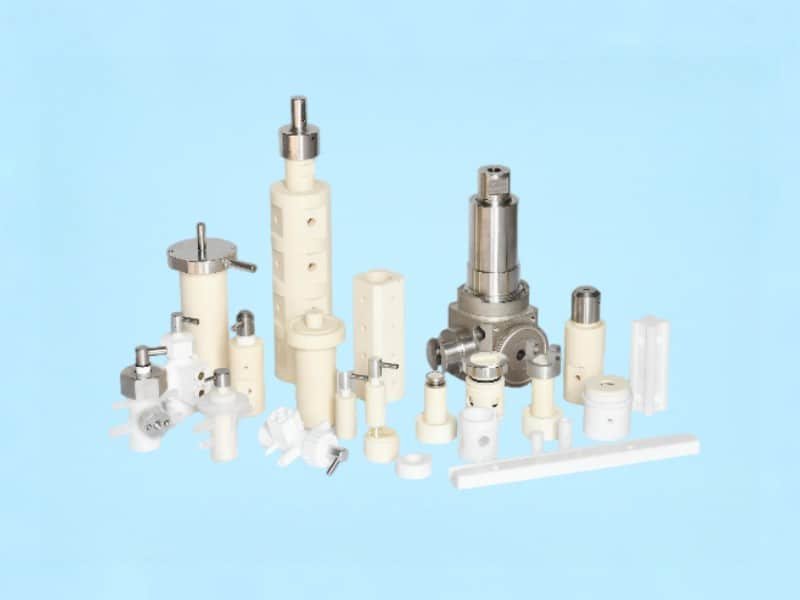
JuchangCeramic provides OEM and custom manufacturing solutions for precision ceramic parts, pumps and industrial components. Whether a buyer has a complete engineering drawing, an existing sample or an early-stage concept, the objective is to translate the requirement into a manufacturable component with a clear specification and production plan.
For industrial buyers, this approach is useful when standard catalog dimensions do not match the equipment design or when a component needs to be adapted for wear, chemical exposure, dimensional accuracy or a particular assembly.
Explore JuchangCeramic custom precision ceramic manufacturing services.
When requesting a quotation, provide as much technical information as possible. A complete drawing is ideal, but a sample, sketch or written application description can also be a starting point for an engineering discussion.
For a more accurate quotation, we recommend preparing:
- 2D engineering drawing and 3D CAD file, if available
- Required ceramic material and grade, or the operating conditions for material selection
- Critical dimensions and tolerances
- Surface roughness and finishing requirements
- Operating temperature, pressure, load and chemical environment
- Expected annual quantity and initial order quantity
- Prototype requirements and target production schedule
- Inspection documentation and packaging requirements
JuchangCeramic’s custom manufacturing service is intended to support buyers who need more than a standard ceramic product. The value comes from reviewing the engineering requirement, clarifying manufacturing details and producing components against an agreed specification.
Expert Recommendation: Choose the Manufacturer That Can Control the Whole Process
An experienced precision ceramic manufacturer in Shenzhen can be a valuable partner when your project requires custom geometry, controlled tolerances, material expertise and reliable repeat production. But buyers should avoid choosing on geography, marketing claims or unit price alone.
Our recommendation is to evaluate five capabilities before approving a supplier:
- Material knowledge: Can the manufacturer explain why a particular ceramic grade suits your operating conditions?
- Engineering support: Can the team identify design risks and manufacturing constraints before production?
- Process control: Can it explain how forming, sintering and precision finishing are controlled?
- Inspection capability: Can it provide measurement results for the critical features on your drawing?
- Repeat-order reliability: Can it maintain the approved material, dimensions and quality requirements over time?
For beginners, start with a clearly defined application and a small qualification order. For established OEM buyers, use a formal supplier approval process with drawings, material specifications, inspection reports and change-control requirements.
For heavy-duty applications, do not assume that the hardest ceramic is automatically the best. Match the material and component design to the actual wear, impact, thermal and chemical conditions. A technically suitable part with consistent manufacturing control is usually a better investment than an impressive material specification that has not been validated in the application.
Ultimately, the best precision ceramic manufacturer is the one that can demonstrate how it will meet your requirements—not simply promise that it can.
Frequently Asked Questions
1. What does an experienced precision ceramic manufacturer do?
An experienced precision ceramic manufacturer develops and produces engineered ceramic components such as plungers, tubes, rods, bearings, sleeves and custom wear parts. Its work may include material selection, drawing review, forming, sintering, precision grinding, polishing and dimensional inspection.
2. Why choose a precision ceramic manufacturer in Shenzhen?
Shenzhen offers access to a broad manufacturing and export ecosystem, which can support engineering communication, supply-chain coordination and overseas delivery. Buyers should still verify the manufacturer’s actual production capabilities, quality systems and responsibility for outsourced processes.
3. Which ceramic material is best for precision industrial components?
There is no universal best material. Alumina is widely used for hardness, wear resistance and electrical insulation. Zirconia can be suitable where higher fracture toughness is needed. Silicon carbide and silicon nitride are considered for selected demanding thermal, mechanical and wear applications. The correct choice depends on operating conditions and the specific material grade.
4. Can a precision ceramic manufacturer produce parts from customer drawings?
Yes. Custom manufacturers commonly work from 2D drawings, 3D CAD files, samples or project specifications. Before production, the manufacturer should review tolerances, geometry, material, finishing requirements and manufacturing feasibility.
5. What tolerances can precision ceramic parts achieve?
Achievable tolerances depend on the ceramic material, component geometry, forming method, sintering shrinkage, machining process and part size. Critical dimensions may require diamond grinding or lapping. Buyers should request tolerances for specific features rather than rely on a general precision claim.
6. Are ceramic components better than metal components?
Not in every application. Ceramics can offer high hardness, wear resistance, electrical insulation and chemical resistance, but many are brittle and less tolerant of impact or tensile stress. Metals may be more suitable where ductility, impact resistance or easy machining is essential.
7. How do I evaluate a ceramic manufacturer’s quality?
Review its material specifications, process controls, inspection equipment, sample measurement reports, traceability practices and relevant quality certifications. Ask how it controls critical dimensions and how it handles nonconforming products and repeat orders.
8. What information is needed for a custom ceramic parts quotation?
Provide a drawing or sample, material requirements, critical tolerances, surface finish, operating environment, expected quantity, target lead time and inspection requirements. If the material has not been selected, describe the application so the manufacturer can assess suitable options.
9. Are precision ceramic parts expensive?
They can cost more upfront than standard metal or polymer parts because ceramic forming, sintering and precision machining may require specialized processes. The total value depends on service life, maintenance, replacement frequency, equipment downtime and the cost of component failure.
10. What should I ask before choosing a custom ceramic parts supplier?
Ask which processes are performed in-house, what ceramic grades are available, how critical dimensions are inspected, whether samples and inspection reports can be provided, how tooling is charged, what the warranty and corrective-action process covers, and whether the supplier can support repeat production.
References
- The American Ceramic Society – Technical ceramic materials, applications and industry resources.
- ISO 9001:2015 – Quality Management Systems – Requirements for quality management systems used by organizations to demonstrate consistent processes and customer-focused quality control.
- National Institute of Standards and Technology (NIST) – Materials science, measurement science and technical standards-related research resources.