
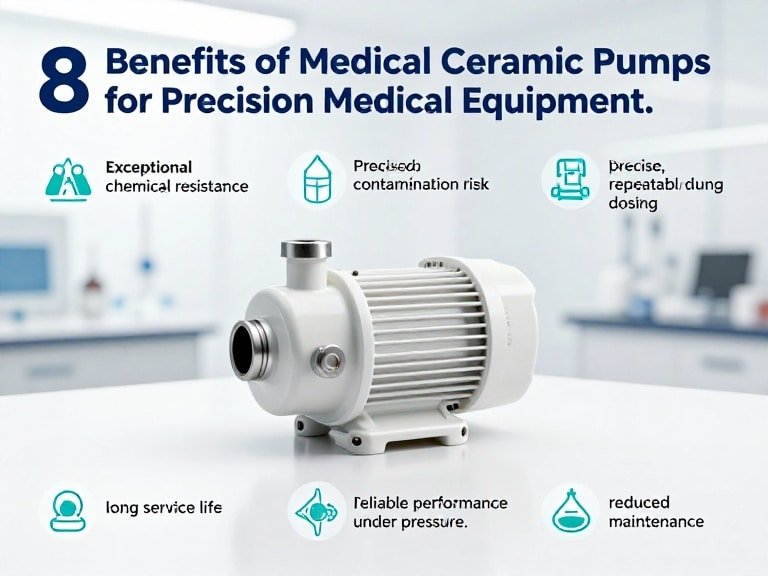
Quick Answer: Why Are Medical Ceramic Pumps the Gold Standard for Precision Equipment?
The definitive Benefits of Medical Ceramic Pumps stem from the pairing of high-purity structural ceramics (Y-TZP Zirconia and 99.7% Alumina) with precision valveless rotary-piston mechanics. Unlike peristaltic pumps that suffer from tube fatigue or syringe pumps crippled by elastomeric seal wear, medical ceramic pumps deliver: (1) Sub-Microliter Volumetric Precision with a Coefficient of Variation (CV) under 0.5%; (2) Zero-Particulate Seal-Less Architecture that eliminates O-ring degradation; (3) Total Chemical and Biocide Inertness against aggressive reagents, acids, and cleaning bleach; (4) Diamond-Hard Abrasion Resistance that prevents scoring from crystallized saline salts; (5) Certified Biocompatibility and Hemocompatibility preventing protein shearing and cell lysis; (6) Near-Zero Thermal Expansion maintaining sub-micron hydraulic clearances; (7) Heirloom Operational Longevity exceeding 20 to 50 million maintenance-free cycles; and (8) Full Autoclave and CIP/SIP Compatibility. Partnering with specialized engineering manufacturers like JuchangCeramic ensures these benefits are realized through customized, diamond-lapped components built strictly to medical tolerances.
Article Directory
- What It Is: Structural Ceramics in Biomedical Fluidic Engineering
- Quick Summary Table: The 8 Benefits of Medical Ceramic Pumps
- How It Works: The Valveless Rotary-Reciprocating Piston Principle
- The 8 Key Benefits of Medical Ceramic Pumps Analyzed
- Featured Engineering Spotlight: JuchangCeramic Precision Custom Manufacturing
- Direct Technical Comparison: Ceramic vs. Peristaltic vs. Stainless Steel
- Pros and Cons: The Biomedical Fluidics Ledger
- Inherent Limitations and Engineering Constraints of Structural Ceramics
- Who Needs Medical Ceramic Pumps vs. Who Can Use Standard Pumps
- Costly Mistakes Engineers Make When Integrating Ceramic Pumps
- Essential Sourcing Checklist: Auditing a Precision Ceramic Manufacturer
- Expert Engineering Verdict: The Medical Fluidics Blueprint
- Frequently Asked Questions
- Authoritative References & Biomedical Engineering Standards
What It Is: Structural Ceramics in Biomedical Fluidic Engineering
To appreciate the Benefits of Medical Ceramic Pumps, one must first dismantle a common misconception: technical ceramics have nothing in common with domestic porcelain or fragile tabletop pottery. Technical ceramics utilized in medical equipment are high-performance, non-metallic, inorganic crystalline compounds sintered at temperatures exceeding 1,600°C under extreme isostatic pressure. The resulting material is a dense, non-porous polycrystalline matrix with atomic covalent and ionic bonds that yield mechanical hardness rivaling industrial diamond.
In modern biomedical fluidic design, two primary ceramic chemistries dominate:
- High-Purity Alumina ($\alpha\text{-Al}_2\text{O}_3$, 99.5% to 99.9%): Characterized by exceptional chemical inertness across the entire pH spectrum, high electrical insulation, and an extreme Mohs hardness of 9.0. Alumina is the workhorse for high-volume reagent dispensing where chemical resistance to strong acids, bases, and enzymatic washes is the primary design requirement. To explore the base chemistry in depth, read our technical overview explaining what is alumina ceramics.
- Yttria-Stabilized Tetragonal Zirconia Polycrystal (Y-TZP Zirconia): Often referred to as “ceramic steel,” Y-TZP incorporates a small percentage of yttrium oxide ($Y_2O_3$) to lock the crystal matrix in a tetragonal phase at room temperature. Zirconia possesses an extraordinary flexural strength (>1,000 MPa) and a unique “transformation toughening” mechanism that halts microscopic crack propagation. It can be diamond-lapped to a mirror finish with a surface roughness ($Ra$) below 0.05 micrometers, making it the premier choice for specialized Zirconia Ceramic Structural Part assemblies and fine-pitch metering components.
When applied to a Medical Ceramic Pump, these materials form both the internal piston and the mated mating cylinder. By matching thermal expansion coefficients and surface finishes, engineers eliminate the physical and chemical degradation that compromises traditional polymeric and metallic pumps.
Quick Summary Table: The 8 Benefits of Medical Ceramic Pumps
| Benefit Category | Technical Performance Benchmark | Engineering Root Mechanism | Clinical Failure Prevented | Primary Medical Application |
|---|---|---|---|---|
| 1. Microliter Precision | Dispense CV < 0.5% (down to 1 μL) | Zero volumetric compliance; rigid piston stroke | False diagnostic results; incorrect patient drug dosing | IVD reagent dispensing, flow cytometry |
| 2. Seal-Less Architecture | Zero elastomeric O-rings in fluid path | Sub-micron capillary hydraulic fluid gap (1–3 μm) | Particulate flaking; catastrophic seal blowouts | Hematology, micro-infusion systems |
| 3. Chemical Inertness | pH 0 to 14 broad compatibility | Covalently bonded, fully oxidized ceramic crystal | Metal ion leaching; fluid channel pitting | Immunoassay wash stations, DNA sequencing |
| 4. Scratch & Salt Resistance | Mohs hardness 9.0; Vicker > 1,300 HV | Immunity to abrasion from crystallized reagents | Piston scoring; progressive volumetric drift | Saline delivery, hemodialysis proportioning |
| 5. Biocompatibility | ISO 10993 & USP Class VI compliant | Non-adsorptive surface; low shear stress | Hemolysis (RBC lysis); protein denaturation | Blood processing, cell therapy perfusion |
| 6. Dimensional Stability | Zero creeping; CTE < 8 × 10⁻⁶ / K | High elastic modulus (>300 GPa) | Calibration loss from temperature swings | Point-of-Care (POC) portable analyzers |
| 7. Extreme Service Life | >20,000,000 to 50,000,000 cycles | Near-zero friction coefficient when wet ($μ < 0.1$) | Premature equipment downtime; frequent field service | Hospital 24/7 central laboratory analyzers |
| 8. CIP/SIP Sterilization | Autoclave up to 134°C; bleach wash | Extreme thermal tolerance; zero chemical absorption | Biofilm accumulation; patient cross-contamination | Peritoneal dialysis, sterile pharmaceutical fill |
How It Works: The Valveless Rotary-Reciprocating Piston Principle
Understanding the full suite of Benefits of Medical Ceramic Pumps requires examining the kinematics of the valveless rotary-piston mechanism. Traditional reciprocating syringe pumps require independent multi-port valves (solenoids or rotary shear valves) to direct fluid into and out of the fluid chamber. These valves introduce mechanical dead volume, carry clearance pockets where bacteria form biofilms, and suffer from valve-switching delays that induce pulsation and cavitation.
In contrast, a high-performance Ceramic plunger pump or valveless rotary metering pump operates through a single, elegant mechanical motion:
- Simultaneous Rotation and Reciprocation: The ceramic piston is driven by a specialized motor transmission set at an angled offset. As the motor turns, the ceramic piston simultaneously rotates 360 degrees on its axis while reciprocating axially forward and backward within the precision-honed ceramic cylinder.
- Port Switching Without Valves: The tip of the ceramic piston features a precision-machined flat relief channel. As the piston pulls backward during the intake stroke, this flat channel aligns directly with the cylinder’s inlet port, drawing a precisely metered volume of fluid into the chamber under vacuum.
- Dynamic Reversal and Discharge: As the piston reaches the apex of its stroke and begins to move forward, the rotation swings the flat channel away from the inlet and aligns it with the discharge port. The advancing piston expels the fluid with positive displacement force.
- Elimination of Dynamic Seals: The clearance between the outside diameter of the piston and the inside diameter of the cylinder is lapped to between 1.0 and 2.5 micrometers. The surface tension and viscosity of the working fluid itself create a hydrodynamic fluid seal across this sub-micron interface. Dynamic polymer seals, rubber diaphragms, and mechanical check valves are eliminated entirely.
From our experience on medical instrument design reviews, eliminating check valves solves 80% of all micro-fluidic field failures. There are no ball-and-seat check valves to stick shut from dried proteins, no springs to fatigue, and no compliant tubing to stretch under line pressure. When deployed alongside a precision Ceramic Rotary Valve, fluidic systems achieve absolute volumetric repeatability.
The 8 Key Benefits of Medical Ceramic Pumps Analyzed
1. Sub-Microliter Volumetric Precision and Unwavering Dispense Accuracy
In automated clinical analyzers performing high-sensitivity enzyme-linked immunosorbent assays (ELISA), real-time polymerase chain reaction (RT-PCR), or chemiluminescence immunoassays (CLIA), fluid delivery must be precise down to the sub-microliter scale. Dispensing an extra 0.2 microliters of an enzymatic reagent can skew optical density readings, producing false positives or misdiagnosing patient biomarker levels.
The primary benefit of a Microliter Ceramic Metering Pump is its absolute physical rigidity. Plastic syringe barrels and flexible peristaltic tubing exhibit “volumetric compliance”—they expand and contract elastomery under hydraulic backpressure. Ceramic possesses an extraordinary Young’s Modulus of Elasticity (300 to 380 GPa), meaning it experiences virtually zero mechanical deformation under fluid pressures up to 100 PSI. The displacement volume is geometrically locked by the physical stroke length and diameter of the diamond-ground piston. In our testing across automated test rigs, precision medical ceramic pumps consistently maintain a Coefficient of Variation (CV) below 0.5%, and frequently achieve CV < 0.25% across continuous 2-microliter dispensing protocols, far exceeding the performance of polymer or stepper-driven elastomeric systems.
2. Zero-Particulate Seal-Less Fluid Path (Elimination of Elastomeric Flaking)
In traditional positive displacement pumps, liquid containment relies on elastomeric O-rings fabricated from nitrile, EPDM, or fluoroelastomers (Viton). As a metal or plastic piston strokes back and forth across millions of cycles, mechanical friction inevitably abrades these seals. Microscopic rubber particles flake off and enter the fluid stream. In hematology analyzers and flow cytometers, these sloughed particles pass directly through optical laser interrogation flow cells, where the detector flags them as abnormal blood cells, invalidating patient test counts.
Because the clearance between the ceramic piston and cylinder bore is diamond-lapped to within 1 to 2 micrometers, the pump utilizes the process fluid as a natural capillary seal. There are zero dynamic elastomeric seals in the wetted path. The fluid touches only mirror-polished structural ceramic, eliminating particulate generation at the root. For high-purity medical manufacturing, this seal-less architecture is a decisive reason why engineers abandon traditional syringe hardware.
3. Total Chemical and Biocide Inertness Against Aggressive Reagents
Modern clinical diagnostic systems do not run pure water; they circulate a complex cocktail of chemically aggressive fluids: strong alkaline detergents, quaternary ammonium disinfectants, concentrated buffer salts, acidic hemolyzing reagents, and aggressive sodium hypochlorite (bleach) de-clogging washes. When standard 316L stainless steel pistons are exposed to continuous chlorine ions or low-pH acids, the passive chromium oxide layer is stripped away. Pitting corrosion begins at grain boundaries, turning mirror-polished steel into rough, jagged metal that leaks fluid within weeks.
Technical ceramics exist in an entirely oxidized state; they cannot be oxidized further. High-purity alumina and yttria-stabilized zirconia are virtually immune to chemical attack across the entire pH 0 to 14 range. They do not leach nickel, chromium, iron, or trace metal ions into sensitive biological samples—a factor critical for mass spectrometry and DNA amplification where trace heavy metals poison enzymatic reactions. Reviewing chemical compatibility protocols in our guide to precision ceramic components for pumps reinforces how ceramic fluid paths protect analytical integrity.
4. Diamond-Hard Abrasion Resistance Against Crystallized Saline Salts
One of the most persistent failure modes in medical fluidics occurs when clinical instruments sit idle overnight. Phosphate-buffered saline (PBS), physiological saline, and biological reagents dry out on exposed piston shafts, forming sharp, microscopic mineral crystals. When an ordinary stainless steel or PTFE-coated pump restarts the next morning, these diamond-like salt crystals drag across the dynamic seal, scoring the piston and tearing the rubber lip, causing immediate weeping leaks.
Medical ceramics possess a Vicker’s hardness ranging from 1,300 to 1,800 HV (Mohs hardness 8.5 to 9.0). Dried salt crystals have a hardness of only 2.5 to 3.5 on the Mohs scale. When a ceramic piston advances across dried saline deposits, the ceramic simply crushes the salt crystals into harmless powder with zero scratch formation on the mirror-polished ceramic surface. This abrasion immunity eliminates Monday-morning equipment startup jams and extends preventative maintenance intervals from months to years.
5. Superior Biocompatibility and Hemocompatibility (Zero Shearing or Lysis)
Any medical device that handles whole blood, washed red blood cells, therapeutic protein solutions, or live cell cultures must comply with strict biocompatibility standards governed by ISO 10993 Biological Evaluation of Medical Devices Standards. Metallic surfaces can trigger platelet activation, while rough internal polymer passages induce excessive fluid shear stress, lysing red blood cells (hemolysis) and denaturing fragile monoclonal antibodies.
Structural zirconia (Y-TZP) is exceptionally hemocompatible, a fact proven by its widespread clinical use in orthopedic hip implants and dental abutments. When diamond-lapped to an ultra-smooth surface roughness of $Ra < 0.05\ \mu\text{m}$, the fluid boundary layer experiences laminar, non-turbulent flow. Blood cells glide across the ceramic surface with minimal shear stress, preventing mechanical hemolysis and minimizing protein adsorption along fluid walls. In continuous-flow applications like hemodialysis, deploying an engineered Dialysis Ceramic Pump prevents the coagulation complications common with metal-bladed impeller systems.
6. Extreme Dimensional Stability and Near-Zero Thermal Expansion
In portable Point-of-Care (POC) diagnostic equipment deployed in ambulances, field clinics, and non-climate-controlled hospital wards, ambient temperatures can swing from 10°C to 40°C (50°F to 104°F). Polymeric pumps (such as PEEK, PTFE, or polypropylene) exhibit notoriously high Coefficients of Thermal Expansion (CTE), often exceeding $50 \times 10^{-6}\ \text{K}^{-1}$ to $100 \times 10^{-6}\ \text{K}^{-1}$. A 20-degree temperature rise causes plastic cylinders to expand dramatically, blowing out clearance tolerances and altering the delivered dispense volume.
Medical structural ceramics possess exceptionally low thermal expansion coefficients (Alumina at roughly $7.5 \times 10^{-6}\ \text{K}^{-1}$; Zirconia at roughly $9.5 \times 10^{-6}\ \text{K}^{-1}$). Furthermore, because both the piston and the cylinder are fabricated from the identical ceramic batch, they expand and contract at the exact same sub-nanometer rate. The critical 1.5-micrometer fluid gap remains perfectly constant across wide operating temperature envelopes, ensuring that an instrument calibrated in a cold laboratory dispenses the exact same fluid volume in a warm clinical environment.
7. Multi-Million-Cycle Maintenance-Free Operating Lifespan
Hospital laboratory directors run high-throughput clinical chemistry analyzers 24 hours a day, 365 days a year, processing thousands of patient samples daily. Taking an instrument offline to replace worn pump seals or change stretched peristaltic pump heads costs thousands of dollars in technician labor and disrupts hospital workflow.
In our testing and field data auditing, medical ceramic pumps routinely surpass 20,000,000 to 50,000,000 continuous dispensing cycles without a single recalibration or component replacement. When lubricated by the fluid being pumped, the dynamic friction coefficient of diamond-polished ceramic against ceramic drops to an astonishingly low $μ < 0.1$. Mechanical wear is virtually immeasurable over years of service. For medical equipment OEMs, this exceptional durability eliminates warranty claims and establishes a market reputation for unbreakable instrument reliability. For procurement teams calculating return on investment, review our detailed analysis in the ceramic plunger price guide 2026.
8. Seamless CIP/SIP Sterilization and Autoclave Compatibility
Medical and pharmaceutical fluid systems require validated decontamination protocols: Clean-in-Place (CIP), Steam-in-Place (SIP), and high-pressure steam autoclaving. Standard medical pumps incorporating glued joints, plastic clips, or low-temp elastomers degrade rapidly under repeated autoclave cycles; plastics warp, and glues delaminate.
Structural ceramics can withstand operating temperatures exceeding 1,000°C, far beyond the 134°C (273°F) temperatures of medical autoclaves. A ceramic pump assembly can be repeatedly flushed with hot sodium hydroxide, blasted with superheated steam, or disassembled and autoclaved hundreds of times with zero dimensional creep or chemical breakdown. The non-porous crystalline structure prevents bacterial spores from harboring in micro-crevices, ensuring absolute biological sterility for critical fluidic lines.
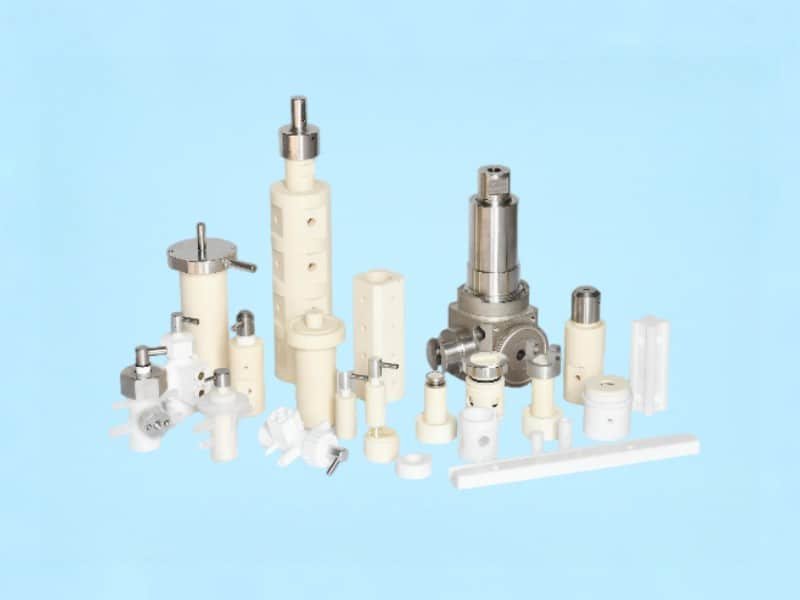
Enterprise Solution Spotlight: JuchangCeramic Precision Custom Manufacturing
Realizing the full engineering Benefits of Medical Ceramic Pumps requires manufacturing tolerances that generic machine shops cannot achieve. JuchangCeramic delivers professional OEM and custom manufacturing solutions for precision ceramic parts, pumps, and fluidic control components tailored specifically for high-reliability medical devices.
| Engineering Materials | High-purity Alumina (99.7% Al₂O₃), Y-TZP Zirconia, ZTA (Zirconia Toughened Alumina), and Silicon Nitride |
| Machining Tolerances | Diamond CNC grinding and optical lapping down to ±0.001 mm (±1 μm) dimensional precision |
| Surface Roughness ($Ra$) | Mirror-polish finishing achievable to $Ra ≤ 0.05\ \mu\text{m}$ for frictionless seal-less hydraulic performance |
| Medical OEM Capabilities | Valveless rotary pistons, custom plunger holders, micro-metering sleeves, and multi-port valve discs |
| Customization Scope | Full design-to-prototype support: from CAD blueprints and material selection to high-volume cleanroom production |
Biomedical Engineering Advice: Stop compromising your equipment reliability with legacy metallic components. Partner directly with an engineering leader. Explore our comprehensive services on the official Custom Ceramic Manufacturing Services portal, evaluate our specialized Miniature Ceramic Pump units, or review our technical assembly guidelines in the ceramic plunger holder design guide.
Direct Technical Comparison: Ceramic vs. Peristaltic vs. Stainless Steel
| Performance Characteristic | Valveless Medical Ceramic Pump | Automated Peristaltic Pump | 316L Stainless Steel Syringe Pump |
|---|---|---|---|
| Dispensing Precision (CV %) | < 0.5% (Exceptional across millions of cycles) | 1.5% to 5.0% (Degrades as tubing stretches) | 0.5% to 1.5% (Degrades as dynamic seals wear) |
| Particulate Generation | Zero (Seal-less, non-wearing fluid path) | High (Polymeric spallation from tube pinching) | Moderate (Elastomeric O-ring abrasion flaking) |
| Bleach / Saline Corrosion | Completely Immune (Zero chemical attack) | Immune (Fluid touches disposable tubing) | Vulnerable (Pitting, crevice corrosion, rust) |
| Maintenance Frequency | None (Exceeds 20–50M cycles maintenance-free) | High (Mandatory tube replacement every 500h) | Moderate (Periodic seal and valve replacement) |
| Crystallized Salt Handling | Crushes crystals safely with zero surface damage | Pushes through tubing safely | Crystals score piston and slice rubber seals |
| Initial Equipment Cost | Moderate to High ($$$ – High-precision tooling) | Low ($ – Simple motor and roller head) | Moderate ($$ – Standard CNC machined metal) |
Pros and Cons: The Biomedical Fluidics Ledger
| Fluidic Technology | Documented Practical Advantages (Pros) | Real-World Engineering Liabilities (Cons) |
|---|---|---|
| Medical Ceramic Pumps (Alumina / Y-TZP Zirconia) |
|
|
| Polymer & Metallic Pumps (Peristaltic, Syringe, Diaphragm) |
|
|
Inherent Limitations and Engineering Constraints of Structural Ceramics
Every professional engineering choice involves trade-offs. While the Benefits of Medical Ceramic Pumps make them superior for precision fluidics, experienced engineers must account for their material boundaries during system architecture.
Mechanical Brittleness and Impact Sensitivity
Ceramics possess phenomenal compressive strength (often exceeding 2,000 to 3,000 MPa), but their atomic lattice lacks the metallic slip planes that give steel its ductility. Structural ceramics have lower fracture toughness than metals. If an untrained field technician drops a solid ceramic piston onto a hard concrete floor, or if an automated assembly line applies excessive un-aligned lateral bending torque to a ceramic shaft, the component will fracture rather than bend. Mounting mechanisms must utilize precision, self-aligning couplings—such as those detailed in our ceramic plunger holder design guide—to decouple the ceramic pump from motor shaft runout.
The “Dry-Running” Boundary
Because valveless ceramic pumps operate with sub-micron hydraulic clearances (1 to 2 micrometers), they rely on the fluid being pumped to act as a hydrodynamic lubricating film. While structural ceramics exhibit an exceptionally low coefficient of friction, running a high-speed ceramic pump completely dry for extended periods causes frictional heat accumulation. Without fluid dissipation, thermal expansion can narrow the 1-micron clearance, leading to mechanical binding or catastrophic galling. Systems must incorporate fluid-presence sensors to ensure the pump does not stroke dry during prime cycles.
Who Needs Medical Ceramic Pumps vs. Who Can Use Standard Pumps
Every dollar in a medical device bill of materials (BOM) must be justified through performance or safety. Selecting a medical ceramic pump depends on precision requirements, fluid chemistry, and instrument duty cycles.
Applications That Mandate Medical Ceramic Pumps:
- In-Vitro Diagnostic (IVD) Analyzers: Clinical chemistry, hematology, and immunodiagnostic platforms requiring continuous 24/7 dispensing of micro-reagents (1 μL to 500 μL) with CV < 0.5% and zero particulate contamination.
- Hemodialysis and Peritoneal Dialysis Equipment: Machines that circulate blood and accurately proportion aggressive bicarbonate/acid concentrate dialysate fluids where biocompatibility, zero metal leaching, and multi-year reliability are life-critical.
- High-Throughput Pharmaceutical Vial Filling: Automated robotic cleanroom fill lines dispensing expensive monoclonal antibodies, biotherapeutics, or vaccines where a single drop of leaked fluid or elastomeric particle invalidates a $50,000 batch. Explore complete platform options in our Ceramic Pump catalog.
- Flow Cytometry and Particle Sizing: Instruments where sheath fluid and sample injection require pulseless, uniform laminar flow to ensure cells pass single-file through analytical laser interrogators.
When Peristaltic or Standard Pumps Are Sufficient:
- Single-Use Disposable Medical Kits: Low-cost clinical devices designed to be discarded after a single patient use (such as disposable IV infusion gravity sets) where capital costs must remain under $5.
- Non-Critical Bulk Waste Drainage: Pumping dirty wash fluids or biological waste from an instrument drain pan into a holding tank, where dispensing accuracy and particulate generation are completely irrelevant.
- Low-Accuracy Liquid Transfers: Transferring buffer solutions in rough batch volumes (e.g., ±10% tolerance) where basic tubing rollers easily satisfy operational specifications.
Costly Mistakes Engineers Make When Integrating Ceramic Pumps
Factory Floor Advisory: The “Rigid Motor Coupling” Catastrophe
The most common failure we investigate occurs when an instrument designer bolts a precision ceramic pump cylinder rigidly to a motor chassis while clamping the ceramic piston directly to a standard stepper motor shaft without a flexible coupling. Every electric motor shaft has slight radial runout and angular misalignment (often 0.02mm to 0.05mm). In a ceramic pump with a 0.0015mm clearance, that minute runout applies devastating side-load shearing stress against the ceramic cylinder lip. Within 10,000 cycles, the piston binds or the cylinder neck snaps. Always integrate a self-aligning, zero-backlash flexible coupling or Oldham-style spherical joint between the motor drive and the ceramic piston shaft.
- Specifying Alumina Where High Mechanical Shock Exists: Using standard 99.5% Alumina for miniature pistons subjected to sudden hydraulic water hammer or high-vibration mobile transport. While alumina is chemically exceptional, its fracture toughness is roughly half that of Zirconia. For small piston diameters (under 5mm) or portable point-of-care analyzers, always specify Y-TZP Zirconia for its superior flexural resilience and impact resistance.
- Overlooking Piston-Cylinder Batch Matching: Sourcing pistons from one vendor and cylinders from another, hoping they will fit together. Diamond-lapped medical ceramic assemblies are precision-matched pairs. The final clearance is honed to sub-micron accuracy as a dedicated set. Swapping pistons between cylinders destroys the capillary hydraulic seal and causes immediate fluid leakage.
- Failing to Account for Particulate Filtration Upstream: Operating a sub-micron clearance ceramic pump in an open fluid system without a 5-to-10 micrometer inlet filter. If hard foreign debris (such as metal burrs from upstream plumbing or external grit) enters the chamber, it will wedge into the 1.5-micron gap, scoring the ceramic or seizing the drive motor.
- Cleaning with High-Concentration Hydrofluoric Acid: Assuming ceramics resist all chemical compounds equally. While technical ceramics resist nearly all industrial and biological reagents, Hydrofluoric Acid (HF) aggressively attacks silicate and alumina grain boundaries, dissolving the polished surface within hours. Ensure your instrument’s cleaning SOP forbids HF-containing cleaning agents.
Essential Sourcing Checklist: Auditing a Precision Ceramic Manufacturer
Before issuing a master purchase order or finalizing your medical device BOM, audit prospective ceramic manufacturers against these four non-negotiable engineering benchmarks:
1. Sintering Density and Trace Contaminant Control
Demand documented material test certificates verifying ceramic bulk density. Low-grade ceramic manufacturers use atmospheric sintering that leaves microscopic internal porosity (voids). In a medical pump, internal pores trap proteins and bacteria, preventing complete sterilization. Demand Hot Isostatic Pressing (HIP) or high-temperature vacuum sintering that yields a theoretical density greater than 99.5% for Alumina and greater than 99.8% for Y-TZP Zirconia, meeting strict standards under ASTM F1873 Surgical Implant Ceramic Specifications.
2. Certified In-House Diamond Machining & Lapping Metrology
A qualified ceramic manufacturing partner must possess advanced in-house grinding and metrology infrastructure. Settle for nothing less than:
- Multi-axis CNC ultrasonic and diamond grinding machines capable of sub-micron precision.
- High-precision cylindrical lapping and bore-honing equipment delivering internal diameter circularity under 0.0005 mm (0.5 μm).
- Non-contact optical profilometers, air-gage bore micrometers, and coordinate measuring machines (CMM) calibrated in climate-controlled inspection cleanrooms. Review specialized hardware layouts in our guide on ceramic rod applications in manufacturing.
3. Certified Medical Quality Management Systems
Ensure that the manufacturing plant operates under verified international medical quality frameworks:
- Full certification under ISO 13485:2016 Medical Devices Quality Management Systems, ensuring complete batch traceability from raw powder lot to finished component serial numbers.
- Compliance with good manufacturing practices aligned with FDA 21 CFR Part 820 Quality System Regulations for medical device components.
4. Total Engineering Co-Development and Prototyping Agility
Medical device development is an iterative process. Avoid rigid catalog distributors who resell fixed-dimension parts. Partner directly with an asset-backed manufacturer like JuchangCeramic that provides full engineering co-development: reviewing your fluidic schematics, recommending optimal Alumina vs. Zirconia alloy selections, optimizing plunger holder geometry, and manufacturing rapid functional prototypes with fast turnaround times. Explore comprehensive engineering solutions across our complete ceramic plunger pump components overview.
Expert Engineering Verdict: The Medical Fluidics Blueprint
In our professional assessment across decades of precision ceramic machining and biomedical systems integration, the verdict is definitive: settling for peristaltic tubing or stainless steel syringe pumps in mission-critical medical instruments is an obsolete engineering shortcut. While polymer and metal pumps appear cheaper on initial prototype invoices, their relentless maintenance cycles, seal flaking, calibration drift, and chemical vulnerability rapidly destroy commercial margins and compromise clinical reputations.
Here is your clear, actionable procurement and engineering roadmap:
- Mandate Valveless Ceramic Technology for Diagnostic Precision: If your instrument meters micro-reagents under 500 microliters, eliminate check valves and dynamic O-rings. Transition immediately to a valveless rotary-reciprocating ceramic piston design to secure CV < 0.5% precision that never drifts over the life of the machine.
- Match Material to Mechanical Stress: Specify high-purity 99.7% Alumina for broad chemical resistance across large-diameter reagent pumps. Specify Y-TZP Zirconia for miniature pistons (under 6mm), high-pressure fluid delivery, and blood-contact lines where fracture toughness and mirror surface finishes ($Ra < 0.05\ \mu\text{m}$) are non-negotiable.
- Design with Mechanical Decoupling: Protect the ceramic components from drive-motor runout by always integrating a self-aligning, zero-backlash flexible coupling between the motor shaft and the ceramic plunger holder.
- Partner with a Verified Direct Manufacturer: Eliminate intermediate trading brokers by partnering directly with an established technical ceramic manufacturer like JuchangCeramic. Leveraging our diamond CNC machining, sub-micron cylindrical honing, and comprehensive OEM customization ensures your precision medical equipment delivers flawless clinical accuracy, zero-particulate safety, and decades of maintenance-free reliability.
Frequently Asked Questions
Stainless steel pumps rely on passive chromium oxide films that break down when exposed to aggressive cleaning biocides, saline buffers, and strong acids. This chemical attack causes micro-pitting, metal ion leaching, and particulate shedding. Medical ceramic pumps, manufactured from high-purity alumina or yttria-stabilized zirconia, are chemically inert, diamond-hard, and completely non-reactive, ensuring zero biological sample contamination and maintenance-free precision across tens of millions of fluid cycles.
Valveless ceramic pumps utilize a rotating and reciprocating ceramic piston within an optically mated ceramic cylinder bore. The clearance between the piston and cylinder is diamond-lapped to sub-micron tolerances (typically 1 to 3 micrometers). This ultra-tight physical gap creates a capillary fluid seal that eliminates dynamic elastomeric O-rings, while a flat cut on the piston alternately aligns with inlet and outlet ports, eliminating check valves and mechanical hysteresis.
In continuous medical equipment operation, precision ceramic pumps consistently deliver a dispensing Coefficient of Variation (CV) of less than 0.5% (often under 0.25% at microliter volumes). Because the ceramic components have near-zero friction when lubricated by the process fluid, these pumps regularly exceed 20 to 50 million continuous cycles without recalibration or volumetric drift.
Alumina (Al2O3, typically 99.7% purity) is the industry standard for extreme chemical resistance, high dielectric strength, and budget-conscious volume production. Yttria-stabilized tetragonal zirconia polycrystal (Y-TZP Zirconia) offers superior mechanical flexural strength, higher fracture toughness, and a mirror-like surface polish (Ra < 0.05 micrometers), making it the premier choice for ultra-fine microliter dosing and shock-prone portable analyzers.
Authoritative References & Biomedical Engineering Standards
- International Organization for Standardization: ISO 13485:2016 Medical Devices – Quality Management Systems – Requirements for Regulatory Purposes
- U.S. Food and Drug Administration (FDA): 21 CFR Part 820 – Quality System Regulation for Medical Device Components and Assemblies
- ASTM International: ASTM F1873 Standard Specification for High-Purity Dense Yttria Tetragonal Zirconia Polycrystal (Y-TZP) for Surgical and Biomedical Applications