
When a conventional metal rotary valve repeatedly suffers from corrosion, abrasive wear, leakage, or unplanned maintenance, changing the valve material can be a more effective solution than repeatedly replacing the same equipment. Ceramic rotary valves offer a practical alternative for demanding fluid-handling applications because their carefully selected ceramic components can provide excellent hardness, chemical stability, and dimensional consistency.
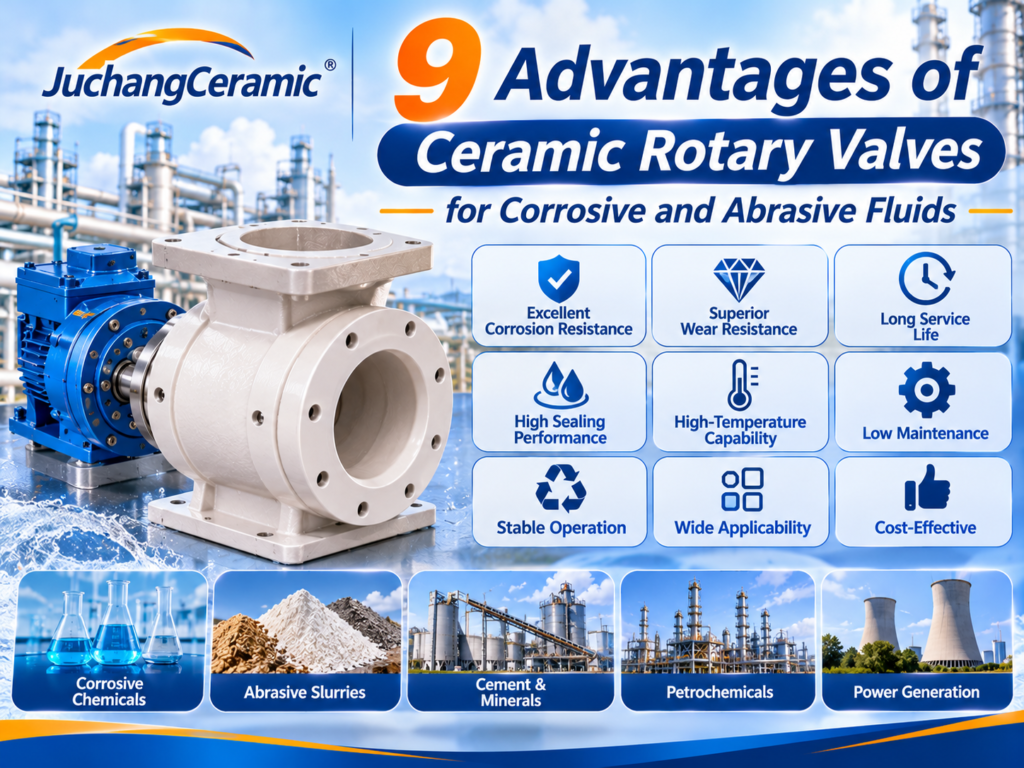
Quick Answer: What Are the Advantages of Ceramic Rotary Valves?
Ceramic rotary valves are particularly valuable when conventional valve materials cannot withstand the combination of chemical attack, abrasive particles, and repeated mechanical movement. Their principal advantages include high wear resistance, corrosion resistance, reduced material degradation, stable sealing surfaces, lower maintenance requirements, and potentially longer service life.
They are especially worth considering for chemical processing, slurry handling, mineral processing, precision fluid metering, and industrial applications involving aggressive or particle-laden fluids.
Our recommendation: evaluate high-purity alumina, zirconia, silicon carbide, and other suitable technical ceramics according to the actual fluid chemistry and operating conditions. Do not select a material based on hardness alone.
Quick Summary: Nine Advantages at a Glance
| Advantage | Engineering Benefit | Practical Value |
|---|---|---|
| 1. Excellent wear resistance | Hard surfaces resist abrasive particle damage. | Reduced component replacement. |
| 2. Corrosion resistance | Suitable ceramic grades resist many aggressive chemicals. | Improved material compatibility. |
| 3. Longer service life potential | Reduced surface degradation under suitable conditions. | Lower lifecycle maintenance costs. |
| 4. Stable sealing surfaces | Precision-finished ceramic faces maintain dimensional consistency. | More reliable flow control. |
| 5. Reduced contamination | Ceramic wetted surfaces can limit metallic contamination. | Better process purity. |
| 6. High hardness | Resistance to scratching and particle-induced surface damage. | Better performance in abrasive service. |
| 7. Thermal stability | Suitable grades retain useful properties at elevated temperatures. | More operating flexibility. |
| 8. Precision fluid control | Accurately manufactured rotary components support repeatable movement. | Consistent dosing and flow. |
| 9. Reduced maintenance costs | Potentially fewer wear-related service interventions. | Improved equipment availability. |
1. What Is a Ceramic Rotary Valve?
A ceramic rotary valve is a flow-control or material-handling device that uses a rotating component to regulate, distribute, meter, or isolate the movement of a fluid or material. Depending on its construction, the valve may incorporate ceramic rotors, discs, seats, sleeves, plugs, or other precision-engineered components.
The defining feature is the use of technical ceramics in critical areas exposed to fluid, particles, friction, or chemical attack.
Common engineering ceramic materials include:
- Alumina (Al₂O₃): A widely used engineering ceramic offering a strong balance of hardness, wear resistance, chemical stability, and manufacturing cost.
- Zirconia (ZrO₂): Known for higher fracture toughness than conventional alumina grades, making it useful where mechanical loading and resistance to cracking are important.
- Silicon carbide (SiC): Particularly attractive for demanding wear and corrosion applications, subject to the chemical environment and specific grade.
The material selection process should consider purity, grain structure, porosity, surface finish, and manufacturing quality. Two ceramic components made from nominally similar materials can deliver different results if their microstructures and processing quality differ.
For a deeper explanation of ceramic material characteristics, see our guide to what alumina ceramics are and how they perform in engineering applications.
How Does a Ceramic Rotary Valve Work?
In a typical rotary valve arrangement, a rotating element changes the alignment between internal passages and stationary ports. Depending on the design, this movement controls the direction, volume, or timing of fluid transfer.
In a precision ceramic valve, the ceramic components provide the critical working surfaces. A properly designed assembly maintains the required clearances or contact conditions between rotating and stationary parts.
For example, in a chemical dosing application, a rotary component can repeatedly align a flow passage with an inlet and outlet. Precision-machined ceramic surfaces help maintain consistent geometry as the component operates.
It is important to distinguish between rotary fluid valves and rotary airlock valves used in powder handling. Their operating principles, sealing arrangements, and performance requirements are different. Buyers should confirm the valve configuration before comparing products.
2. Nine Advantages of Ceramic Rotary Valves for Corrosive and Abrasive Fluids
Advantage 1: Excellent Wear Resistance in Abrasive Environments
Wear resistance is one of the strongest reasons to consider ceramic rotary valves.
Fluids containing silica particles, mineral fragments, metal oxides, ceramic powders, and other hard solids can gradually damage conventional valve surfaces. As the internal components wear, clearances change, sealing performance deteriorates, and flow characteristics may become inconsistent.
Technical ceramics such as alumina and silicon carbide have high hardness and can resist many forms of abrasive surface damage. This makes them attractive for applications involving repeated contact with solid particles.
From our experience, the biggest opportunity is often not eliminating wear completely but slowing the rate at which critical sealing and metering surfaces deteriorate.
Practical example: A mineral-processing facility handling fine abrasive slurry may experience frequent valve maintenance because particles continuously interact with internal surfaces. A properly selected ceramic valve can reduce this wear-related maintenance burden.
For applications involving abrasive fluids, we recommend assessing particle size, hardness, concentration, velocity, and flow direction before specifying the ceramic material.
Advantage 2: Strong Resistance to Chemical Corrosion
Corrosive fluids can attack metal valve bodies, rotors, and sealing components. Depending on the chemistry, this can lead to oxidation, pitting, surface degradation, or contamination of the process fluid.
Many technical ceramics offer excellent chemical stability in a broad range of industrial environments. High-purity alumina, zirconia, and silicon carbide can provide useful alternatives to conventional metallic materials when chemical compatibility has been established.
However, ceramic corrosion resistance is not universal. Hydrofluoric acid, hot concentrated alkalis, certain molten salts, and other aggressive environments may attack particular ceramic compositions.
Published research on ceramic corrosion demonstrates that material degradation depends on composition, temperature, exposure time, and the specific chemical medium. This is why a ceramic rotary valve should be specified using actual process chemistry rather than a general claim of acid resistance.
Practical recommendation: Request chemical compatibility information for the exact ceramic grade, including concentration and operating temperature. Also evaluate seals, adhesives, metallic supports, and other wetted components.
Advantage 3: Longer Service Life Potential
One of the most commercially important advantages of ceramic rotary valves is their potential to extend component service life.
Conventional valves may require frequent replacement when internal surfaces suffer a combination of corrosion and abrasion. Repeated replacement increases spare-parts expenditure and creates additional labor and production downtime.
By selecting suitable ceramic working surfaces, manufacturers can reduce several common degradation mechanisms simultaneously.
For commercial users, the real benefit is not simply buying a valve that lasts longer. It is reducing the frequency of maintenance interventions and improving the reliability of the production process.
Nevertheless, ceramic components are brittle compared with many metals. Their service life depends on proper support, alignment, installation, and protection from mechanical shock.
We recommend evaluating actual maintenance records from the existing valve before calculating the expected financial benefit of upgrading.
Advantage 4: Precision Sealing and Dimensional Stability
In metering and flow-control applications, dimensional consistency matters.
Wear at the sealing interface can create additional clearance, allowing unwanted leakage or changing the amount of fluid transferred during each operating cycle. Chemical attack can create similar problems by damaging the working surface.
Precision ceramic components can be manufactured with carefully controlled dimensions and fine surface finishes. Their resistance to many forms of chemical and mechanical degradation helps preserve these characteristics during suitable operating conditions.
This is particularly valuable in equipment where consistent rotary movement and repeatable internal geometry are important.
For example, a chemical dosing system may need to deliver a repeatable quantity of fluid over thousands of operating cycles. A precision-engineered ceramic rotor and mating surface can help maintain consistent performance.
However, a low leakage rate is not guaranteed simply because a valve uses ceramic. Surface flatness, roundness, concentricity, assembly tolerances, operating pressure, and sealing design all matter.
Advantage 5: Reduced Risk of Metallic Contamination
Some manufacturing processes require strict control over the materials that come into contact with the process fluid.
Metallic corrosion products, surface particles, or dissolved metal ions can create unwanted contamination in applications involving specialty chemicals, high-purity fluids, electronic materials, and certain laboratory processes.
Suitable ceramic wetted components can reduce the risk of contamination associated with metallic surfaces.
This advantage is particularly relevant when a valve operates in a process where material purity influences product quality or downstream equipment performance.
For example, a manufacturer processing high-purity chemical solutions may prefer a ceramic flow-control component to reduce potential metallic interaction.
For demanding purity requirements, we recommend checking the complete wetted material list, including seals and joining materials. Ceramic construction alone does not establish that a complete valve assembly meets a particular cleanliness or contamination specification.
Advantage 6: High Hardness Against Scratching and Surface Damage
Hardness contributes directly to the ability of a material to resist scratching, indentation, and certain abrasive wear mechanisms.
Many engineering ceramics are significantly harder than conventional engineering metals. Alumina and silicon carbide are commonly selected for wear-resistant components because of their surface hardness.
In abrasive fluid-handling equipment, this can help maintain the geometry of important working surfaces even when the fluid contains hard particles.
However, hardness and toughness are not the same property. A ceramic may resist scratching exceptionally well while remaining vulnerable to impact and tensile stress.
For heavy-duty applications, the correct choice is not necessarily the hardest ceramic. A material with a better balance of hardness, fracture toughness, and chemical compatibility may provide a more reliable result.
We recommend evaluating the complete component design rather than comparing material hardness figures in isolation.
Advantage 7: Thermal Stability for Demanding Operating Conditions
Industrial valves can operate under elevated temperatures and changing thermal conditions. These environments can accelerate corrosion, influence seal performance, and affect dimensional tolerances.
Many technical ceramics retain useful mechanical properties at temperatures where some polymeric materials or conventional sealing arrangements may become unsuitable.
For ceramic rotary valves, this can offer additional design flexibility in selected chemical-processing and industrial applications.
Nevertheless, maximum material temperature is not the same as the maximum operating temperature of a complete valve. Seals, bearings, actuator components, housing materials, and thermal expansion differences must also be considered.
Thermal shock is another important limitation. Rapid temperature changes can produce internal stresses that damage brittle ceramic components.
Our advice: Specify continuous operating temperature, peak temperature, startup conditions, cleaning temperature, and expected temperature fluctuations before choosing a ceramic rotary valve.
Advantage 8: Precision Fluid Metering and Repeatable Operation
In industrial fluid handling, the valve must do more than survive chemical exposure. It must also perform consistently.
Precision ceramic rotors and mating components can be manufactured with tight dimensional tolerances and carefully controlled surface finishes. These characteristics are useful in rotary systems where repeatable passage alignment and flow regulation are required.
This is particularly relevant to chemical dosing, specialty-fluid processing, laboratory equipment, and precision metering systems.
For example, a manufacturer distributing small volumes of an aggressive chemical may need a flow-control component that maintains consistent internal geometry throughout repeated operation.
In these applications, ceramic rotary valve technology can complement other precision ceramic products, including microliter ceramic metering pumps and ceramic plunger pumps.
One important distinction: a rotary valve does not automatically guarantee accurate dosing. Flow accuracy also depends on the actuator, control system, pressure differential, fluid viscosity, internal leakage, and overall system design.
Advantage 9: Lower Lifecycle Maintenance Costs
For industrial buyers, purchase price is only one part of the equipment investment.
A low-cost valve that requires frequent replacement may ultimately cost more than a higher-priced ceramic alternative. The difference becomes particularly significant when maintenance requires shutting down a production line or draining a chemical-processing system.
Ceramic rotary valves can improve lifecycle economics by reducing wear-related component replacement and certain corrosion-related maintenance problems.
Consider a facility that replaces conventional valve components several times each year. Each intervention involves spare parts, maintenance labor, production interruption, and possibly cleaning or disposal procedures.
If a ceramic upgrade significantly reduces those interventions, the initial investment may be recovered through operating savings.
However, ceramic valves are not always cheaper to maintain. Improper installation, impact damage, unsuitable ceramic grades, or incompatible seals can eliminate the expected savings.
We recommend calculating total cost of ownership over a realistic operating period rather than comparing purchase prices alone.
3. Limitations: What Buyers Should Know Before Choosing Ceramic Rotary Valves
Although the advantages of ceramic rotary valves are substantial, there are several limitations that should be considered before purchasing.
Advantages
- High hardness and wear resistance.
- Excellent chemical stability for suitable grades.
- Good dimensional stability.
- Potentially longer component life.
- Reduced metallic contamination risk.
- Suitable for precision applications.
- Potential lifecycle maintenance savings.
Disadvantages
- Brittle compared with most metals.
- Sensitive to impact and poor installation.
- Can be more expensive to manufacture.
- Material compatibility must be verified.
- Precision machining requirements can increase lead times.
- Thermal shock can cause cracking.
- Seals and supporting components may remain wear-limiting factors.
When Is a Ceramic Rotary Valve Not Necessary?
For beginners evaluating industrial valve options, it is important not to overengineer the application.
If the process involves clean water, mild operating temperatures, low mechanical loading, and no significant corrosion or abrasion, a conventional valve may provide adequate performance at a lower purchase cost.
Likewise, if the equipment is exposed to severe impact, uncontrolled pressure surges, or frequent mechanical shock, the complete valve design may require reconsideration before ceramic components are introduced.
Our position is straightforward: use ceramic when its material properties solve a measurable operational problem. Do not pay for advanced materials without a corresponding engineering or commercial benefit.
4. Ceramic vs. Metal vs. Polymer-Lined Valves: Which Is Better?
Choosing between ceramic, metal, and polymer-lined valve designs requires understanding the actual failure mechanism in the existing system.
A metal valve may offer better impact tolerance and easier repair. A polymer-lined valve can be suitable for certain corrosive fluids and applications requiring a more compliant lining. Ceramic valves are particularly attractive when hardness, wear resistance, and chemical stability are major requirements.
| Evaluation Factor | Ceramic Rotary Valve | Metal Valve | Polymer-Lined Valve |
|---|---|---|---|
| Abrasive wear resistance | High for suitable grades and conditions | Varies significantly by alloy and treatment | Depends on lining material and particle loading |
| Chemical resistance | Excellent for compatible ceramic grades | Depends on alloy and chemical environment | Depends on polymer chemistry and temperature |
| Impact resistance | Generally lower | Generally higher | Varies by construction |
| Temperature capability | Often high at material level | Depends on alloy and design | Limited by polymer and lining construction |
| Dimensional stability | Excellent under suitable conditions | Good, depending on temperature and loading | Potential creep or deformation |
| Metal contamination | Can be reduced at ceramic wetted surfaces | Potentially higher depending on corrosion | Can be reduced at intact lined surfaces |
| Initial cost | Often higher for precision components | Varies; often competitive | Varies by lining and construction |
| Best application | Abrasive and chemically aggressive service | General industrial and mechanically demanding service | Compatible corrosive fluids with suitable operating conditions |
When Should You Upgrade from Metal to Ceramic?
We recommend considering a ceramic rotary valve upgrade when the existing metal valve experiences one or more of the following problems:
- Repeated internal wear caused by hard suspended particles.
- Corrosion damage that shortens replacement intervals.
- Changes in flow accuracy caused by worn sealing surfaces.
- Unacceptable metallic contamination in the process fluid.
- High maintenance expenditure associated with internal component replacement.
If the existing valve fails mainly because of mechanical impact or vibration, changing to ceramic without correcting the installation or support arrangement is unlikely to solve the problem.
5. Best Industrial Applications for Ceramic Rotary Valves
The commercial value of ceramic rotary valves becomes most apparent when the equipment operates in an environment that challenges conventional materials.
1. Chemical Processing
Chemical manufacturing frequently involves acids, alkaline solutions, solvents, and specialty chemical mixtures. A compatible ceramic valve can help reduce corrosion-related degradation in selected applications.
Before selecting a grade, engineers should review concentration, temperature, exposure duration, and the compatibility of all wetted components.
2. Mining and Mineral Processing
Mining operations often involve abrasive slurries containing quartz, mineral particles, and other hard solids. These particles can accelerate wear at internal valve surfaces.
Ceramic components are worth evaluating where abrasive wear causes repeated maintenance or reduced operating efficiency.
3. Pharmaceutical and High-Purity Manufacturing
Some pharmaceutical and specialty manufacturing processes require controlled material contact and consistent fluid handling. Suitable ceramic wetted surfaces can reduce certain metallic contamination concerns.
However, the entire valve assembly must meet the process’s cleanliness, extractables, sterilization, and regulatory requirements. Ceramic material selection alone does not establish pharmaceutical suitability.
4. Electronic Chemicals and Precision Manufacturing
Electronic materials manufacturing often requires precise control of fluid delivery and material purity. Precision ceramic components can be valuable where chemical compatibility and repeatable operation are important.
For related applications, explore our precision ceramic pump solutions and custom precision ceramic components.
5. Industrial Powder and Specialty Material Processing
Some rotary equipment handles fine powders or mixtures containing abrasive solid particles. In these applications, component geometry, particle size, sealing arrangement, and mechanical loading are important selection factors.
For powder-handling applications, verify whether the required equipment is a rotary fluid valve or a rotary airlock valve. The two should not be treated as interchangeable products.
6. How to Choose the Right Ceramic Rotary Valve
Selecting a ceramic rotary valve should begin with a detailed review of operating conditions. In most professional situations, a manufacturer cannot make a reliable material recommendation from the fluid name alone.
Step 1: Identify the Exact Fluid Composition
Document all chemicals, concentrations, impurities, suspended particles, and cleaning agents that may contact the valve.
For mixtures, consider whether chemical interactions change the corrosiveness of the fluid. Also identify any intermittent exposure to cleaning or sterilization chemicals.
Step 2: Evaluate Abrasive Particle Characteristics
For slurry applications, record:
- Particle size distribution.
- Particle hardness and shape.
- Solid concentration.
- Fluid velocity.
- Expected particle impact and contact conditions.
ASTM G75 provides a standardized approach to evaluating slurry abrasivity and comparing material abrasion response. It is a useful reference when a manufacturer needs to assess candidate materials under representative slurry conditions.
We recommend discussing whether material testing can be performed using a representative process slurry rather than relying exclusively on general material property sheets.
Step 3: Select the Appropriate Ceramic Material
| Material | Main Strength | Potential Limitation | Selection Guidance |
|---|---|---|---|
| High-purity alumina | Hardness, wear resistance, chemical stability | Relatively low fracture toughness | Strong general candidate for many industrial wear applications |
| Zirconia | Higher fracture toughness and strength in suitable grades | Hydrothermal aging and chemical stability require evaluation | Consider where mechanical toughness is especially important |
| Silicon carbide | Excellent hardness and strong corrosion and wear performance in many environments | Grade-specific processing and compatibility considerations | Evaluate for demanding abrasive and corrosive applications |
These are general engineering comparisons, not universal chemical compatibility ratings. Actual performance depends on grade composition, manufacturing method, surface finish, and operating environment.
Our guide to industrial ceramic products and their applications provides additional information about technical ceramic solutions.
Step 4: Confirm Mechanical and Operating Requirements
Material properties alone cannot determine whether a valve will perform correctly. The engineering specification should include:
- Operating and maximum pressure.
- Continuous and peak operating temperature.
- Rotational speed and duty cycle.
- Required flow rate and control accuracy.
- Pressure differential and potential pressure surges.
- Required sealing performance and leakage limits.
- Installation alignment and vibration conditions.
Ask the manufacturer to explain how the ceramic parts are supported and protected from impact, uneven loading, and thermal stress.
Step 5: Evaluate Manufacturing Precision
Precision manufacturing is particularly important for rotary components with close-fitting mating surfaces.
Ask suppliers about:
- Ceramic composition and purity.
- Density and open porosity.
- Dimensional tolerances.
- Surface roughness and flatness.
- Roundness and concentricity where relevant.
- Inspection procedures and quality documentation.
- Batch consistency and traceability.
For applications requiring specialized geometries, a manufacturer capable of producing high-precision alumina and zirconia ceramic components may offer greater design flexibility than a supplier limited to standard parts.
Step 6: Compare Total Cost of Ownership
Consider the complete financial impact of the valve over its expected operating life.
A practical comparison should include:
- Initial purchase price.
- Installation and commissioning costs.
- Replacement parts and maintenance labor.
- Production downtime.
- Cleaning and disposal expenses.
- Expected operating life under actual process conditions.
For commercial users, even a moderate reduction in unplanned maintenance can justify a more expensive valve if downtime has a significant financial impact.
7. Five Common Mistakes When Purchasing Ceramic Rotary Valves
Mistake 1: Choosing the Hardest Ceramic Without Checking Chemical Compatibility
High hardness does not guarantee chemical resistance. A material that performs well in abrasive water-based slurry may be unsuitable for a different corrosive chemical.
Better approach: Evaluate hardness, fracture toughness, corrosion behavior, and actual fluid compatibility together.
Mistake 2: Ignoring Ceramic Brittleness
Ceramic components can fail under impact, tensile stress, poor support, or uneven installation loading.
Better approach: Review housing design, installation procedures, alignment, and mechanical support.
Mistake 3: Comparing Only Initial Purchase Prices
A lower-cost valve may create significantly higher maintenance expenses if it requires frequent replacement.
Better approach: Calculate lifecycle costs and include the financial impact of downtime.
Mistake 4: Ignoring Seals and Other Wetted Materials
A ceramic rotor cannot compensate for an incompatible polymer seal or a corroding metallic support component.
Better approach: Request a complete bill of materials for all wetted components and verify compatibility under actual operating conditions.
Mistake 5: Purchasing Without Confirming Manufacturing Tolerances
Precision rotary equipment requires accurate dimensions and consistent surface quality. Poorly manufactured components can cause leakage, friction, vibration, and premature failure.
Better approach: Request dimensional inspection reports, surface finish specifications, material certificates, and relevant quality records.
8. Expert Recommendation: Are Ceramic Rotary Valves Worth the Investment?
Our recommendation is to consider ceramic rotary valves when the existing equipment has a documented problem involving abrasive wear, chemical corrosion, surface degradation, or process contamination.
For a clean, low-demand application, conventional valve technology may remain the more economical choice. But for industrial users handling abrasive slurries, aggressive chemicals, or demanding precision fluids, ceramic components can offer a meaningful improvement in reliability and lifecycle performance.
Our Recommendations by Application
| Application Requirement | Material Worth Evaluating | Our Recommendation |
|---|---|---|
| General abrasive fluid handling | High-purity alumina | Start with alumina and verify slurry-specific wear performance. |
| High mechanical loading | Zirconia or suitable composite ceramics | Prioritize fracture toughness and structural design. |
| Severe abrasive and corrosive service | Silicon carbide or suitable advanced ceramics | Verify chemical compatibility and test under representative conditions. |
| Precision metering | Precision-ground alumina or zirconia | Prioritize dimensional tolerances and sealing geometry. |
| High-purity fluid handling | Suitable high-purity ceramic grades | Evaluate all wetted materials and contamination requirements. |
Why Manufacturing Quality Matters
Even the best ceramic material cannot compensate for poor manufacturing quality. The final performance of a ceramic rotary valve depends on material formulation, powder preparation, forming, sintering, precision machining, grinding, polishing, and inspection.
At JuchangCeramic, we focus on precision ceramic manufacturing for industrial equipment and demanding fluid-handling applications. Our approach emphasizes matching material selection and component geometry to the customer’s actual engineering requirements.
For OEM manufacturers, this is particularly important when standard ceramic parts cannot meet the required dimensions, sealing geometry, or operating conditions.
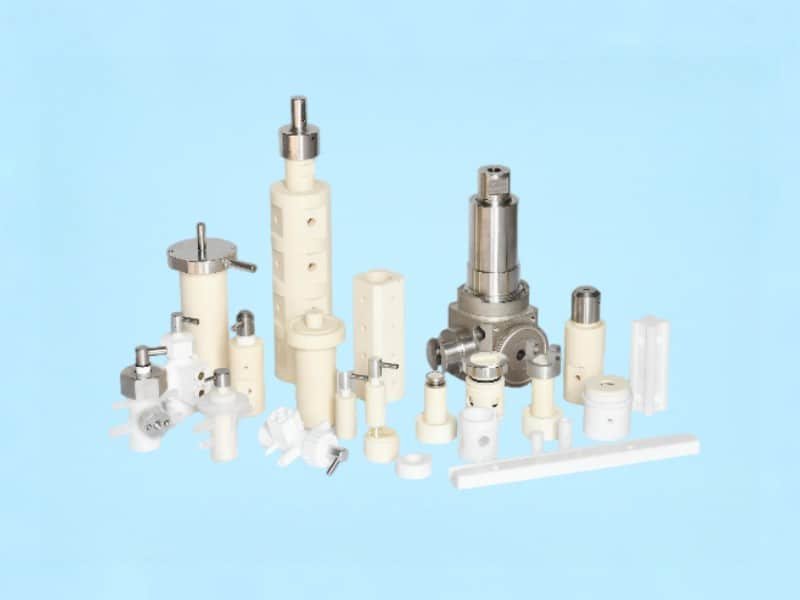
Custom Ceramic Manufacturing Services
JuchangCeramic delivers professional OEM and custom manufacturing solutions for precision ceramic parts, pumps, and components. Whether you have complete engineering drawings or just an initial concept, we help transform your requirements into precision-manufactured products.
Our services support customized dimensions, ceramic material selection, component development, and manufacturing requirements for industrial applications.
When Should You Request a Custom Ceramic Solution?
Custom manufacturing is worth considering when:
- Standard ceramic rotary components do not fit your equipment.
- You need specific tolerances or surface finish requirements.
- Your process involves an unusual combination of corrosion and abrasion.
- You are developing an OEM valve or precision fluid-control assembly.
- You need consistent production of specialized ceramic components.
Providing a technical drawing, sample component, fluid specification, and operating parameters will help a manufacturer evaluate feasibility and provide a more accurate quotation.
9. Frequently Asked Questions About Ceramic Rotary Valves
1. What are the main advantages of ceramic rotary valves?
The main advantages of ceramic rotary valves include excellent wear resistance, chemical corrosion resistance for suitable material grades, high hardness, dimensional stability, reduced metallic contamination, precision sealing potential, and lower lifecycle maintenance costs. They are particularly useful in demanding industrial applications involving abrasive or corrosive fluids.
2. Are ceramic rotary valves suitable for corrosive chemicals?
Yes, suitable ceramic rotary valves can handle many corrosive chemicals. High-purity alumina, zirconia, and silicon carbide offer different chemical resistance characteristics. However, compatibility depends on chemical concentration, temperature, exposure time, and ceramic composition. The seals and other wetted components must also be compatible.
3. Which ceramic material is best for abrasive fluids?
High-purity alumina is a strong general candidate because of its hardness and wear resistance. Silicon carbide is also worth evaluating for demanding abrasive and corrosive environments. Zirconia may be preferable where higher fracture toughness is required. The best choice depends on slurry composition, particle characteristics, operating conditions, and mechanical loading.
4. Are ceramic rotary valves better than metal valves?
Ceramic rotary valves can outperform metal valves in suitable abrasive and corrosive applications because of their hardness and chemical stability. However, metal valves generally offer greater impact tolerance and may be more economical for general-purpose applications. The best choice depends on the process environment and lifecycle cost.
5. Do ceramic rotary valves require regular maintenance?
Yes. Although ceramic components can reduce wear-related maintenance, the complete valve still requires inspection. Maintenance should include checking sealing surfaces, alignment, actuator operation, external connections, and signs of impact damage or leakage. Inspection intervals should be determined by the operating conditions.
6. Can ceramic rotary valves handle high temperatures?
Many technical ceramics have excellent high-temperature stability. However, the maximum operating temperature of a complete valve also depends on its seals, housing, bearings, actuator, and thermal expansion characteristics. Thermal shock must also be considered when temperatures change rapidly.
7. Why are ceramic rotary valves sometimes more expensive?
Technical ceramics require specialized manufacturing processes, including powder preparation, forming, high-temperature sintering, precision grinding, and inspection. Complex geometries and tight tolerances can increase manufacturing costs. However, longer component life and reduced downtime may offset the higher initial investment in suitable applications.
8. How do I choose a reliable ceramic rotary valve manufacturer?
Look for a manufacturer with relevant technical ceramic experience, material selection capabilities, precision machining equipment, dimensional inspection procedures, and OEM customization support. Request material specifications, tolerances, surface finish information, quality records, and evidence of application-specific testing before placing an order.
9. Can ceramic rotary valve components be custom manufactured?
Yes. Precision ceramic manufacturers can produce customized rotary components, seats, discs, sleeves, and other parts according to engineering drawings or samples. Custom manufacturing is useful when standard components cannot satisfy specific dimensions, material requirements, or sealing conditions.
10. Are ceramic rotary valves worth upgrading to for industrial applications?
They are worth evaluating when conventional valves experience frequent abrasive wear, corrosion, contamination, or costly maintenance. The upgrade is most attractive when the expected reduction in component replacement and production downtime exceeds the additional purchase and installation costs.
10. Technical References and Further Reading
The following technical references provide useful background on ceramic material behavior, corrosion, and abrasive wear evaluation. They support material selection and engineering assessment; they should not be interpreted as universal certification of a particular ceramic rotary valve.
- ASTM International — ASTM G75-24. Standard Test Method for Determination of Slurry Abrasivity and Slurry Abrasion Response of Materials. A relevant standardized method for evaluating slurry abrasivity and comparing material responses to abrasive conditions.
- Journal of the European Ceramic Society — Herrmann et al. (2005). Hydrothermal Corrosion of Zirconia-Toughened Alumina (ZTA) at 200°C. Research examining how ceramic composition and microstructure influence corrosion behavior under hydrothermal conditions.
- Corrosion Science — (1997). The Effect of Corrosion and Erosion on Ceramic Materials. Research investigating how chemical and erosive environments affect ceramic material degradation.