
Ceramic pump manufacturing accuracy is determined long before the finished component reaches the inspection bench. Material selection, powder preparation, forming pressure, sintering conditions, machining capability, dimensional measurement, and assembly tolerances all influence whether a ceramic plunger or pump component delivers consistent performance. A supplier may quote an extremely tight tolerance, but that number means little if the manufacturing process cannot reproduce it across an entire production batch.
For industrial buyers, pump manufacturers, and engineering teams, the priority should be repeatable dimensional accuracy rather than an impressive specification on a quotation. In precision metering, medical fluid handling, chemical dosing, and high-pressure applications, small variations can affect leakage, flow consistency, wear, and operating stability.
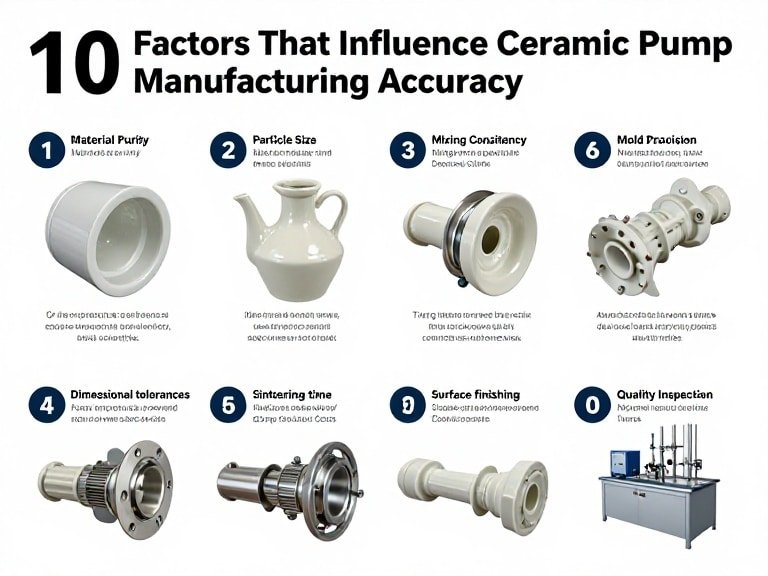
Quick Answer: What Influences Ceramic Pump Manufacturing Accuracy?
The 10 most important factors are ceramic raw material quality, powder preparation, forming method, sintering control, machining precision, grinding and polishing, dimensional measurement, component design, assembly tolerances, and process quality management.
Our recommendation: Do not evaluate a ceramic pump manufacturer based only on its claimed machining tolerance. Evaluate its complete production process, measurement equipment, material traceability, and ability to maintain consistent dimensions across repeated orders.
What Is Ceramic Pump Manufacturing Accuracy?
Ceramic pump manufacturing accuracy refers to how closely a manufactured ceramic component matches its specified dimensions, geometry, surface characteristics, and functional requirements. It also includes the ability to reproduce those specifications consistently across multiple production batches.
For a ceramic plunger pump, accuracy may involve plunger diameter, roundness, cylindricity, straightness, surface roughness, and the dimensional relationship between the plunger and its mating sleeve. For a ceramic rotary valve, the critical characteristics may instead include rotor geometry, port alignment, flatness, and sealing surface quality.
These characteristics are related, but they are not interchangeable. A component can meet its nominal diameter requirement while still having excessive roundness error or poor surface finish. It may pass a basic dimensional check but fail to provide the expected sealing or operating performance.
How Does Manufacturing Accuracy Affect Pump Performance?
Precision ceramic components are commonly used where chemical resistance, wear resistance, dimensional stability, and controlled fluid handling are important. The relationship between component accuracy and pump performance depends on the pump architecture and operating conditions.
For example, an oversized clearance between a ceramic plunger and its mating component may increase internal leakage in a design that relies on a close sliding fit. An excessively tight fit may increase friction, restrict movement, or create assembly problems. The correct clearance is therefore an engineering requirement, not simply a matter of making every dimension as small as possible.
From our experience in custom ceramic component development, the most effective approach is to identify critical-to-function dimensions first and then design the manufacturing and inspection process around them.
Quick Summary Table: 10 Factors That Influence Ceramic Pump Manufacturing Accuracy
| Factor | What It Influences | Manufacturing Priority |
|---|---|---|
| 1. Raw material quality | Density, strength, purity, consistency, and sintering behavior | Very High |
| 2. Powder preparation | Particle distribution, flowability, and green-body uniformity | Very High |
| 3. Forming method | Initial geometry, density distribution, and dimensional consistency | High |
| 4. Sintering control | Shrinkage, density, warpage, and microstructure | Very High |
| 5. Precision machining | Final dimensions and geometric tolerances | Very High |
| 6. Grinding and polishing | Surface roughness, flatness, and functional contact | High |
| 7. Measurement and inspection | Verification of actual dimensional performance | Very High |
| 8. Component design | Manufacturability, stress distribution, and tolerance requirements | High |
| 9. Assembly tolerances | Fit, alignment, sealing, and operating stability | Very High |
| 10. Quality management | Batch consistency, traceability, and process repeatability | Very High |
10 Factors That Influence Ceramic Pump Manufacturing Accuracy
1. Ceramic Raw Material Quality and Composition
Raw material quality is the foundation of ceramic pump manufacturing accuracy. Even advanced machining equipment cannot fully compensate for inconsistent ceramic material properties.
Alumina and zirconia are two commonly used engineering ceramics in precision pump applications. They have different mechanical, thermal, and chemical characteristics, so selecting the correct material is essential.
Alumina is widely used because of its hardness, wear resistance, electrical insulation, and chemical stability in many environments. Zirconia offers high fracture toughness relative to many other advanced ceramics and is useful for demanding mechanical applications.
Material quality can be influenced by:
- Purity and chemical composition.
- Particle size and distribution.
- Powder contamination.
- Binder and additive consistency.
- Supplier batch-to-batch variation.
- Moisture content and storage conditions.
For commercial production, we recommend specifying the actual ceramic grade and material properties instead of purchasing components based only on descriptions such as high-purity alumina or premium zirconia.
Buyers can learn more about what alumina ceramics are before selecting a material for their pump design.
2. Ceramic Powder Preparation and Particle Distribution
Before ceramic powder becomes a solid component, it must be prepared for forming. Powder characteristics influence how consistently the material fills a mold, distributes under pressure, and develops a uniform green body.
Particle size distribution, granulation, binder content, moisture, and powder flowability all matter. Poorly controlled powder preparation can produce density differences within the formed component.
These variations may become more visible during sintering, when regions with different initial densities can shrink differently. The result may include dimensional distortion, internal defects, or inconsistent mechanical properties.
In most professional situations, manufacturers should control incoming powder specifications and maintain documented preparation procedures. For high-precision pump components, material preparation deserves the same attention as final machining.
3. Ceramic Forming Method and Green Body Density
The forming process determines the initial geometry of the ceramic component. It also influences density distribution, internal structure, and the amount of machining required after sintering.
Different forming methods are suitable for different product geometries and production volumes.
- Uniaxial pressing: Suitable for relatively simple geometries and repeatable production when the powder and tooling are properly controlled.
- Cold isostatic pressing: Applies pressure from multiple directions and can help produce more uniform density in suitable shapes.
- Injection molding: Useful for complex geometries and repeatable production, but requires careful control of feedstock and debinding.
- Extrusion: Suitable for continuous or elongated geometries such as certain ceramic rods and tubes.
The important point is that no forming method is automatically the most accurate. The correct method depends on component geometry, production quantity, material behavior, and the required post-sintering machining allowance.
For example, a long ceramic plunger may require a different forming strategy from a small rotary valve component with complex internal geometry. Forcing both designs into the same manufacturing route can increase cost without improving quality.
For more information about geometry and application selection, see our guide to ceramic rod applications in manufacturing.
4. Sintering Temperature, Time, and Shrinkage Control
Sintering is one of the most influential stages in ceramic pump manufacturing accuracy. During this process, the formed ceramic body is heated under controlled conditions to develop the required density and mechanical properties.
As the material densifies, it shrinks. The amount of shrinkage depends on the ceramic composition, powder characteristics, green density, component geometry, and sintering schedule.
If temperature distribution is inconsistent or the process is poorly controlled, the finished component may develop:
- Dimensional deviations.
- Uneven shrinkage.
- Warpage or bending.
- Density variation.
- Residual stresses or defects.
Manufacturers must establish appropriate firing parameters for each material and geometry. Furnace loading, support arrangements, heating rates, holding time, cooling rates, and atmosphere may all influence the final result.
We recommend evaluating sintering consistency through production records and inspection data rather than accepting a general statement that the manufacturer uses high-temperature furnaces.
5. Precision Machining and Grinding Capability
Once ceramic components have been sintered, precision machining is often necessary to achieve final dimensions. This is particularly important for ceramic plungers, sleeves, metering components, and sealing parts.
Advanced ceramics are hard and brittle compared with conventional metals. Conventional turning and milling methods may not be suitable for achieving the required final geometry. Diamond grinding and other specialized abrasive machining processes are commonly used.
Machining accuracy depends on:
- Machine rigidity and positioning capability.
- Diamond wheel specification and condition.
- Grinding speed and feed rate.
- Workpiece support and clamping.
- Coolant and thermal management.
- Operator experience and process parameters.
For a precision ceramic plunger, controlling diameter alone is not sufficient. Straightness, cylindricity, concentricity, and surface condition may be equally important depending on the design.
For buyers, this is one of the most important supplier evaluation criteria. Ask which machining operations are performed in-house, which are outsourced, and how final dimensions are verified.
6. Surface Grinding, Lapping, and Polishing Quality
Surface finish directly influences the functional behavior of ceramic pump components. A component may have acceptable external dimensions but still perform poorly if its contact surfaces are rough, uneven, or inconsistent.
Grinding, lapping, and polishing are used to improve different surface characteristics. The appropriate process depends on the component’s geometry and application.
For example, mating surfaces in certain ceramic pump assemblies require carefully controlled flatness and surface finish to achieve reliable sealing. A ceramic plunger operating against a sleeve may require a controlled surface texture and dimensional relationship to manage friction and leakage.
However, smoother is not always automatically better. Surface roughness requirements must be defined according to lubrication, fluid properties, operating speed, sealing mechanism, and material pairing.
We recommend specifying surface roughness using recognized parameters such as Ra, with the measurement method and evaluation conditions clearly agreed upon. Where functional performance depends on additional surface characteristics, these should also be documented.
7. Dimensional Measurement and Inspection Equipment
Manufacturing accuracy cannot be established without reliable measurement. A supplier may have sophisticated machining equipment, but without appropriate inspection tools it cannot consistently verify whether finished components meet the drawing.
Common inspection equipment includes:
- Coordinate measuring machines (CMMs).
- Precision micrometers and bore gauges.
- Roundness and cylindricity measuring instruments.
- Surface roughness testers.
- Optical measurement systems.
- Flatness and geometric measurement equipment.
Measurement capability should match the tolerance being inspected. A measuring instrument with inadequate resolution, poor calibration status, or unsuitable fixturing can produce misleading results.
Professional manufacturers should also consider measurement uncertainty. If the required tolerance is extremely tight relative to the measurement system’s capability, the inspection result may not provide sufficient confidence.
For commercial buyers, request dimensional inspection reports for critical features. For new projects, it is sensible to agree on the inspection method and acceptance criteria before mass production.
8. Component Geometry and Engineering Design
Not every dimensional accuracy problem originates on the factory floor. Some begin with an unrealistic or unnecessarily complicated design.
Ceramics are hard and wear-resistant, but their brittleness means sharp corners, sudden changes in cross-section, thin walls, and poorly supported features can increase manufacturing and service risks.
For precision pump components, design considerations include:
- Wall thickness and geometric symmetry.
- Fillet radii and stress concentration.
- Length-to-diameter ratio.
- Machining accessibility.
- Datum selection and tolerance allocation.
- Thermal expansion and material compatibility.
For example, a long and slender ceramic plunger may be more challenging to grind and measure than a short component of similar diameter. A design that does not provide suitable reference surfaces can also complicate inspection.
From our experience, early design-for-manufacturing discussions can reduce unnecessary machining operations and improve production repeatability. This is particularly valuable for custom ceramic components with complex drawings.
Explore our custom precision ceramic parts manufacturing services when your design requires engineering review before production.
9. Assembly Tolerances and Component Matching
A ceramic component can pass individual dimensional inspection and still fail to deliver the expected pump performance after assembly.
This happens because pump accuracy depends on the interaction between multiple components. Plunger diameter, sleeve bore, alignment, seals, housing dimensions, and mounting conditions must work together.
In a close-fitting ceramic plunger assembly, excessive clearance may increase leakage. Insufficient clearance may create excessive friction or binding, particularly when operating temperatures change or the assembly is exposed to particles.
For this reason, engineers should establish a tolerance stack-up rather than evaluating each component independently.
We recommend that manufacturers and customers agree on:
- Functional clearance requirements.
- Component datum references.
- Assembly alignment requirements.
- Seal and gasket specifications.
- Operating temperature and fluid conditions.
- Functional testing and acceptance criteria.
For applications where precise displacement is essential, a complete assembly test may provide more useful evidence than individual component dimensional reports alone.
10. Quality Management and Production Process Consistency
The final factor is the manufacturer’s ability to reproduce quality over time. A perfect prototype is not proof of a stable production process.
In commercial manufacturing, the challenge is maintaining dimensional accuracy across different operators, shifts, machines, material batches, and production orders.
A mature quality management system should include:
- Incoming material inspection.
- Documented process parameters.
- In-process dimensional checks.
- Equipment calibration and maintenance.
- Final inspection and traceability.
- Nonconformance and corrective action procedures.
- Batch-level quality records.
ISO 9001 provides a widely recognized framework for quality management systems. However, ISO 9001 certification alone does not guarantee that a manufacturer can achieve a particular ceramic pump tolerance. Actual process capability and inspection evidence must support the claim.
For long-term OEM partnerships, we recommend evaluating defect trends, repeat-order consistency, corrective action effectiveness, and the supplier’s ability to communicate technical problems before they become delivery issues.
Comparison of Ceramic Manufacturing Processes and Their Accuracy Considerations
Different ceramic production methods serve different purposes. Buyers should select a manufacturing process according to component geometry, required tolerance, production volume, and total project cost.
| Manufacturing Process | Main Advantages | Accuracy Considerations | Best-Suited Applications |
|---|---|---|---|
| Uniaxial Pressing | Efficient production and relatively straightforward tooling | Density gradients and geometry-related variation require control | Simple ceramic blanks and repeated shapes |
| Cold Isostatic Pressing | Pressure applied more uniformly around the powder | Final dimensions still depend on sintering and machining | Rods, tubes, and larger blanks |
| Ceramic Injection Molding | Supports complex shapes and repeatable production | Feedstock, debinding, and shrinkage require close control | Complex components and larger production runs |
| Ceramic Extrusion | Efficient for continuous and elongated profiles | Die design, drying, firing, and straightness affect results | Ceramic rods and tubes |
| Diamond Grinding | Suitable for hard, sintered ceramic materials | Machine rigidity, wheel condition, and fixturing are critical | Precision plungers and sleeves |
| Lapping and Polishing | Improves surface quality and selected geometric features | Process consistency and measurement are essential | Sealing and mating surfaces |
Which Manufacturing Process Should You Choose?
For simple, high-volume ceramic components, pressing may offer the best balance of production efficiency and cost. For long rods or tubes, extrusion or isostatic pressing may be more appropriate depending on the geometry and material.
For complex shapes, injection molding can be attractive, but tooling and process development should be evaluated carefully. For tight final dimensional requirements, precision grinding and finishing are often necessary regardless of the initial forming method.
Our recommendation is to avoid comparing manufacturing quotations based only on the forming process. Compare the complete route from powder preparation through final inspection.
Precision Ceramic Pump Manufacturing: Pros and Cons
Precision ceramic manufacturing provides clear performance advantages, but it also requires more specialized production control than many conventional metal components.
| Advantages | Limitations |
|---|---|
| High hardness and excellent wear resistance in suitable material grades | Hardness makes final machining more specialized and potentially expensive |
| Good corrosion resistance for many chemical environments | Chemical compatibility must still be verified for the specific fluid and conditions |
| Excellent dimensional stability in appropriate operating environments | Thermal expansion and thermal gradients still require engineering consideration |
| Suitable for precise metering and controlled fluid handling | Performance depends on the complete pump assembly and clearance design |
| Long service potential in properly designed applications | Ceramics can be brittle and may fail under impact or excessive tensile stress |
| Suitable for demanding industrial and specialized fluid systems | Material selection and manufacturing validation can increase initial project costs |
Applications Where Ceramic Pump Manufacturing Accuracy Matters Most
1. Ceramic Plunger Pumps
Ceramic plungers are used in applications where wear resistance, chemical compatibility, and controlled dimensional relationships are important. Plunger diameter, straightness, cylindricity, and surface finish can influence leakage, friction, and service performance.
For customers sourcing these components, ceramic plunger pumps are a relevant product category to evaluate.
2. Medical Ceramic Pumps
Medical fluid handling applications may require controlled dosing, repeatable displacement, and compatible wetted materials. Manufacturing accuracy is important, but the complete system must also meet applicable regulatory, validation, cleanliness, and safety requirements.
For these applications, see our medical ceramic pump solutions.
3. Dialysis Ceramic Pumps
Dialysis-related equipment involves sensitive fluid management. Component geometry, surface quality, material compatibility, and assembly consistency must be evaluated within the overall medical device design and validation process.
Explore our dialysis ceramic pump category for application-specific product information.
4. Ceramic Rotary Valves
Rotary valves rely on controlled geometry and contact relationships between moving and stationary parts. Flatness, alignment, surface condition, and dimensional consistency are important to the sealing and operating behavior of the assembly.
For these systems, our ceramic rotary valve products provide a relevant reference point.
5. Microliter Ceramic Metering Pumps
When very small fluid volumes must be delivered repeatedly, manufacturing variation can become especially important. Plunger dimensions, internal geometry, sealing conditions, and operating parameters all influence dosing repeatability.
Customers developing small-volume fluid systems can review our microliter ceramic metering pumps.
How to Evaluate Ceramic Pump Manufacturing Tolerances
One of the most common problems in custom ceramic manufacturing is requesting a tolerance without defining how the component will function. A drawing may specify a very tight diameter tolerance, but the actual performance requirement may depend more heavily on roundness, cylindricity, surface finish, and the mating component.
Understand the Main Dimensional Characteristics
| Characteristic | Meaning | Why It Matters in Ceramic Pumps |
|---|---|---|
| Diameter | Size across a cylindrical feature | Controls fit and clearance |
| Roundness | Deviation of a cross-section from a perfect circle | Influences consistent contact and sealing |
| Cylindricity | Combined control of the cylindrical surface form | Important for long sliding components |
| Straightness | Deviation of a line element or axis from a straight reference | Helps prevent uneven contact and alignment issues |
| Flatness | Deviation of a surface from a perfect plane | Important for selected sealing interfaces |
| Surface Roughness | Quantified characteristics of surface texture | Influences friction, wear, and sealing behavior |
| Concentricity or Runout | Relationship between geometric features or rotating surfaces | Important for alignment and rotary assemblies |
Do Not Specify the Tightest Possible Tolerance
A tighter tolerance usually increases manufacturing difficulty, inspection requirements, and rejection risk. It may also increase production lead time and cost.
For example, if a pump operates reliably with a properly validated clearance range, demanding a substantially tighter clearance without a functional reason may add cost without improving performance.
We recommend a tolerance allocation process:
- Identify the functional requirement of the pump.
- Determine which dimensions directly influence that requirement.
- Define the required geometric tolerances and surface characteristics.
- Review the manufacturer’s actual machining and measurement capability.
- Validate prototype performance under representative operating conditions.
- Freeze the approved drawing and inspection acceptance criteria before mass production.
Where applicable, engineering teams can use ISO GPS principles and relevant geometric tolerancing standards to define dimensions, datums, and acceptance requirements. ISO 1101 is an important reference for geometrical product specifications and geometrical tolerancing.
Common Mistakes That Reduce Ceramic Pump Manufacturing Accuracy
Using Material Specifications That Are Too General
Ordering a component simply as alumina ceramic or zirconia ceramic leaves too much room for variation. Specify the material grade, relevant properties, and acceptable documentation requirements.
Ignoring Sintering Shrinkage During Product Development
Final dimensions cannot be reliably achieved by treating sintering as a simple heating operation. Shrinkage behavior must be considered during tooling and process development.
Checking Diameter but Ignoring Geometry
A diameter measurement does not confirm roundness, cylindricity, or straightness. Buyers should identify all critical features on the engineering drawing.
Requesting Extremely Tight Tolerances Without a Functional Reason
Unnecessary precision increases costs. Define what the component must achieve in service before requesting additional dimensional control.
Approving a Prototype Without Evaluating Batch Consistency
A single good sample does not prove production capability. For commercial projects, request sample quantities, inspection data, and a clear plan for controlling repeat orders.
Choosing the Lowest-Cost Manufacturer Without Technical Evaluation
Low unit pricing can become expensive if it leads to dimensional instability, assembly problems, product returns, or repeated rework. Compare total project costs rather than quotation prices alone.
How to Choose a Ceramic Pump Manufacturer for High-Precision Projects
Choosing a manufacturer is a technical and commercial decision. The supplier must understand not only how to produce a ceramic part but also how that part interacts with the complete pump system.
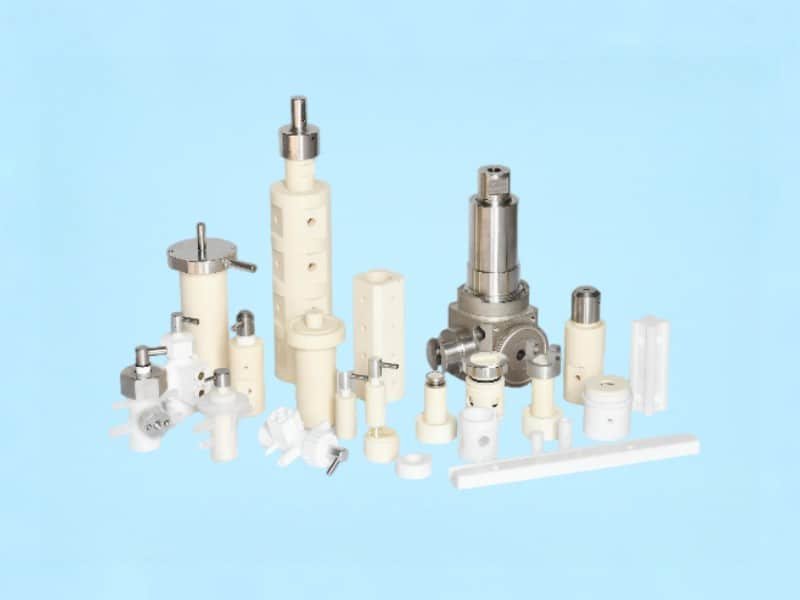
JuchangCeramic delivers professional OEM and custom manufacturing solutions for precision ceramic parts, pumps, and components. Whether customers have complete engineering drawings or only an initial product concept, the objective is to translate technical requirements into manufacturable products with accurate quotations and reliable production.
1. Check Material and Application Knowledge
A suitable supplier should understand the differences between alumina, zirconia, and other engineering ceramics. It should be able to discuss wear resistance, chemical compatibility, mechanical loading, thermal behavior, and manufacturing limitations.
2. Evaluate the Complete Manufacturing Process
Ask about powder preparation, forming, sintering, grinding, lapping, polishing, and final inspection. A manufacturer that can explain the complete process is better positioned to identify the source of dimensional variation.
3. Request Relevant Inspection Reports
Ask for dimensional reports that cover the critical characteristics of your component. If surface roughness, roundness, flatness, or cylindricity affects performance, make sure those characteristics are included rather than relying on a basic dimensional checklist.
4. Compare OEM, ODM, and Standard Product Solutions
Different purchasing models suit different project stages.
| Supply Model | How It Works | Best For | Commercial Consideration |
|---|---|---|---|
| Standard Products | Purchase from an existing product range | Replacement parts and established applications | Usually faster evaluation and less development work |
| OEM Manufacturing | Produce components according to customer drawings and specifications | Established equipment designs | Requires accurate drawings and clear acceptance criteria |
| ODM Development | Develop or optimize a design with manufacturing input | New products and engineering development | Requires technical collaboration and prototype validation |
5. Assess Cost, Lead Time, and Repeat-Order Capability
The total cost of precision ceramic manufacturing includes more than material and machining. Tooling, development, inspection, yield, packaging, and delivery also influence the final project cost.
For commercial users, we recommend evaluating the following:
- Prototype and tooling charges.
- Minimum order quantity and production batch size.
- Expected production lead time.
- Inspection and testing costs.
- Scrap and rework management.
- Repeat-order consistency.
- Technical communication and engineering support.
When comparing the cost of ceramic plungers, remember that two components with the same nominal dimensions may have very different prices because of material grade, geometric tolerances, surface finish, and inspection requirements.
6. Review Custom Design and Engineering Support
A capable supplier should be able to review drawings, identify difficult features, recommend manufacturing adjustments, and discuss whether a specified tolerance is commercially reasonable.
This is particularly important for new pump designs. A small design adjustment made before tooling can sometimes reduce machining complexity and improve production stability.
For projects involving specialized ceramic pump components, explore JuchangCeramic custom precision ceramic manufacturing services.
Expert Recommendation: How to Improve Ceramic Pump Manufacturing Accuracy
Improving ceramic pump manufacturing accuracy requires process control from raw material preparation through final assembly. There is no single machine, material, or inspection instrument that can compensate for weaknesses throughout the rest of the production process.
Our recommendations depend on the buyer’s project stage.
For Beginners Developing a New Ceramic Pump
- Start with a clear application and operating-condition specification.
- Select alumina or zirconia according to actual engineering requirements.
- Work with a manufacturer before finalizing difficult geometries.
- Identify critical dimensions rather than over-tolerancing every feature.
- Build and test prototypes before committing to large production volumes.
For Established Pump Manufacturers
- Review material and sintering batch variation.
- Monitor grinding and polishing process stability.
- Introduce appropriate geometric inspection for critical features.
- Track defect rates and process capability over multiple production batches.
- Use assembly-level testing to confirm functional performance.
For Industrial Procurement Teams
- Compare technical specifications rather than price alone.
- Request traceable material and dimensional documentation.
- Evaluate the supplier’s ability to reproduce approved samples.
- Clarify inspection criteria and responsibility for nonconforming products.
- Consider total ownership cost, including service life and replacement frequency.
Frequently Asked Questions About Ceramic Pump Manufacturing Accuracy
1. What factors influence ceramic pump manufacturing accuracy the most?
The most influential factors are raw material quality, powder preparation, forming consistency, sintering shrinkage, precision machining, and dimensional inspection. Component design and assembly tolerances also determine whether individual ceramic parts perform accurately within a complete pump.
2. Why is sintering important for ceramic pump accuracy?
Sintering causes ceramic components to densify and shrink. If temperature distribution, firing time, green density, or furnace loading is inconsistent, the finished component may experience dimensional variation, warpage, or density differences.
3. Which ceramic material is better for precision pump components, alumina or zirconia?
Neither is universally better. Alumina is widely used for hardness, wear resistance, and chemical stability. Zirconia offers higher fracture toughness than many conventional engineering ceramics and is suitable for demanding mechanical applications. The correct choice depends on fluid compatibility, loading, wear conditions, and manufacturing requirements.
4. How does surface roughness affect ceramic pump performance?
Surface roughness can influence friction, wear, sealing, and fluid leakage. The required finish depends on the pump design and operating conditions. A suitable surface specification should be established for each functional interface rather than assuming that the smoothest possible surface is always best.
5. What machining methods are used for precision ceramic components?
Common methods include diamond grinding, cylindrical grinding, surface grinding, lapping, and polishing. The selection depends on the ceramic material, component geometry, dimensional tolerance, and surface requirements.
6. How can manufacturers maintain consistent ceramic pump dimensions?
They should control incoming materials, powder preparation, forming parameters, sintering schedules, machining conditions, and inspection procedures. Statistical process monitoring, equipment calibration, and batch traceability also help improve production repeatability.
7. What inspection equipment is used for ceramic pump components?
Depending on the geometry and specification, manufacturers may use CMMs, micrometers, bore gauges, roundness testers, cylindricity instruments, optical measurement systems, and surface roughness testers. The equipment must be appropriate for the required tolerance and measurement uncertainty.
8. Does tighter manufacturing tolerance always mean better pump performance?
No. Tighter tolerances increase manufacturing and inspection costs and may not improve functionality if the original design already meets its performance requirements. The correct tolerance should be based on clearance, sealing, alignment, wear, and operating conditions.
9. What should buyers ask a custom ceramic manufacturer?
Buyers should ask about ceramic grade, material documentation, forming and sintering methods, machining capabilities, dimensional inspection equipment, surface finish control, prototype validation, production capacity, and repeat-order quality consistency.
10. Can JuchangCeramic manufacture customized precision ceramic pump components?
JuchangCeramic provides OEM and custom manufacturing solutions for precision ceramic parts, pumps, and components. Customers can discuss projects using existing engineering drawings or initial product concepts, with manufacturing requirements evaluated according to material, geometry, dimensional accuracy, and intended application.
Technical References and Industry Standards
The following authoritative resources provide technical background for ceramic material selection, dimensional tolerancing, and quality management. Specific standards and editions should be checked against the requirements of each project.
- ISO 1101 – Geometrical Product Specifications (GPS): Geometrical Tolerancing.
A key reference for defining geometric tolerances, including form, orientation, location, and run-out requirements. - ISO 9001 – Quality Management Systems.
Provides a framework for quality management, process control, documented procedures, and continual improvement. - The American Ceramic Society.
An industry and technical resource covering advanced ceramics, material science, ceramic processing, and engineering applications.