
In the highly demanding sectors of modern industrial manufacturing, aerospace engineering, and medical equipment production, traditional materials such as stainless steel, bronze, and high-performance polymers frequently reach their physical limits. When subjected to extreme temperatures, aggressive chemical corrosion, or relentless mechanical friction, standard metals degrade rapidly. This is precisely where advanced technical ceramics intervene. When clients approach us looking to solve chronic mechanical failures, the foundation of our answer frequently centers on one critical question: What is alumina ceramics, and how can it transform your operational reliability?
From our experience engineering advanced technical components, alumina ceramics represent the most versatile and cost-effective material in the advanced ceramics family. Also known chemically as Aluminum Oxide (Al2O3), alumina ceramics offer an exceptional combination of mechanical strength, electrical insulation, and chemical inertness. In this comprehensive guide, we will dissect the material science behind alumina ceramics, explore its core properties, outline the intricate manufacturing process, and detail the specific industrial applications where we recommend replacing traditional metals with precision-engineered alumina ceramics.
Table of Contents
- 1. Understanding the Fundamentals of Alumina Ceramics
- 2. Core Properties and Characteristics of Alumina Ceramics
- 3. The Manufacturing and Sintering Process
- 4. Industrial Applications: Where We Recommend Alumina Ceramics
- 5. Summary Table: Alumina Ceramics Material Properties
- 6. Frequently Asked Questions (FAQs)
- 7. Industry and Academic References
1. Understanding the Fundamentals of Alumina Ceramics
To accurately define what alumina ceramics are, we must look at their chemical composition. Alumina ceramics are advanced technical ceramics composed primarily of aluminum oxide (Al2O3). Unlike traditional clay-based pottery ceramics, technical alumina ceramics are synthesized from highly refined chemical powders to ensure an incredibly dense, flawless microstructure.
The performance of alumina ceramics is directly proportional to their purity level. In industrial manufacturing, alumina ceramics are generally classified by the percentage of aluminum oxide they contain, typically ranging from 85% to 99.9%. From our experience, the selection of the correct purity grade is vital for the success of any engineering project:
- 85% to 90% Alumina Ceramics: These lower-purity grades contain a higher percentage of a glassy phase (silicate binders). They are easier to machine and fire, making them highly cost-effective for standard wear-resistant tiles and basic electrical insulators.
- 95% to 96% Alumina Ceramics: This is the industry standard for most mechanical applications. We recommend 95% alumina ceramics for mechanical seals, pump plungers, and heavy-duty wear components due to its excellent balance of fracture toughness and hardness.
- 99% to 99.9% Alumina Ceramics: High-purity alumina ceramics possess virtually no glassy phase. They offer maximum resistance to chemical corrosion, extreme temperatures, and plasma bombardment. These grades are mandatory in semiconductor manufacturing, laser equipment, and high-end medical devices.
2. Core Properties and Characteristics of Alumina Ceramics
The widespread adoption of alumina ceramics across heavy industry is driven by a unique set of physical, thermal, and electrical properties that far exceed those of traditional metallurgy.
Supreme Mechanical Strength and Wear Resistance
Alumina ceramics are incredibly hard, ranking 9 on the Mohs hardness scale (second only to diamond, which is a 10). This extreme hardness translates to unparalleled wear resistance. When used in abrasive environments, such as pumping abrasive slurries or handling raw mineral powders, alumina ceramics will outlast hardened tool steel by a factor of ten to one. It does not gall or micro-weld under friction, ensuring long-term dimensional stability.
Exceptional Chemical Inertness
Unlike steel, which rusts, or polymers, which degrade under UV light and aggressive solvents, alumina ceramics are chemically inert. They are completely impervious to water, strong acids (such as hydrochloric and sulfuric acid), and strong alkalis, even at elevated temperatures. This makes alumina ceramics the premier choice for chemical processing infrastructure.
High Thermal Stability
Alumina ceramics possess excellent thermal stability, with a melting point exceeding 2000 degrees Celsius. High-purity alumina ceramics can operate continuously in environments up to 1700 degrees Celsius without losing structural integrity or softening. Furthermore, they exhibit a relatively low coefficient of thermal expansion, meaning they maintain strict tolerances across vast temperature fluctuations.
Superior Electrical Insulation
At room temperature, alumina ceramics are excellent electrical insulators. Because of their high dielectric strength and low dielectric loss, they are heavily utilized in high-voltage substrates, spark plug insulators, and electronic feedthroughs.
3. The Manufacturing and Sintering Process
Transforming raw aluminum oxide powder into a solid, precision-engineered component is a highly complex metallurgical process. At JuchangCeramic, our manufacturing protocols in Shenzhen are stringently controlled to produce zero-defect alumina ceramics.
The process begins with the preparation of sub-micron alumina powders, which are mixed with organic binders. The material is then formed into a “green” (unfired) state using methods such as isostatic pressing, dry pressing, or injection molding. Because green alumina ceramics are relatively soft, they can be machined into complex geometries at this stage.
The critical transformation occurs during sintering. The green components are placed in high-temperature kilns and fired at temperatures between 1500 and 1700 degrees Celsius. During sintering, the organic binders burn away, and the alumina particles fuse together at the atomic level, shrinking the component by roughly 15-20% to reach its final, incredibly dense state. Because sintered alumina ceramics are so hard, achieving final dimensional tolerances requires precision diamond grinding and lapping.
4. Industrial Applications: Where We Recommend Alumina Ceramics
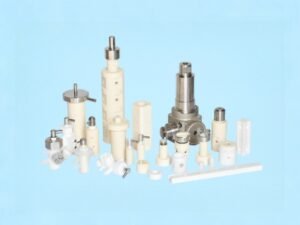
Understanding what alumina ceramics are used for demonstrates their versatility. We apply the extraordinary properties of alumina ceramics to solve critical bottlenecks in fluid dynamics and precision engineering.
Fluid Handling and Precision Pumping
In chemical plants and refineries, pumping abrasive and highly corrosive slurries destroys metal pumps rapidly. We recommend utilizing our Ceramic Pump series, which leverages the extreme wear resistance of high-purity alumina. For exact volumetric dosing in cosmetic or battery manufacturing, the tight dimensional tolerances of a Ceramic plunger pump ensure zero leakage and millions of maintenance-free cycles without surface degradation.
Medical and Pharmaceutical Manufacturing
The medical field requires absolute sterility. Standard metal pumps can shed microscopic ions into fluids, contaminating pharmaceutical batches or biological fluids. Alumina ceramics are totally biocompatible and non-reactive. In life-saving fluid management, the mechanisms powering our Medical Ceramic Pump systems ensure that sensitive medications remain uncontaminated. Similarly, our specialized Dialysis Ceramic Pump relies on the non-porous, sterile nature of precision alumina ceramics to safely handle blood and dialysate fluids safely.
Fluid Control and Valving
Controlling the flow of aggressive gases and liquids requires valves that will not corrode or seize. A Ceramic Rotary Valve made from 99% alumina ceramics provides a perfect, self-lubricating seal that outlasts standard Teflon or stainless steel seals, even when exposed to severe particulate abrasion.
Bespoke Engineering Components
Every industrial challenge is unique. For engineers requiring specific geometries that must survive extreme heat or electrical arcing, we offer comprehensive manufacturing of Custom Ceramic parts. From structural supports in aerospace applications to specialized insulators in semiconductor manufacturing, we engineer alumina ceramics to meet the exact blueprints of our global clients.
5. Summary Table: Alumina Ceramics Material Properties
To assist procurement engineers and system designers, we have compiled a summary matrix of the physical and thermal properties typical of 95% and 99% alumina ceramics.
| Physical Property | 95% Alumina Ceramics | 99% Alumina Ceramics |
|---|---|---|
| Density (g/cm³) | 3.60 – 3.70 | 3.80 – 3.90 |
| Hardness (Mohs Scale) | 9 | 9 |
| Compressive Strength (MPa) | ~2000 | ~2500 |
| Maximum Operating Temperature (°C) | 1500 | 1700 |
| Thermal Conductivity (W/m·K) | 18 – 20 | 25 – 30 |
| Dielectric Strength (kV/mm) | 15 | 17 |
| Corrosion Resistance | Excellent | Outstanding |
6. Frequently Asked Questions (FAQs)
Are alumina ceramics fragile like glass?
While alumina ceramics belong to the ceramic family and are classified as brittle materials compared to ductile steel, they possess an incredibly high compressive strength. Under normal to severe compressive loads, they will not shatter. However, they possess low tensile strength, meaning they are sensitive to sharp, direct impacts. We recommend proper structural housing and thermal expansion fitting when installing alumina ceramics components into steel assemblies to prevent impact fractures.
Can alumina ceramics be machined?
Yes, but it depends on the state of the material. Before firing (in the “green” state), alumina ceramics can be easily machined using standard CNC equipment. However, once the material has been sintered and reaches its final hardness, it can only be machined using diamond-tipped grinding tools, which is a slow and highly precise process. This is why complex Custom Ceramic parts are designed to near-net shape prior to sintering.
Why choose alumina ceramics over zirconia ceramics?
From our experience, alumina ceramics are generally more cost-effective than zirconia and offer superior thermal conductivity and electrical insulation. Zirconia is tougher and more resistant to impact (fracture toughness), making it better for extreme high-impact environments. However, for general wear resistance, chemical processing, and high-temperature insulation, alumina ceramics remain the most logical and economical choice.
7. Industry and Academic References
To further expand your understanding of advanced materials science, tribology, and the rigorous engineering standards governing technical ceramics, we recommend consulting the following authoritative sources: