
The single most destructive mistake a mechanical engineer can make is designing an advanced technical ceramic part using the exact same geometric principles applied to stainless steel. Metal yields; ceramic fractures. As industrial applications push the boundaries of temperature, corrosion, and wear, Zirconia (specifically Yttria-Stabilized Tetragonal Zirconia Polycrystal, or Y-TZP) has emerged as the premier “ceramic steel.” However, achieving the phenomenal performance characteristics of this material requires a fundamental shift in design philosophy.
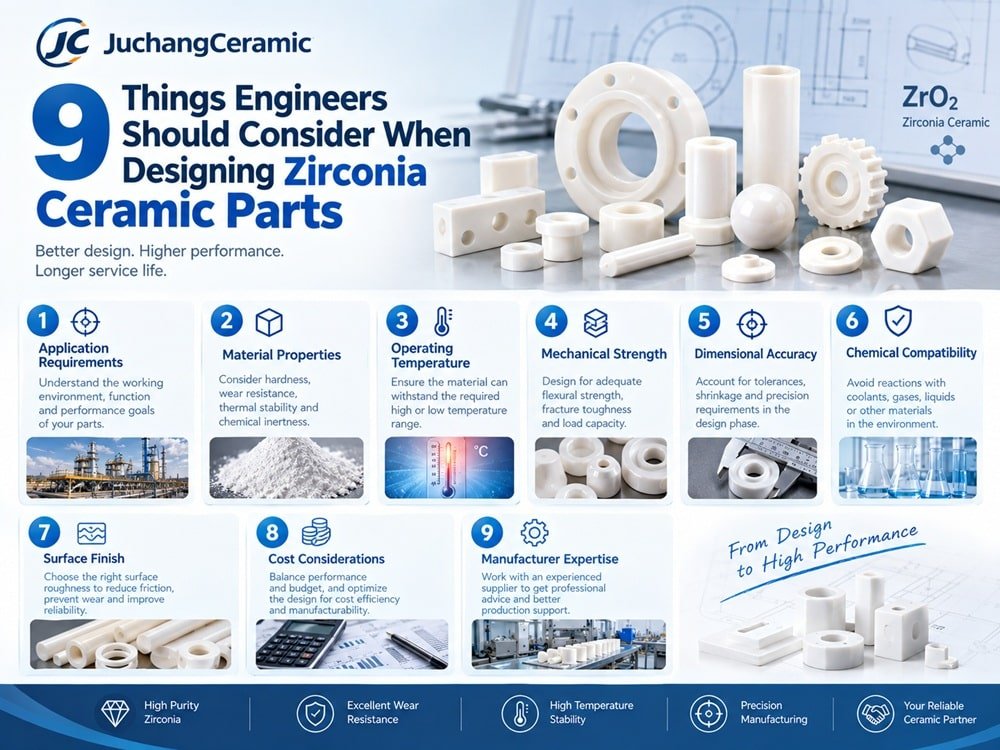
From our experience engineering fluid handling systems and high-wear tooling at JuchangCeramic, we consistently see brilliant engineers submit CAD files that are physically impossible to manufacture economically or destined to fail under load. When Designing Zirconia Ceramic Parts, you must account for the reality of green-state machining, the 20-30% volume shrinkage during sintering, and the exorbitant cost of post-fire diamond grinding. In this comprehensive guide, we will break down the commercial and practical realities of engineering with zirconia, providing you with direct, actionable rules to ensure your parts are manufacturable, functional, and cost-effective.
Quick Answer: Core Design Rules for Zirconia
If you are actively Designing Zirconia Ceramic Parts, you must adhere to these foundational principles to avoid catastrophic failure and excessive manufacturing costs:
- Eliminate Sharp Corners: Use generous radii and fillets (minimum 0.5mm) to prevent stress concentrations.
- Account for Shrinkage: Zirconia shrinks up to 30% during sintering; design with uniform wall thicknesses to prevent warpage.
- Loosen Non-Critical Tolerances: “As-fired” tolerances are typically ±1-2%. Specifying tighter tolerances requires expensive post-sinter diamond grinding.
- Avoid Tapping Internal Threads: Threaded ceramics are highly prone to notch sensitivity and chipping. Use metal inserts or external threading instead.
In most professional situations, we recommend consulting with your ceramic manufacturer during the initial CAD phase to optimize for “green” (pre-fired) machining, which reduces costs by up to 80% compared to grinding fully hardened zirconia.
Table of Contents
What is Zirconia Ceramic?
Zirconia (Zirconium Dioxide, ZrO2) is an advanced technical ceramic renowned for possessing the highest mechanical strength and fracture toughness at room temperature of all advanced ceramics. Unlike traditional ceramics, which are notoriously brittle, specific grades of zirconia are alloyed (stabilized) with materials like Yttria (Y2O3) or Magnesia (MgO). This stabilization locks the crystal structure into a metastable state, creating a material that physically behaves closer to steel than to glass, earning it the nickname “ceramic steel.” This unique property makes it the ideal material for high-wear industrial ceramic products.
How Transformation Toughening Works
To successfully navigate Designing Zirconia Ceramic Parts, you must understand its unique defense mechanism: transformation toughening. When a micro-crack begins to propagate through a stabilized zirconia component due to mechanical stress, the stress energy triggers the crystal structure at the crack tip to transform from a tetragonal phase to a monoclinic phase.
This phase transformation is accompanied by a localized volume expansion of approximately 3% to 5%. This expansion literally pinches the crack shut, stopping it from growing and preventing catastrophic failure. This dynamic self-healing capability is why zirconia is vastly superior to standard alumina in applications involving impact or severe mechanical shock.
9 Things Engineers Should Consider When Designing Zirconia Ceramic Parts
1. Eliminate All Sharp Corners and Edges
In metal design, sharp 90-degree internal corners are common. In ceramic design, they are a death sentence. Ceramics are highly notch-sensitive. A sharp internal corner acts as a massive stress multiplier. You must use generous internal fillets (minimum R0.5mm) and external chamfers or radii. This not only prevents stress fracturing under load but also prevents chipping during the green machining and handling phases.
2. Design for Sintering Shrinkage
Ceramic parts are machined from a soft, chalk-like “green” blank and then fired in a kiln at temperatures exceeding 1400°C. During this sintering process, the zirconia part will shrink isotropically by roughly 20% to 30%. Because of this massive volume change, you must design parts with symmetrical geometries whenever possible. Highly asymmetrical designs will cool and shrink at different rates, leading to severe warpage and bowing.
3. Maintain Uniform Wall Thickness
Related to shrinkage is thermal mass. If you design a part with a massive, thick base connected to a paper-thin wall, the thin wall will heat up and cool down much faster during the sintering cycle. These thermal gradients cause internal residual stresses that will tear the part apart before it even leaves the kiln. Always transition thicknesses gradually using smooth tapers, and core out thick sections to maintain uniform mass.
4. Strategic Tolerancing (Avoid Over-Tolerancing)
From our commercial perspective, over-tolerancing is the number one driver of unnecessary cost. “As-fired” zirconia typically holds tolerances of ±1% to 2%. If your application can accept these tolerances, the part will be highly economical. If you demand ±0.005mm, the part must be fired oversized and then slowly ground down using diamond tooling. Diamond grinding is incredibly slow and expensive. Only apply tight tolerances to the specific functional mating surfaces, not the entire part.
5. Optimize for Green Machining
To keep costs down, the manufacturer will do 95% of the shaping while the zirconia is in its soft, pre-sintered “green” state. When Designing Zirconia Ceramic Parts, avoid deep, blind holes with flat bottoms, or undercuts that require complex multi-axis milling. Design features that can be easily accessed by standard CNC end mills from a direct line of sight.
6. Rethink Threaded Connections
Do not attempt to tap fine internal threads into zirconia. The sharp V-shape of standard machine threads creates severe stress risers, and the threads will likely shear off when torque is applied. Instead, design oversized smooth holes and use threaded metallic inserts bonded with high-temp epoxies. If external threads are absolutely necessary, use a rounded thread profile (like an Acme or knuckle thread) rather than a sharp metric thread.
7. Understand Joining and Assembly Methods
Zirconia has a thermal expansion coefficient similar to cast iron, making it easier to join to certain metals than alumina. However, if you are designing a press-fit assembly, you must calculate the interference fit carefully. Zirconia has a high modulus of elasticity (it is very stiff). A press fit that works for steel-on-steel will easily crack a ceramic ring. Consider using shrink-fitting techniques (heating the metal jacket and chilling the ceramic pin) or specialized structural adhesives.
8. Surface Finish Specifications
An as-fired zirconia surface will have a slight roughness (typically Ra 0.8 – 1.2 µm). If you are designing components like ceramic bearings or piston plungers, you will need a highly polished surface (Ra < 0.1 µm). Polishing zirconia to a mirror finish is highly effective and dramatically reduces friction coefficients, but it adds processing time. Clearly denote which surfaces require polishing and which can remain as-fired.
9. Beware of Hydrothermal Aging (LTD)
In most professional situations, Y-TZP zirconia is exceptional. However, it suffers from Low-Temperature Degradation (LTD) when exposed to hot water or steam (typically between 150°C and 300°C) over prolonged periods. The moisture causes the tetragonal phase to spontaneously transform to monoclinic on the surface, leading to micro-cracking and loss of strength. If your application involves superheated steam, you must specify a different grade, such as Magnesia-Partially Stabilized Zirconia (Mg-PSZ) or an alumina-zirconia composite, as explored in our guide on zirconia vs alumina ceramic components.
Benefits of Zirconia Ceramic
When you successfully implement the rules for Designing Zirconia Ceramic Parts, the resulting components offer staggering advantages. Zirconia provides extreme wear resistance, easily outlasting hardened tool steels in abrasive environments. It is chemically inert, making it impervious to most acids and alkalis. Furthermore, it possesses low thermal conductivity, making it an excellent thermal insulator in high-heat engine components or welding nozzles.
Limitations and Hard Truths
We must use practical judgment: zirconia is not a universal replacement for metal. The primary limitation is cost. Raw zirconia powder is expensive, and the diamond grinding required for precision finishing drives unit costs up significantly. Secondly, despite being the “toughest” ceramic, it is still a ceramic. It does not exhibit plastic deformation. If a shock load exceeds its yield strength, it will not dent or bend—it will shatter. You must design to keep the material in compression, avoiding tensile stress.
Who Should Use It & Who Does Not Need It
Who Should Use It: We highly recommend zirconia for engineers dealing with severe abrasive wear, corrosive fluid handling, or precision dispensing. It is the absolute gold standard for high precision zirconia ceramic parts in medical dosing pumps, wire drawing capstans, and specialized cutting blades.
Who Does Not Need It: If your application involves high tensile stretching, severe bending moments, or is highly price-sensitive where standard hardened steel performs adequately, zirconia is a wasteful over-specification. For purely structural applications at room temperature without severe abrasion, stick to metals.
Common Mistakes in Ceramic Design
Expert Buying Considerations
When evaluating manufacturers to produce your zirconia designs, ask them directly about their “green machining” capabilities. A competent supplier should be able to look at your CAD drawing and suggest minor modifications that allow them to hit your tolerances in the green state, thereby eliminating the need for expensive diamond grinding after firing. Also, inquire about their specialized tooling; for example, understanding the ceramic plunger holder design guide principles shows if a supplier truly understands ceramic-to-metal assembly dynamics.
Quick Summary & Comparison Tables
Pros and Cons of Zirconia Ceramics
| Pros (Advantages) | Cons (Disadvantages) |
|---|---|
| Highest fracture toughness of all advanced ceramics (transformation toughening). | Vulnerable to Low-Temperature Degradation (LTD) in hot aqueous environments. |
| Exceptional wear and abrasion resistance (lasts 10x longer than steel). | High raw material and post-fire diamond grinding costs. |
| Thermal expansion coefficient close to steel (allows for easier metal joining). | Brittle failure mechanism (cannot yield or dent under impact). |
| Low thermal conductivity (acts as a superior thermal barrier). | Heavy (higher density than alumina). |
Comparison: Zirconia vs. Alumina vs. Stainless Steel
| Property | Zirconia (Y-TZP) | Alumina (99.5%) | 316 Stainless Steel |
|---|---|---|---|
| Fracture Toughness | High (8-10 MPa·m½) | Low (4-5 MPa·m½) | Very High (Yields, does not fracture easily) |
| Hardness (Vickers) | ~1200 HV | ~1600 HV (Harder but more brittle) | ~150-200 HV |
| Thermal Shock Resistance | Moderate | Good | Excellent |
| Cost Profile | High | Low/Moderate | Low |
| Best Use Case | High impact, heavy wear, precision pumps | High temp electrical insulation, steady wear | General structural, high tensile loads |
Expert Recommendation: Partnering for Success
In our testing and daily operations, the gap between a successful prototype and an expensive paperweight lies in manufacturer collaboration. You should not have to guess if your design violates ceramic engineering principles. If you are developing precision ceramic components for pumps or high-wear tooling, partner with experts who will actively refine your CAD.
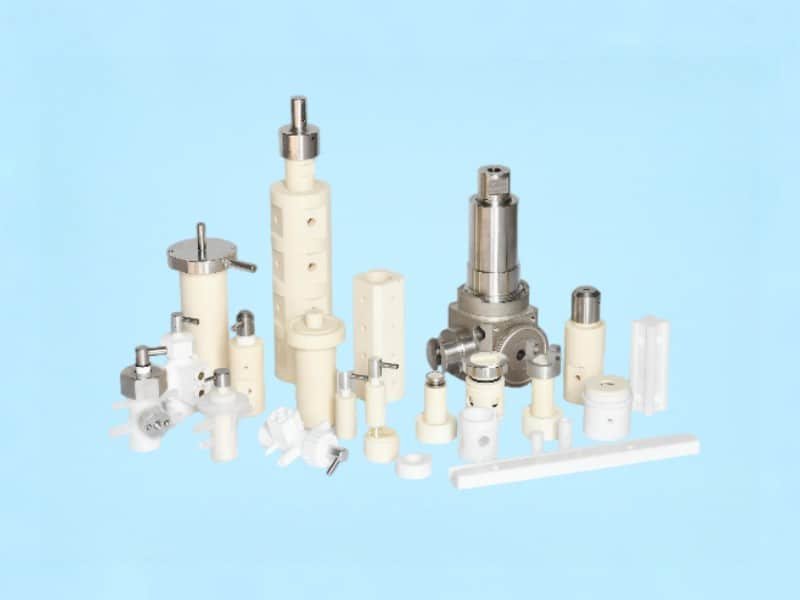
Custom Ceramic Manufacturing Services
JuchangCeramic delivers professional OEM and custom manufacturing solutions for precision ceramic parts, pumps, and components. Whether you have complete drawings or just an idea, we transform your requirements into high-performance products with accurate quotation and reliable production.
Our engineering team specializes in Design for Manufacturability (DFM) for advanced ceramics. We review your models to optimize for green machining, account for exact sintering shrinkage profiles, and minimize diamond grinding costs, ensuring your project is both functionally superior and commercially viable.
Consult with our engineering team today to optimize your ceramic design.
By leveraging professional guidance early in the design phase, you can confidently utilize advanced materials like zirconia, dramatically improving the lifespan and reliability of your industrial machinery, just as we have proven with our extensive ceramic rod applications in manufacturing.
Frequently Asked Questions (FAQ)
How precise can zirconia ceramic parts be machined?
In the “as-fired” state without secondary processing, tolerances of ±1% to 2% are standard. However, by utilizing post-sinter diamond grinding and lapping, extremely tight tolerances of ±0.001mm (1 micron) and mirror surface finishes can be achieved, though this significantly increases the manufacturing cost.
Can I use zirconia in high-temperature steam environments?
Standard Yttria-Stabilized Zirconia (Y-TZP) is susceptible to Low-Temperature Degradation (LTD) when exposed to moisture or steam at temperatures between 150°C and 300°C over time, which causes micro-cracking. For these specific hydrothermal environments, Magnesia-Partially Stabilized Zirconia (Mg-PSZ) or specialized composite grades must be specified instead.
Is zirconia heavier than standard steel?
No, zirconia is lighter than standard steel but significantly heavier than aluminum. The density of typical Y-TZP zirconia is around 6.05 g/cm³, whereas stainless steel is approximately 8.0 g/cm³, and aluminum is 2.7 g/cm³.
Authoritative References & Industry Standards
To ensure your designs meet established scientific and industrial standards, we recommend consulting the following authoritative sources:
- American Ceramic Society (ACerS): The premier global organization for ceramic materials science, offering extensive peer-reviewed data on transformation toughening mechanisms. Visit ACerS
- National Institute of Standards and Technology (NIST): Provides rigorous structural ceramics database information, including mechanical properties and fracture toughness testing standards. Visit NIST
- MatWeb Material Property Data: A comprehensive database for comparing the exact flexural strength, elastic modulus, and thermal properties of various zirconia grades against metals. Visit MatWeb