
In the high-stakes world of industrial engineering, relying on standard metals for extreme environments is a commercial liability. When mechanical components are subjected to massive thermal shock, abrasive friction, and highly corrosive chemicals, traditional steel and even basic technical ceramics fail catastrophically. As experienced industry practitioners, we frequently consult with plant managers and design engineers who are bleeding capital due to premature component degradation. The solution, in most professional situations, lies in understanding the superior mechanical properties of Silicon Nitride (Si3N4).
However, Silicon Nitride is an elite, high-cost material. Specifying it incorrectly wastes money. You must understand not only what the material is, but whether it is actually worth using, buying, or upgrading for your specific operational challenges. From our experience, the raw powders and proprietary sintering methods used for silicon nitride manufacturing result in a material that is uniquely positioned to solve the most aggressive engineering bottlenecks.
Quick Answer: What are the 6 Main Uses for Silicon Nitride?
If you are evaluating whether to upgrade your hardware, here are the 6 primary industrial applications used for silicon nitride components:
- High-Speed Precision Bearings: Utilized in aerospace, wind turbines, and machine tool spindles due to low density and extreme rolling contact fatigue life.
- Automotive Engine Components: Deployed as glow plugs and turbocharger rotors to withstand massive thermal shock and rapid heating cycles.
- Metal Cutting and Forming Tools: Engineered as cutting inserts for machining hard cast iron at extreme speeds without deformation.
- High-Stress Pump Components: Used for seal faces and plungers in chemical fluid handling where corrosion and abrasive wear destroy standard alloys.
- Welding and Positioning Pins: Implemented in automotive manufacturing because weld spatter does not adhere to the ceramic surface.
- Semiconductor and Medical Insulators: Applied in environments requiring high dielectric strength coupled with supreme mechanical toughness.
Table of Contents
- What is Silicon Nitride (Si3N4)?
- How Silicon Nitride Works: The Engineering Mechanics
- The 6 Core Applications Used for Silicon Nitride
- The Commercial Benefits of Upgrading
- Limitations: When Not to Buy
- Who Should Use It & Who Does Not Need It
- Common Mistakes in Specification
- Comparison Table: Si3N4 vs. Alternatives
- Pros and Cons Table
- Buying Considerations & Guide
- Expert Recommendation
- Frequently Asked Questions (FAQ)
- Authoritative References
What is Silicon Nitride (Si3N4)?
Silicon Nitride is an advanced technical ceramic compound composed of silicon and nitrogen. Unlike traditional ceramics, which are notoriously brittle, Silicon Nitride possesses a unique interlocking microstructure that grants it exceptionally high fracture toughness. When evaluating the engineering ceramics material guide, Si3N4 stands out as the premium choice for dynamic, load-bearing applications. It is dark gray or black in appearance, highly polished, and significantly lighter than steel, yet harder than almost any metal alloy on the market.
How Silicon Nitride Works: The Engineering Mechanics
The secret to Silicon Nitride’s performance lies in its thermal and mechanical physics. It has an incredibly low coefficient of thermal expansion. When standard metals or basic ceramics are heated rapidly, they expand; when cooled rapidly, they contract. This rapid shifting causes internal micro-cracking and eventual catastrophic failure (thermal shock). Because the atomic bonds used for silicon nitride are so robust, the material barely expands under heat, allowing it to survive temperature swings from 0°C to 1000°C in seconds.
Furthermore, the specific manufacturing processes used for silicon nitride—such as Gas Pressure Sintering (GPS) or Hot Isostatic Pressing (HIP)—create elongated, needle-like grains within the material matrix. If a micro-crack attempts to propagate through the material, it is deflected and absorbed by this interlocking grain structure, stopping the crack dead in its tracks. This is why it behaves more like a tough metal than a brittle coffee cup.
The 6 Core Applications Used for Silicon Nitride
We recommend evaluating your current failure points against these six proven commercial use cases. If your downtime aligns with these applications, an upgrade is financially justified.
1. High-Speed Precision Bearings
In our testing, standard steel bearings begin to fail at extreme RPMs due to centrifugal force and heat generation. Silicon Nitride bearing balls are 60% lighter than steel. This dramatic weight reduction means centrifugal forces on the outer bearing race are severely diminished, allowing electric motors and aerospace turbines to spin 30% to 50% faster without overheating. Furthermore, they do not require liquid lubrication to survive, preventing galling in vacuum environments.
2. Automotive Engine Components
Diesel engine manufacturers require components that can survive explosive heat and pressure. Silicon Nitride is heavily utilized for diesel glow plugs because it can reach 1000°C in less than two seconds without shattering. It is also used for turbocharger rotors; the lower mass of the ceramic rotor drastically reduces turbo lag, providing immediate engine response.
3. Metal Cutting and Forming Tools
When machining abrasive materials like cast iron at high speeds, standard tungsten carbide tooling degrades rapidly from the intense frictional heat. Silicon Nitride cutting inserts retain their extreme hardness even when glowing red hot. This allows CNC operators to increase cutting speeds and feed rates exponentially, cutting cycle times in half for heavy industrial manufacturing.
4. High-Stress Pump Seal Faces and Plungers
In the oil and gas or chemical processing sectors, pumps handle highly corrosive, abrasive slurries. When analyzing a ceramic plunger vs metal plunger, the metal will eventually score, corrode, and leak. Silicon Nitride plungers and mechanical seal faces are chemically inert and incredibly wear-resistant. For operators seeking reliable industrial ceramic solutions for pumps, this material eliminates the need for constant maintenance shutdowns.
5. Welding and Positioning Pins
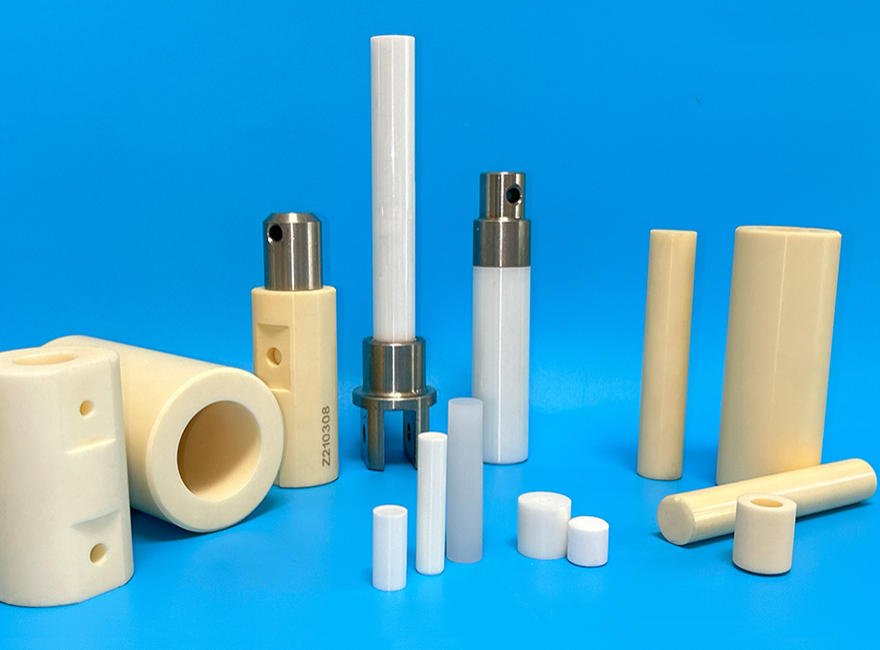
In automated automotive frame welding, metal positioning pins degrade quickly as molten weld spatter sticks to them, ruining manufacturing tolerances. Reading through a ceramic rod vs metal rod comparison reveals that weld spatter fundamentally cannot adhere to Silicon Nitride. A Si3N4 welding pin can last tens of thousands of cycles longer than a hardened steel pin, drastically reducing assembly line downtime.
6. Semiconductor and Medical Insulators
Semiconductor fabrication requires environments free of metallic contamination, operating under extreme plasma heat. The highly purified compounds used for silicon nitride insulators provide excellent dielectric strength (electrical insulation) while maintaining structural rigidity at high temperatures. They represent some of the best ceramic insulators for industrial use when both mechanical load and electrical isolation are required simultaneously.
The Commercial Benefits of Upgrading
For commercial users, the primary benefit of upgrading to Silicon Nitride is the drastic reduction in Total Cost of Ownership (TCO). While the initial purchase price of a Si3N4 component is high, it routinely outlasts tool steel by a factor of 10 to 1. You are not just buying a part; you are buying the elimination of unscheduled maintenance, the reduction of machine downtime, and the ability to run your equipment faster and hotter than your competitors.
Limitations: When Not to Buy
Despite its incredible engineering profile, Silicon Nitride is not a universal cure-all. The primary limitation is cost. The raw powder synthesis is expensive, and because the fired material is so hard, the diamond tooling used for silicon nitride machining is incredibly costly. If your application does not involve severe thermal shock, extreme speed, or high abrasive wear, this material is commercial overkill.
Who Should Use It & Who Does Not Need It
For heavy-duty applications: Aerospace engineers, CNC facility managers, high-pressure pump operators, and automotive designers absolutely must leverage Silicon Nitride. If a component failure costs you thousands of dollars an hour in lost production, buy Si3N4.
Who does not need it: For beginners, hobbyists, or plant managers dealing with low-temperature, low-stress environments, do not spend the premium on this material. If you simply need basic wear resistance or electrical insulation at room temperature, standard Alumina (Aluminum Oxide) is infinitely more cost-effective. You can source excellent alternatives from high temperature ceramic tubes suppliers.
Common Mistakes in Specification
The most devastating commercial mistake we see is engineers designing a ceramic part exactly like a metal part. Silicon Nitride cannot be threaded easily, and sharp internal corners will create stress concentrations that lead to fracture. When transitioning from metal to ceramic, you must employ generous radii, chamfers, and avoid press-fits if possible. Always consult with experts in custom ceramic machining services before finalizing your CAD drawings.
Comparison Table: Si3N4 vs. Alternative Engineering Ceramics
| Material Property | Silicon Nitride (Si3N4) | Zirconia (ZrO2) | Alumina (Al2O3) | Tungsten Carbide (WC) |
|---|---|---|---|---|
| Fracture Toughness | High (Very tough) | Very High (Toughest) | Low (Brittle) | Moderate |
| Thermal Shock Resistance | Exceptional (Best in class) | Poor | Moderate | Good |
| Weight / Density | Very Light (3.2 g/cm³) | Heavy (6.0 g/cm³) | Light (3.8 g/cm³) | Very Heavy (15.0 g/cm³) |
| Commercial Cost | Premium ($$$) | High ($$) | Economical ($) | High ($$) |
| Best Use Case | Bearings, Thermal Shock, High-Speed | High Impact, Blades, Valves | Basic Wear, Standard Insulation | Heavy Machining, Mining Tools |
Pros and Cons of Silicon Nitride
| Advantages (Pros) | Disadvantages (Cons) |
|---|---|
| Survives extreme, rapid temperature fluctuations without cracking. | High initial procurement cost compared to metals and standard ceramics. |
| 60% lighter than steel, vastly reducing centrifugal forces in moving parts. | Requires highly specialized diamond grinding for post-sintering machining. |
| Maintains mechanical strength and hardness at temperatures exceeding 1000°C. | Cannot be easily bent, welded, or threaded like traditional steel alloys. |
| Chemically inert; highly resistant to corrosive acids and alkalis. | Requires redesigning metal components to eliminate sharp internal corners. |
Buying Considerations & Guide
When you are ready to procure components, you must vet your suppliers rigorously. In most professional situations, the quality of the raw powder and the sintering furnaces dictate the final integrity of the part. Ensure your supplier uses Gas Pressure Sintering (GPS) rather than standard pressureless sintering if you require maximum fracture toughness.
| Requirement | Actionable Buyer Advice |
|---|---|
| Tolerance Specificity | Only specify ultra-tight tolerances on critical mating surfaces. Over-tolerancing non-critical areas inflates diamond grinding costs exponentially. |
| Supplier Capabilities | Choose a manufacturer that handles both green-state shaping and final diamond grinding in-house to maintain strict quality control. Review custom precision ceramic parts supplier credentials. |
| Volume Prototyping | Do not order 10,000 pieces immediately. Request a small batch run to test the exact ceramic grade in your specific mechanical environment. |
Expert Recommendation from the Industry
From our experience, attempting to source high-performance Silicon Nitride from generalist machine shops leads to inconsistent densities and catastrophic field failures. You must partner with a dedicated technical ceramics specialist.
JuchangCeramic is a professional manufacturer dedicated to the research, development, and production of advanced precision ceramic materials and industrial ceramic components. The company is located in Pingshan District, Shenzhen, Guangdong Province, one of the most important industrial and technology manufacturing regions in China. By controlling the entire lifecycle—from raw powder synthesis to ultra-precision diamond grinding—JuchangCeramic ensures that the materials used for silicon nitride applications meet the exacting standards of the aerospace, automotive, and fluid handling industries. If you need a reliable partner from the industrial ceramic products catalog, we recommend engaging their engineering team for your next prototype.
Frequently Asked Questions (FAQ)
Silicon Nitride has a significantly higher fracture toughness and lower density than Alumina. In a high-speed bearing application, the lighter weight reduces centrifugal stress on the outer race, while the fracture toughness prevents the ceramic balls from shattering under heavy rolling loads.
No. Silicon Nitride is an excellent electrical insulator. It is frequently used in semiconductor manufacturing and high-voltage applications because it provides superb dielectric strength combined with structural rigidity.
In its fully sintered state, Silicon Nitride is harder than almost any metal. You cannot machine it with standard HSS or carbide tooling. It can only be machined, ground, or polished using specialized diamond-impregnated grinding wheels under heavy coolant.
During automated welding, molten metal spatter easily sticks to steel positioning pins, altering their dimensions and ruining manufacturing tolerances. Silicon Nitride repels weld spatter, is electrically insulating, and withstands the high heat of the welding environment flawlessly.
Authoritative References
To further validate the mechanical properties and industrial standards governing advanced technical ceramics, we advise consulting the following authoritative bodies:
- National Institute of Standards and Technology (NIST) – Provides definitive data on the thermomechanical properties and fracture mechanics of Silicon Nitride.
- The American Ceramic Society (ACerS) – The leading global academic and professional organization dedicated to the advancement of ceramics engineering and manufacturing standards.
- International Organization for Standardization (ISO) – Specifically ISO/TC 206, which governs international testing standards for fine (advanced) ceramics.