
Navigating the advanced materials landscape can be an expensive endeavor if you make the wrong specification choices. The engineering world is filled with myths regarding technical ceramics, particularly regarding the default assumption that higher purity always equates to better performance. From our experience as a professional manufacturer dedicated to the research, development, and production of advanced precision ceramic materials, we see engineers over-specifying and under-utilizing this incredibly versatile material on a daily basis.
The truth is that understanding Aluminium oxide ceramic properties requires more than looking at a generic datasheet. It demands commercial and practical judgment to know when it will thrive as a wear-resistant component and when it will catastrophically fail under mechanical shock. In this comprehensive guide, we strip away the encyclopedia-style jargon to deliver actionable intelligence. We will detail exactly what this material is, how its unique microstructure dictates its industrial performance, and whether you should be utilizing it in your next engineering assembly.
Quick Answer: What is an Aluminium Oxide Ceramic?
An Aluminium oxide ceramic (often referred to as Alumina or Al2O3) is a highly versatile, technical advanced ceramic known for its exceptional hardness, excellent dielectric properties, and strong resistance to extreme wear and chemical corrosion. In commercial manufacturing, it is typically produced in purity grades ranging from 95% to 99.8%. While it offers massive compressive strength and temperature resistance up to 1700°C, its primary limitation is its brittleness; it possesses low fracture toughness compared to metals. It is the ideal, cost-effective material choice for electrical insulators, seal rings, and wear-resistant fluid handling components.
Table of Contents
- What It Is: Decoding Aluminium Oxide Ceramic
- How It Works: The Microstructure Behind the Properties
- Key Benefits of Alumina in Industrial Applications
- Limitations: When Alumina Fails
- Who Should Use It vs. Who Does Not Need It
- Common Mistakes in Specifying Alumina
- Buying Considerations & Grade Selection
- Expert Recommendation from JuchangCeramic
- Summary & Comparison Tables
- The Bottom Line
- Frequently Asked Questions
What It Is: Decoding Aluminium Oxide Ceramic
If you are exploring what is alumina ceramics, you must first understand its base composition. Aluminium oxide ceramic is an advanced, non-metallic, inorganic material formed through the compounding of aluminum and oxygen. Unlike traditional ceramics (like clay or porcelain) which are based on natural silicates, technical alumina is synthetically refined from bauxite ore using the Bayer process. The result is a fine white powder that is then shaped and fired (sintered) at extreme temperatures to create a dense, rigid solid.
In the industrial manufacturing sector, you rarely find 100% pure alumina. It is generally alloyed with trace amounts of silica, magnesia, or zirconia to lower sintering temperatures and alter its mechanical and electrical properties. The most common commercial grades you will encounter are 95%, 96%, 99%, and 99.8% purity. Each grade presents vastly different Aluminium oxide ceramic properties, making material selection a highly targeted engineering decision rather than a one-size-fits-all approach.
How It Works: The Microstructure Behind the Properties
The mechanical and thermal supremacy of Aluminium oxide ceramic stems entirely from its crystalline microstructure. The atoms of aluminum and oxygen form exceptionally strong ionic and covalent bonds. These tight atomic bonds are the reason the material requires diamond tooling to cut once it has been fired.
When alumina is sintered, the powder particles fuse together, eliminating porosity and forming a dense polycrystalline structure. In most professional situations, the “glassy phase”—the secondary elements like silica added to lower purity grades (e.g., 95% Alumina)—acts as a binder between these crystals. This phase is crucial. It is what allows 95% or 96% alumina to be successfully metallized for electronic packaging. Conversely, high-purity 99.8% alumina has almost no glassy phase, resulting in a material that is incredibly hard and chemically inert, but significantly harder to bond to metal components. Understanding this microstructural behavior is critical when exploring ceramic rod applications in manufacturing, where the balance between hardness and flexibility dictates component survival.
Key Benefits of Alumina in Industrial Applications
Why do engineers specify an Aluminium oxide ceramic over hardened steel or engineered plastics? The answer lies in its unique combination of extreme properties. For heavy-duty applications, alumina delivers a return on investment that traditional metals cannot match.
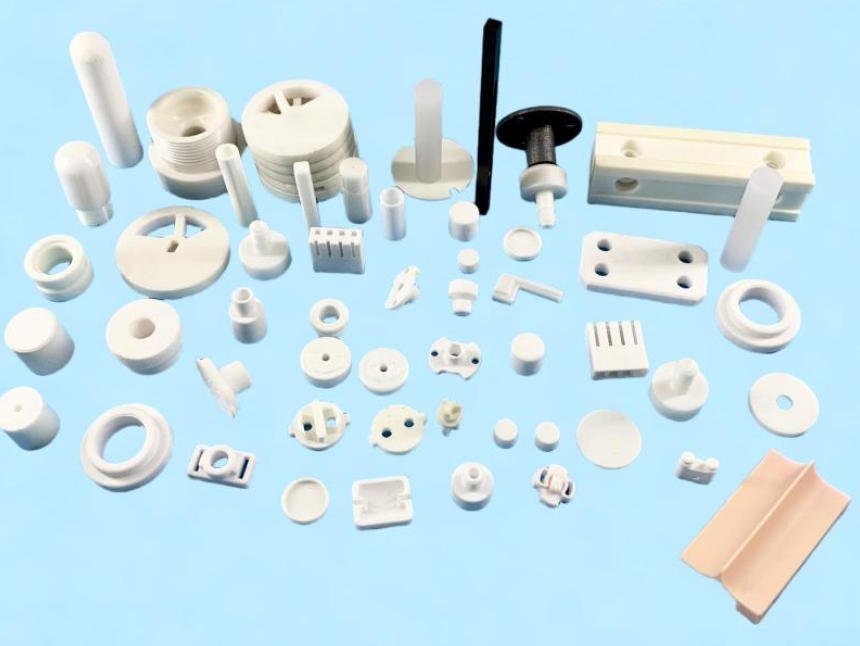
- Exceptional Hardness and Wear Resistance: With a Mohs hardness of 9 (second only to diamond and boron carbide), alumina outlasts steel in abrasive environments by a factor of up to 15 to 1. This makes it the premier choice for wire drawing guides, seal faces, and mud pump liners.
- High Compressive Strength: Alumina can withstand crushing loads. Its compressive strength often exceeds 2,000 MPa, allowing it to function flawlessly in high-pressure fluid environments. This is exactly why alumina ceramic parts for metering pumps have become the industry standard over metal alternatives.
- Superior Electrical Insulation: Even at high temperatures, alumina prevents the flow of electrical current. It features high volume resistivity and excellent dielectric strength, making it the backbone of the semiconductor and high-voltage electrical industries.
- Chemical Inertness: Alumina does not rust, corrode, or react with strong acids and alkalis, ensuring long-term stability in aggressive chemical processing plants.
- Thermal Stability: It maintains its mechanical strength at temperatures approaching 1,600°C to 1,700°C, far beyond the melting point of most industrial alloys.
Limitations: When Alumina Fails
It is vital to utilize commercial and practical judgment when deploying this material. Aluminium oxide ceramic is not indestructible. In our testing and failure analysis labs, we see the same repeated mechanism of failure: mechanical impact.
Alumina suffers from low fracture toughness (typically around 3 to 4 MPa·m½). This means that while it can withstand immense gradual pressure (compressive force), a sudden, sharp impact will cause it to shatter catastrophically. It lacks the ductility of metal to deform under stress. Additionally, while its thermal resistance is high, its thermal shock resistance is relatively poor due to a high coefficient of thermal expansion combined with low thermal conductivity. If you drop a 99% alumina component from 1000°C directly into cold water, it will fracture instantly. If your application involves high-impact strikes or rapid temperature cycling, you must carefully evaluate zirconia vs alumina ceramic components, as Zirconia offers significantly higher impact toughness.
Who Should Use It vs. Who Does Not Need It
For commercial users and high-volume manufacturers: You should use Aluminium oxide ceramic if your primary enemies are abrasive friction, high voltage, or chemical corrosion. If you are designing metering pumps, laser tubes, semiconductor wafer chucks, or high-speed bearing systems, alumina provides the perfect balance of performance and price. You should definitely explore what are ceramic bearings used for if you wish to eliminate lubrication failure in high-RPM machinery.
For beginners or low-load applications: If you are designing a low-stress structural component for a consumer device that might be dropped, or if the operating environment does not exceed 150°C and has no abrasive contact, you do not need advanced technical ceramics. Standard injection-molded plastics (like PEEK or Delrin) or machined aluminum will be vastly cheaper and easier to prototype. Do not pay for advanced Aluminium oxide ceramic properties if your application does not actively demand them.
Common Mistakes in Specifying Alumina
The most expensive mistake we witness is the assumption that “higher purity is always better.” Engineers routinely specify 99.8% alumina for components that only require the mechanical strength of 95% alumina. High-purity alumina is significantly more difficult (and expensive) to machine and fire. Furthermore, if you plan to braze your ceramic component to a metal fitting, a 95% or 96% alumina grade is actually superior because its silica glassy phase bonds far more effectively with metallization pastes (like Moly-Manganese) than a 99.8% grade does. Over-specifying purity wastes capital without providing any functional benefit to the end product.
Buying Considerations & Grade Selection
When you are ready to procure an Aluminium oxide ceramic component, your buying decision must be guided by the specific operational environment. Consider the following:
- Tolerances and Machining: Technical ceramics shrink by roughly 20% during the firing process. If you require tight dimensional tolerances (e.g., +/- 0.005 mm), the component must be diamond-ground after firing. This “hard machining” step can account for over 60% of the final part cost. Only specify ultra-tight tolerances on the exact surfaces that interface with other parts; leave non-critical surfaces “as-fired.”
- Volume Pricing: Because the tooling for dry pressing and injection molding is expensive, ceramics are highly volume-sensitive. Ordering 50 pieces will carry a high unit cost, whereas ordering 50,000 pieces drops the unit cost dramatically. For budget forecasting, refer to an updated ceramic plunger price guide 2026.
- Assembly Methods: Determine early on how the ceramic will attach to the rest of your assembly. Shrink-fitting, epoxy bonding, and active metal brazing all require different design considerations. Review a reliable ceramic plunger holder design guide to avoid costly assembly failures.
Expert Recommendation from JuchangCeramic
The Manufacturer’s Verdict

As a leading facility situated in the industrial hub of Shenzhen, China, JuchangCeramic specializes in turning raw ceramic powder into high-tolerance industrial solutions. We recommend standardizing on 95% or 96% alumina for the vast majority of mechanical and electrical applications where metallization or cost-efficiency is a priority. Reserve 99% and 99.8% alumina strictly for semiconductor processing, extreme high-voltage environments, or highly corrosive plasma chambers where absolute chemical purity is non-negotiable.
If you are struggling with rapid wear on your metallic machine parts, upgrading to precision ceramic components for pumps is not just an upgrade; it is a permanent operational fix. However, always consult with your manufacturing partner during the CAD design phase to ensure your geometry is optimized for ceramic manufacturing processes, avoiding sharp internal corners that act as stress concentrators.
Summary & Comparison Tables
Pros and Cons of Aluminium Oxide Ceramic
| Advantages (Pros) | Disadvantages (Cons) |
|---|---|
| Extreme hardness and abrasive wear resistance. | High brittleness and low fracture toughness. |
| Outstanding electrical insulation properties. | Vulnerable to severe thermal shock. |
| Maintains strength at very high temperatures (>1500°C). | Expensive to machine (requires diamond tooling). |
| Chemically inert against most acids and alkalis. | High initial tooling costs for custom molded shapes. |
| Highly cost-effective compared to other advanced ceramics (like Silicon Nitride). | Cannot be threaded easily; requires metal inserts or alternative fastening. |
Material Comparison: Alumina vs. Zirconia vs. Silicon Carbide
| Property / Feature | Aluminium Oxide (Alumina) | Zirconium Oxide (Zirconia) | Silicon Carbide (SiC) |
|---|---|---|---|
| Primary Strength | Electrical insulation & cost-efficiency | High fracture toughness & impact resistance | Extreme hardness & thermal conductivity |
| Fracture Toughness | Low (~3-4 MPa·m½) | Very High (~8-10 MPa·m½) | Low (~4 MPa·m½) |
| Thermal Shock Resistance | Poor | Moderate | Excellent |
| Best Use Case | Pump plungers, electrical insulators, seal rings | Wire drawing dies, ceramic scissors, high-impact valves | Mechanical seals in high-heat abrasive environments |
| Relative Cost | $$ (Lowest) | $$$ (Moderate) | $$$$ (High) |
The Bottom Line
Aluminium oxide ceramic is the undisputed workhorse of the advanced materials industry. Its impressive properties—spanning extreme hardness, dielectric supremacy, and chemical immunity—solve mechanical problems that traditional metals simply cannot handle. However, unlocking these benefits requires a calculated approach to purity selection, tolerance specification, and assembly design. By understanding the material’s brittleness and optimizing your components for ceramic manufacturing realities, you can drastically reduce machine downtime, eliminate wear-related failures, and ultimately drive superior profitability in your industrial operations.
Frequently Asked Questions
In terms of compressive strength and hardness, yes, alumina is vastly stronger and harder than steel. It will not deform or scratch under pressures that would easily crush steel. However, in terms of tensile strength and impact toughness, steel is superior because it is ductile and can bend, whereas alumina is brittle and will fracture upon heavy impact.
Alumina has moderate thermal conductivity compared to other ceramics. It is a much better conductor of heat than plastics or glass, but it is not as thermally conductive as metals like aluminum or specialized ceramics like Aluminum Nitride (AlN) or Silicon Carbide (SiC).
Due to its versatile properties, alumina is used to manufacture spark plug insulators, pump plungers, mechanical seal faces, semiconductor wafer handling components, ballistic armor plating, and laser tubes. For a comprehensive overview, review an updated industrial ceramic products list 2026.
Authoritative Industry References
- National Institute of Standards and Technology (NIST) – Property data and standard reference databases for advanced ceramics and material characterization.
- ASTM International – Standard test methods for determining the mechanical, thermal, and electrical properties of monolithic advanced ceramics.
- The American Ceramic Society (ACerS) – Research, academic papers, and industry standards regarding the microstructure, processing, and application of Aluminium oxide and other technical ceramics.